

A blueprint to follow
NGO stands for Non-Governmental Organisation. These are typically non-profit, citizen-led groups operating independently of government, focused on social, environmental, or humanitarian causes.
HPVT in Kashmir, a combination of hope, help, and trust.
When I delved deep into functioning and operations as a clinical auditor and certified professional in healthcare quality and social activist, what I’ve observed is the proliferation of healthcare NGOs in Kashmir, many providing vital support (crowdfunding, transport, subsidised drugs) at state hospitals.
Through my expertise in clinical auditing and quality control, HPVT (Help Poor Voluntary Trust) stands out for its selfless, humble service via kiosks at major hospitals like SMHS.
Visiting HPVT’s outlets at Iqbal Park & Safa Kadal, and interacting with founder Mr. Farooq, confirmed their impactful ground-level work. My professional evaluation recognises their significant contribution to filling patient service gaps in this piece.
In the shadowed valleys of Kashmir, where political turmoil has etched lines of suffering across generations, a profound truth emerges: hope is not merely an emotion but a form of resistance.
Amidst crossfire and curfews, the Help Poor Voluntary Trust (HPVT) stands as a luminous testament to this principle, transforming despair into dignity since its founding in 1998, if I didn’t err in date.
More than a humanitarian organisation, HPVT embodies what scholar Jonathan Lear terms “radical hope”—the capacity to envision flourishing beyond current imaginable horizons.
Operating in one of the world’s most militarised regions, this Srinagar-based NGO has woven a tapestry of care that stretches from emergency medicine to intergenerational solidarity, proving that even in fractured landscapes, hope can be engineered through relentless compassion.
The Anatomy of Hope in a Zone with a long History of disturbances; Kashmir’s decades-long conflict has birthed a public health catastrophe.
With healthcare systems “uncoordinated and fragmented”, and political blockades paralysing state services—as during the 2019 Article 370 revocation when Ayushman Bharat health cards ceased functioning —the poor face impossible choices.
Families like Shameema’s, a dialysis patient in Bemina, confronted the grim calculus of selling assets or forgoing treatment when her golden card failed during internet blackouts.
In such voids, HPVT emerged not as a stopgap but as an architecture of possibility.
HPVT’s Foundational Framework of Hope: The organisation is rooted in an ethical commitment to serve all individuals without discrimination based on creed, caste, or religion, thereby fostering social cohesion across societal divides.
Its operational model is volunteer-driven, with over a hundred dedicated individuals, including doctors and lawyers, which promotes a strong sense of community ownership and participatory engagement.
Marking a Silver Jubilee milestone from 1998 to 2023, the initiative also reflects a sustained and resilient presence, demonstrating its ability to endure and thrive despite challenging and volatile circumstances.
Medicines, Mobility, Mechanics of Mercy, and Humility; HPVT’s genius lies in its precision targeting of systemic gaps.
At five major Srinagar hospitals—including SMHS and SKIMS—their kiosks function as lifelines for the invisible poor. By 2019, over 1,700 registered patients received free medicines, trolleys, nebulisers, and urine containers, with volunteers like government employee Mohammad Ali Lone working post-hours to sustain operations.
Their work transcends charity:
Pharmaceutical Justice: HPVT’s subsidised pharmacy and medicine distribution counter market monopolies that price life-saving drugs beyond reach. During COVID-19, they pivoted to “convenient and risk-free solutions” for vulnerable patients, including home deliveries amid lockdowns.
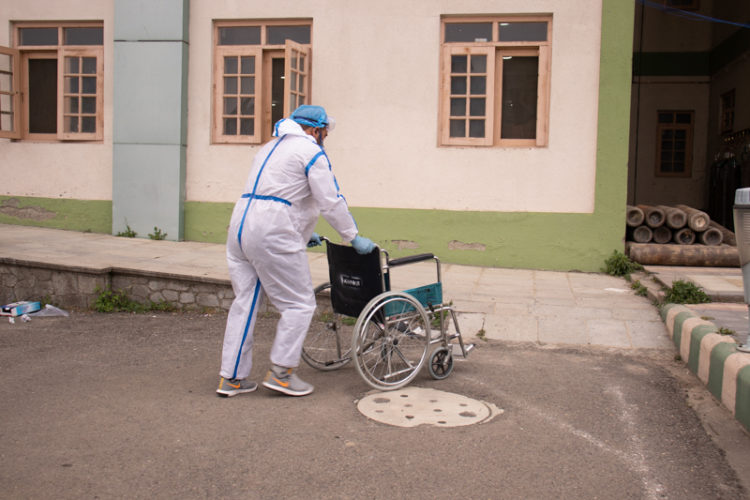
Mobility as Autonomy: Through wheelchair and tricycle distributions—like those coordinated with Bhagwan Mahavir Viklang Sahayta Samiti —they transform dependency into agency. A wheelchair is not merely equipment; it is freedom to attend school, work, or gaze at Chinar trees without shame.
Long-Distance Solidarity: The trust’s ambulance fleet facilitates journeys as far as Delhi, critical for specialised cancer or cardiac care absent locally. When public transport freezes during crackdowns, these ambulances traverse checkpoints, becoming mobile sanctuaries.
Domiciliary oxygen support, this organisation has sufficient stock of oxygen concentrators, oxygen cylinders, BiPAP, CPAP machines, and patients are getting this facility free also.
Services at times extend beyond medical aid, mobility devices, ambulances, they provide emotional support via calls/email, Medicine distribution during internet blackouts, and remote volunteering during pandemics.
The Samaritan Ethos: Volunteers as Vessels of Hope; Unlike top-down aid models, HPVT harnesses Kashmir’s latent social capital.
Its 100+ volunteers—students, lawyers, teachers, government employees—reflect a cross-section of society bound by a “spirit of self-service”.
This mirrors global movements like Samaritans, where emotional support depends on “tolerant and open-minded” locals, but adapts uniquely to Kashmir’s context: Skill-Based Mobilisation: Pharmacists manage medicine kiosks with MARG software expertise; mental health counsellors address trauma in a region scarred by “pervasive militarisation”.
Recruitment prioritises those experienced in substance abuse, a silent epidemic in conflict zones.
Intergenerational Healing: Youth volunteers bridge societal fractures. As one anonymous teacher running a community school noted, education combats the “rust eating away at [children’s] mental growth” during curfews. HPVT’s volunteer model thus incubates future community leaders.
Hope as Resilience: Many NGOs face suspicion from all sides, as cultural “invasion” or proxies. Beneath HPVT’s humanitarian output lies a deeper resonance: hope as defiance.
In a land where political expression is surveilled, distributing a wheelchair or an antibiotic becomes a quiet reclamation of agency.
This aligns with what Kashmiri youth narratives articulate—hope as an “accomplice of memory” sustaining resistance intergenerationally.
When HPVT commemorated its Silver Jubilee at Tagore Hall amid “massive gatherings”, it signalled endurance against erasure.
Critically, HPVT avoids ideological alignment, focusing on universal dignity, and has maintained an apolitical stance and operations.
Yet, their work subtly counters dehumanising state narratives by centring Kashmiri lives. As academic Ashima Kaul observes, Kashmir’s peace hinges on “wise political leadership” —but HPVT proves civil society can co-author hope when governments falter.
The Unfinished Landscape: Despite distributing over 104 artificial limbs and 20 wheelchairs in a single camp, HPVT acknowledges their work remains “a drop in the ocean of miseries” .
Challenges persist: Resource Limitations: Dependence on philanthropists’ risks and volatility.
Yet, HPVT adapts. Recent job ads for mental health staff and pharmacists reveal strategic growth, ensuring Kashmir’s hope infrastructure scales with suffering.
My Vision for HPVT: Based on Kashmir’s deficiencies in diagnostics and therapeutics, you strongly advocate for HPVT to expand its brand and scale up.
You propose a strategic progression:
1. State of the Art Diagnostic Centres: Addressing critical testing shortages
2. First Aid Centres: Providing immediate, accessible care.
3. Preventive Oncology: Focusing on early cancer detection/intervention, catering to remote areas with mobile diagnostics, including mammography. All is doable with people’s cooperation and generous funding.
Ultimate Goal: A state-of-the-art, not-for-profit hospital to offer comprehensive, affordable care, building on their proven model of service and trust.
My insight highlights HPVT’s potential to evolve from essential support services into a cornerstone of Kashmir’s healthcare infrastructure, tackling systemic gaps with their established credibility and compassion.
The Cellular Biology of Hope: HPVT exemplifies hope not as abstract optimism, but as material practice.
Each ambulance ride to Delhi, each dialysis session, each wheelchair delivered is a cellular unit in the body of resistance.
In a region where, as the dying PhD scholar “Jamshed,” name changed, declared, freedom is snatched through hope, HPVT’s medicine kits become quiet weapons of survival.
Their 25-year journey whispers to Kashmir: What politics fractures, compassion reassembles. As global crises multiply, this trust offers a blueprint—hope engineered through logistics, solidarity, and the stubborn belief that every life deserves dignity.
In HPVT’s Kashmir, hope is not just felt; it is dispensed, administered, and driven home.
The aim of this article is not merely to acknowledge the selfless work of the particular NGO but to present it as a model for others to emulate.
By highlighting its transparent operations, ethical organisational processes, and community-centric approach, we hope to inspire trust in the noble efforts of NGOs.
In an era where accountability matters, showcasing such honest work can rebuild public confidence and encourage generous donations.
Since NGOs largely depend on community funding, their credibility and effectiveness must be visible and verifiable. HPVT sets a standard worth replicating for those committed to genuine social impact.