

Since the last five years, or so, during September-October, Kashmir has been grumbling with stories of how apple growers and traders are suffering at the hands of authorities as apple-laden trucks are being made to wait long.
This year again, the story is back. Apart from apple traders, some politicians have also spoken publicly about the matter.
A narrative that is being subtly pushed by some of these traders and politicians is that “there is a conspiracy by the centre to arrest the popularity of the Kashmiri apple, promote the Himachal apple and thereby dent Kashmir, economically.
The narrative is surviving and doing good in Kashmir, primarily because of the large appetite in Kashmir for conspiracy theories painting Delhi as the villain.
On studying the issue by analysing opinions of various stakeholders, in light of the ground inputs, a completely different picture evolves.
Several shades of it can be discussed one by one.
Firstly, let’s focus on a new variety of apple called ‘High Density’.
For the last few years, this variety has been experimented with in Kashmir. This hybrid apple offers full potential produce from the third year onwards.
It was said, this season happens to be the first season in Kashmir to witness full potential produce from most of High high-density apple orchards.
Further, they have produced way beyond the expectations of the growers. One apple grower said, “produce from high-density apple orchards is at least three times that of from similar-sized orchards of other varieties”.
This new variety came early, by the first week of September, and has provided handsome profit to the growers. However, for apple traders (middlemen) this has created a situation of surplus supply.
Another factor is high temperature and lack of rain in the Valley floor, especially in South Kashmir.
Due to this factor, traditional varieties of apples started ripening sooner. Apples collected from the ground after falling from trees are categorised as “C type” and fetch very little money.
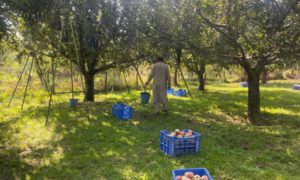
Therefore, growers (especially in South Kashmir) started plucking their apples as soon as they gained the desired reddish shade, at least two weeks before their anticipated time of harvest.
This batch of apples, over and above the huge produce of ‘high density apples’, made the supply much more than the demand.
This made growers sell apples in much low price to traders/ middlemen.
Another grower said, apple boxes, usually sold for ₹1200 (each), were even sold as low as ₹500 by the growers to intermediaries to avoid further losses.
However, apple growers are not unhappy as they have still made good money.
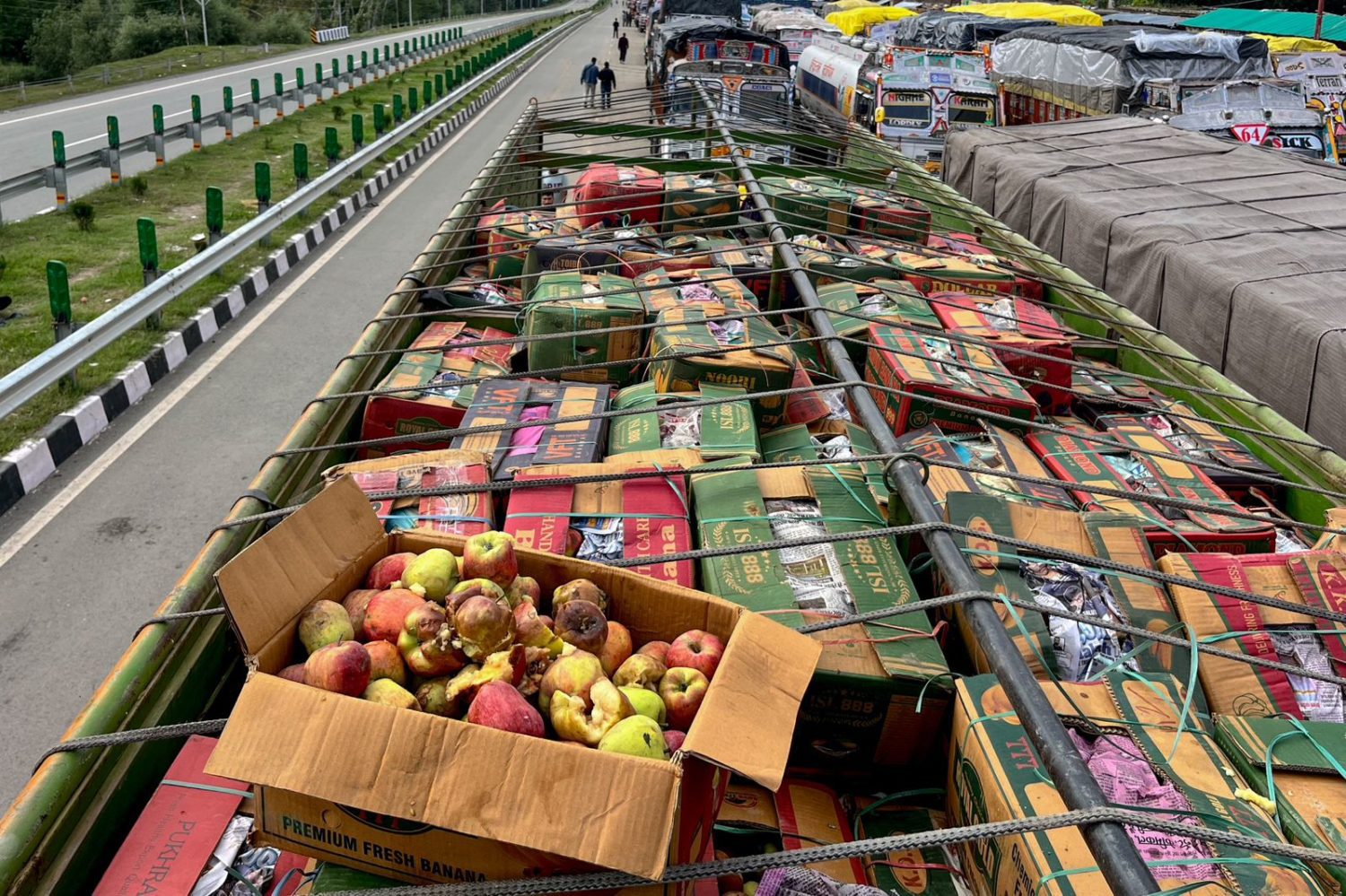
Coming to the road blockade this time, due to heavy rains, land/ mud sliding, and shooting stones, portions of NH 44 between Banihal and Udhampur were in a state of disuse for a couple of days during mid-September.
This blockade was due to nature’s fury, and authorities had no control over it. Despite best efforts, the restoration of the highway through such fragile mountains took days.
Further, on the opening of the highway, there were a number of trapped vehicles with passengers waiting to cross over. This further increased the waiting time for apple laden trucks.
But, accusing the authorities of having done it deliberately is very unfair and seems vested-interest-driven.
Now, the aspect of the Kashmiri middlemen. Many of these big traders are also owners of cold storage, a scarce infrastructure in Kashmir.
These Kashmiri middlemen try to buy apples at the lowest price and sell them at the highest price to gain maximum profit.
So, they very carefully choose the buying and selling time.
Some growers even find these Kashmiri traders capable of creating artificial panic by spreading rumours of a road blockade to bring the growers to sell their produce at a much cheaper price.
The scarcely available infrastructure, Cold Storage, is the next aspect.
During Syed Mufti’s term as CM, many reforms were brought in for the horticulture sector. Subsidy for cold storage was one of them.
Many influential personalities had subsequently availed the subsidy to construct cold-storage.
Few are even suspected to have availed the subsidy without construction of any cold-storage.
The total volume of cold-storage available is much below the demand, especially this year. To top it up there is huge mismanagement at such cold-storage facilities.
To one’s surprise, there are few storages with limited or no air-conditioning facilities. Many of the owners and managers of these storage facilities behave like feudals.
At the time of crisis, instead of helping apple grower or small traders, they mostly increase their storage charges.
Many cold-storages observe two-three days of holiday per week. The loading and unloading speed at these storages is generally way slow, keeping in view the need.
All of these cause an extra-long queue of apple-laden trucks outside each such cold-storage. Some suggest this further creates opportunities for the cold-storage owners to buy the apples from the waiting trucks at a relatively cheaper price and store the same in their own storage for a suitable time of sale.
Apart from financial losses to the smaller traders, such mismanagement at cold-storages also leads to serious road traffic violations.
Kashmiri businessmen and rich apple growers must realise that there is serious need of establishing more number of cold-storages and making their services more affordable.
Let’s talk about fruit processing units in Kashmir. Unlike Himachal Pradesh and Maharashtra, business community in Kashmir has not invested much in fruit processing units in Kashmir. As a result there are very few of them functional in Kashmir valley.
Therefore, transportation blockade still remains a singular point of failure in the massive horticulture economy.
With the modern insurance system, it is quite feasible to insure each truck load of apples moving towards Delhi, suitably including the clauses of perishing due to road blockade.
The leaders of various apple growers or traders associations need to come up with suitable win-win insurance policies in this regard.
Finally, let’s discuss the Himachal angle. Himachal was badly affected by rain, cloudburst and landslides this time.
All forms of transportation and communication were badly affected. The loses were much worse than that in Kashmir. Still, no such conspiracy theory came out of Himchal.
The theory of so called “apple conspiracy” is another eye opener for common Kashmiris to get over the Delhi-bashing syndrome and look within for shortcomings with an intent to bring in progressive change to the region.
It’s time to introspect such conspiracy theories based on ground realities and look at them without any historical, regional or political biases. May the blind appetite in Kashmir for conspiracy theories shrink for good.
Dr Ipsa Pattanayak is an anthropologist by training and an English teacher by experience. Now a full-time mother, she remains a voracious reader, writer, and travel enthusiast. She writes on themes of society and contemporary issues with an anthropologist’s eye for nuance.