

He never stepped inside as a pupil, but Abdul Rashid has kept Lal Ded Memorial School alive from the water for 45 years.
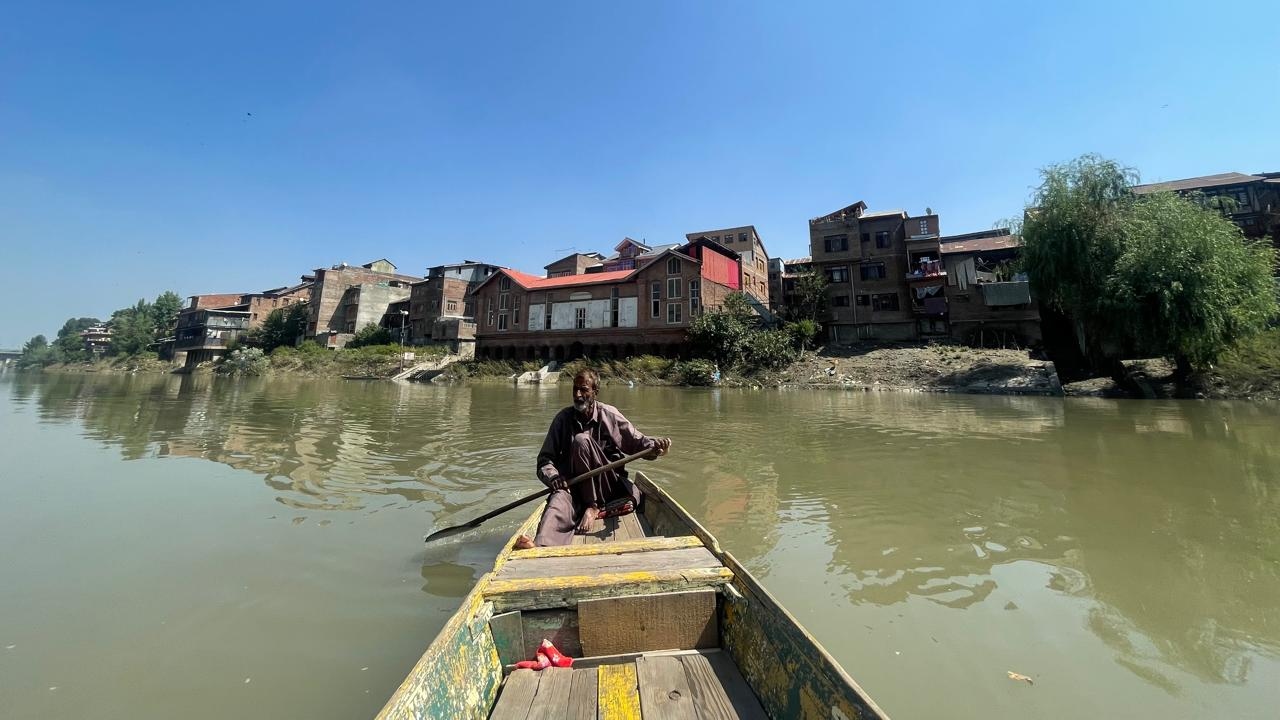
Abdul Rashid’s day begins at dawn when the Jhelum is a sheet of pale steel.
He unties his shikara from a willow stump, checks the tin that holds a brass souvenir, and rows the 300 strokes to Habba Kadal.
The three-storey stone block rises like an old man who refuses to sit. Rashid floats past, presses his palm to his heart, lifts it in a tiny wave, and lets his lips whisper the morning greeting.
The building does not answer, but he hears children anyway.
In 1979, the boatman was nine and the verandah was packed with boys in white shirts and girls in bright ribbons. They bought warm snacks from his mother for ten paisa and asked him to say English words.
“Pencil, rubber, river,” he recited, earning praise and amusement for every correct accent. That was his first classroom, though he never crossed the iron gate.
Today the gate is orange with rust. The name board has vanished, and the guard opens it only for festivals or funerals.
Rashid, 54, knows the wedding price list by heart: five thousand rupees for two days, one thousand extra if the baraat brings more than 50 guests.
“Business is good in summer,” he says with a shrug. “Celebrations and condolences never slow down in this part of the world.”
He ties the boat and climbs stone steps once meant for horses. The ground floor smells of damp carpet and leftover rice. Plaster peels like torn paper. In the far corner, a marble slab reads, “Hindu High School, Est. 1910.” History survives in small letters.
Back on the water, Rashid tells the full story to anyone who hires the ride. Words roll with the same tempo as his oar.
“Maharaja’s cousin built it in 1890 for boat tax, market tax, even cinema ticket tax,” he begins. “Then the Pandit leaders came with another request. They wanted a school. Nothing went on paper. A handshake sealed the understanding.”
The school rose on the riverbank in the year of the silk uprising in Kashmir. Muslim boys studied there too, seated on the same benches, learning the same lessons. The fee was two annas, cheaper than a cup of salt tea.
Then, in the watershed year of 1947, the poet Dina Nath Nadim renamed it the Lal Ded Memorial, honouring the 14th-century mystic who used vakhs to explain the universe.
Enrolment touched 600 by 1985. Rashid shows a faded class photo he found floating during the 2014 flood.
“Look at faces,” he says, finger moving across Hindu and Muslim students in the same row. “We were one notebook.”
The notebook tore in 1990.
Pandit families left amid turmoil. Rashid’s passenger list changed from children to soldiers carrying radios and fear. “I still rowed,” he says. “River does not choose who sits inside.”
By 2007, just 28 pupils were left. The campus stared down at gloomy ghats emptied of their communal pulse. Property dealers found the owner’s heirs in Jammu, paid well, and carried away the deodar beams.
“They sold the timber and planned a glass mall for tourists,” Rashid says, spitting into the current. “The education society woke up, but files move slower than my boat.”
What followed was a familiar course of events. INTACH approached the court, the tourism department halted demolition, and by 2011 a cultural centre was announced.
For the first two summers after the campus changed, the halls hosted embroidery shows, book readings, and school trips. Rashid earned extra money ferrying visitors. “I thought the laughter had returned,” he says.
Then the 2014 flood submerged the ground floor. Files vanished, funds dried up, and the keys ended up with a caretaker who saw a rental opportunity.
Rashid opens a plastic envelope kept inside his tin box. He saves relics the way people save wedding jewellery: a brass inkpot from the staff room, a slate with Urdu alphabet, and a 1992 Republic Day badge. “Buyers offer good money, but I refuse,” he says. “Memory is not for sale.”
Alumni now live across oceans. On Facebook, they post old cricket pictures and tag #BringBackLalDed. Rashid scrolls on a cracked phone.
“They dream of a library and a coffee shop,” he smiles. “I dream of a toilet first. Brides refuse to change clothes here because drain backs up.”
Rashid keeps his own roll call of broken panes: twenty-two today, maybe twenty-one by tomorrow if neglect continues. But he remains positive about the old structural defiance.
The earthquake of 2005 shook new concrete houses until they cracked, but Lal Ded lost hardly a chip. Likewise, the flood of 2014 swept away bridges upstream. The building stayed, ankles in water, head above the surge.
The boatman taps the wall with his knuckles and hears the notable reply. “Old lime still breathes,” he mutters. “Stone can wait. People, that’s the part we don’t know.”
The evening azan drifts from the mosque across the Jhelum bund, dotted with dozens of deserted homes. Some boys take selfies on a nearby bridge. Rashid pushes off, his oar dipping like a pen writing on water.
The river turns gold, then grey. Lights flicker on the new mall across the bank, glass and chrome rising where willows once wept.
Rashid stores his oar, kisses the souvenir for luck, and looks back one last time.
“The school and I are the same,” he whispers. “We carry yesterday on our back and still float.”