
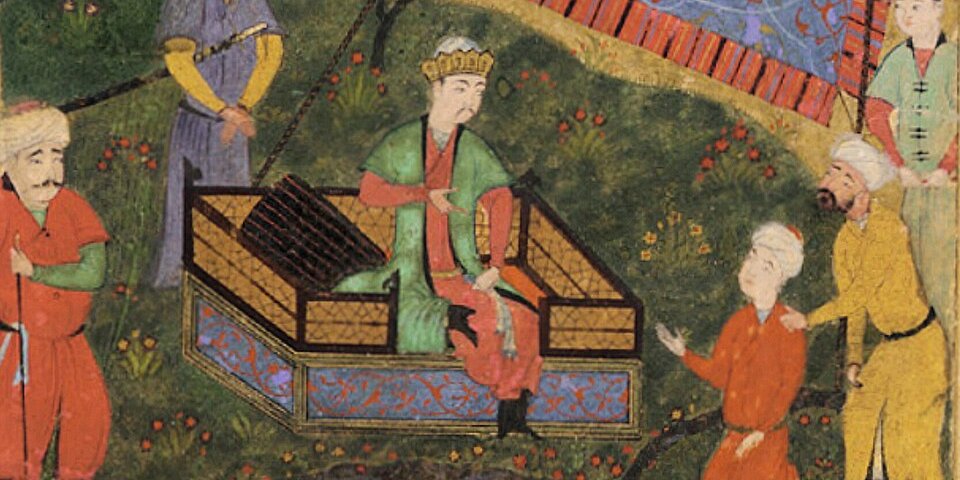

Sikandar Shahmiri, the seventh sultan of Kashmir’s Shah Miri dynasty – who ruled from 1398 C.E. till his death in 1413 C.E. is historically portrayed as “Sikandar Buthsikan”, “the iconoclast”, or “the idol-breaker”.
The essay titled “Beyond Butshikan: Reassessing Sikandar Shahmiri’s ‘Iconoclast’ Legacy” by Khawar Khan Achakzai challenges the historic narrative and instead provides enough evidence to prove that he was a pragmatist who worked on the principles of realpolitik.
His actions aimed at consolidating the power of the state and seizing the economic assets that were in control of the existing religious order.
It also contextualises Sultan Sikander within medieval Kashmiris political landscape, aiming to evaluate his actions without modern communal bias rather than completely exonerating him for temple destructions.
The key supportive evidence in this paper is the pictures from “Kashmir Sculptures by J L Bhan” which show a four-armed Brahmin sculpture inscribed in the Sharda script that honours Sultan Sikanadar, contradicting his image as an “ Iconoclast” or the destroyer of Hindu iconography.
The inscription reads “Sri Sikindra sa ha Reoya Sangapaty Rahulya Kastvehkene”, which the author translates to “The revered Sikindra, together with Reoya, the chief (or leader) associated with Rahula…”
Words in this inscription express respect and regard for Sikandar, even though terminology like “Reoya” (perhaps the name of a place or person) and “Kastvehkene” (potentially a verb or place-name fragment) are confusing and require expert judgement.
The reference to the sculpture is also found in S.L. Shali’s Kashmir: History and Archaeology through the Ages.
Images shared have never been shared before, especially from J L Bhan’s Kashmir Sculptures, as they are nowhere to be found these days.
Another piece of evidence of praise for Sikandar is found on a stone engraved by a sculptor named Gaggaka, and cited by B.K. Deambi in his Corpus of Śāradā Inscriptions.
A feature of great interest in the inscription is the second verse, which reads the following: “When four thousand years increased by five hundred and thirty of the Kali (era) had elapsed, there (ruled) in Satisara a king (named) Jayanolabadenasaha (Zain-ul- abidin), the son of the Illustrious Sakandara”.
The inscription shows that both Sikandar and his son are highly commended in the same line.
The fact that little to no attention has been paid to the connotation and context under which such inscriptions were made in Kashmir history texts lends credence to the theory that Sikandar was depicted notoriously for political and communal reasons.
The archaeological evidence suggests that during Sikandar’s rule, temple spoils were repurposed and adapted into new constructions like mosques and governmental buildings.
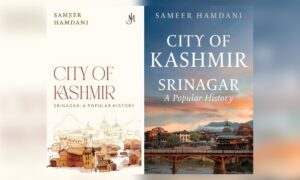
Art historian Sameer Hamdani, in his book ‘The Syncretic Traditions of Islamic Religious Architecture of Kashmir’ mentions that a major architectural aspects of edifices created during the Sultanate period demonstrate a clear endeavour on the part of the new rulers to embrace the local lexicon rather than importing and then imposing one from beyond Kashmir.
The author also differentiates between “empires of extraction” (colonial capitalism) and “empires of incorporation” to demonstrate how Islamic conquerors adopted architectural tradition and reused taxes such as jizya.
However, the author himself recognises that these architectural trends can be attributed to the thesis only speculatively and “would require much more profound research that is far beyond the scope of this paper.”
Historians Richard G. Salomon and Chitralekha Zutshi have frequently reinterpreted Sikandar’s conduct.
In their writings, both academics place more attention on literary, political, and social settings than on Sikandar’s figure’s purely religious motivations.
Both claim that realpolitik, not religious fanaticism, was the driving force behind Sikandar’s policy.
Sikandar’s actions, like those of earlier Hindu rulers in Kashmir, were attempts to gain political legitimacy by gaining access to the substantial wealth controlled by their religious establishments and asserting state power over influential Brahmanical institutions, even though they were disguised in religious terminology.
The primary source of the “Iconoclast” narrative is Jonaraja’s Rajtarangini, commissioned by Sikandar’s son Zain ul Abidin.
Jonaraja’s political motives exaggerated Sultan Sikandar’s tyranny to legitimise Zain Ul Abidin as a benevolent saviour to the Brahmin elite.
Later Persian texts (like Baharistani i Shahi) also exaggerate past events to align with a specific ideological and religious agenda to project a classic representation of Islamic piety and orthodoxy.
Because Kashmir is located in a seismically active zone, research by seismologists Mayank Joshi and V.C. Thakur reveals that earthquakes are one of the primary causes of temple damage and destruction.
Recorded earthquakes in 1555, 1736, 1779, 1784, and 1828 CE severely damaged stone structures.
Tilted pillars, broken stones, and rearranged building blocks are all signs of earthquake damage rather than deliberate human devastation, and these damage patterns can still be seen in ancient temples in Kashmir.
In addition to this proof, the Martand Sun temple’s limestone construction did not aid in its preservation; rather, it made it extremely vulnerable to centuries of natural chemical weathering.
The author also highlights the previous Hindu kings, such as Mihirakula and Harsha, who targeted religious institutions because they were powerful centres of wealth, land, and political influence, and not simply out of religious animosity.
Chinese scholar, traveller monk Xuanzang claims in his writings that Mihirakula persecuted Buddhists, killing thousands of monks and destroying hundreds of monasteries and an estimated 1,600 stupas.
King Harsha, on the other hand, plundered Hindu temples to seize their vast economic endowments.
His actions were driven by financial ambition and the desire for political control, establishing a pattern of using religious institutions as reservoirs of wealth to be extracted.
These historical precedents demonstrate that destroying and looting sacred sites was a shared “political grammar” and a standard method of state consolidation across pre-modern South Asia, regardless of a ruler’s religious affiliation.
By contextualising Sultan Sikandar Shahmiri’s actions against this long-standing historical backdrop, the author argues that his reign should be viewed not as an anomaly of religious zealotry, but as a continuation of a deeply rooted practice of asserting state power over wealthy rival establishments.
Sultan Sikandar’s rule was established through administrative syncretism, where the senior-most minister Rai Magre and army chief Achaladeva Achala were Hindus.
His administration relied heavily on the Brahmin elite, demonstrating religious accommodation.
According to the author, without acquitting Sikandar, the order for anti-Hindu policies and the demolition of temples is largely attributable to Sikandar’s Commander-in-Chief Suhabhatta—a Brahmin who embraced Islam.
The paper labels this as a “convert’s syndrome” in which the intra-communal struggle is emphasised rather than the iconoclasm by the state.
It seems legitimate to raise a query about whether this actually relieves the state of responsibility, considering the fact that Sikandar was the sovereign ruler.
Sultan Sikandar Shahmiri’s legacy is significantly more nuanced than the conventional “iconoclast” story implies.
Instead of being only motivated by religious fanaticism, his activities were grounded in the practical ideas of realpolitik, with the primary goals being the consolidation of state power and the acquisition of the enormous wealth possessed by powerful Brahmanical institutions.
Hindu monarchs like Harsha and Mihirakula had previously employed a well-established “political grammar” of state consolidation, which was consistent with this deliberate theft of riches from sacred places.
Furthermore, the exaggerated, politically motivated descriptions of his dictatorship are undermined by the presence of Hindu elites in his administration.
Favourable Sharda inscriptions from his era, and the important role of natural calamities like earthquakes in temple destruction, collectively undermine the exaggerated, politically motivated accounts of his tyranny.
Therefore, Sikandar’s reign must be understood not as a period of one-dimensional religious fanaticism, but as a calculated exercise of medieval statecraft, wealth acquisition, and administrative syncretism.