
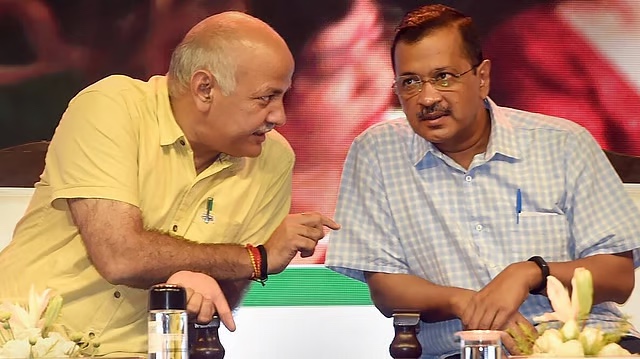

New Delhi: A day after AAP chief Arvind Kejriwal took a similar position, former Delhi deputy chief minister Manish Sisodia informed Delhi High Court Judge Swarana Kanta Sharma that he would not continue appearing before her in the excise policy case.
In a two-page letter to Justice Sharma, Sisodia said he had reviewed Kejriwal’s April 27 communication and found himself “in respectful agreement,” citing Mahatma Gandhi’s principle of Satyagraha as the basis for his stance.
“After much reflection, my answer is similar to Kejriwal’s. I cannot,” Sisodia wrote, saying he could not participate in proceedings while harbouring “a serious apprehension about the appearance of impartial justice.”
The development comes eight days after Justice Sharma rejected Kejriwal’s recusal plea on April 20, dismissing allegations of conflict of interest and political bias. Sisodia said two issues continued to trouble him.
He pointed to Justice Sharma’s “repeated public attendance” at events linked to the Akhil Bharatiya Adhivakta Parishad (ABAP), a lawyers’ body seen as affiliated with the RSS. He also cited the professional engagements of her children on Union government legal panels, where case allocations are overseen by Solicitor General Tushar Mehta, who represents the government in the matter.
Referring to RTI data cited by Kejriwal, Sisodia noted that Justice Sharma’s son was assigned 5,904 dockets between 2023 and 2025, placing him among the top 10 out of around 700 panel counsels, with each appearance carrying a fee of ₹9,000 per day.
Responding to Justice Sharma’s April 20 order, Sisodia said it addressed an issue he had not raised. “I had not questioned the children’s right to practise their profession. No citizen can and should do that,” he wrote, adding that his concern was about the constitutional duty of a judge to ensure and uphold the perception of impartial justice.
He also raised concerns over disclosure, asking whether there was a duty on the judge to inform parties of such circumstances at the outset, and whether the Solicitor General should have placed these facts before the court.
Sisodia acknowledged that his decision could harm his legal position and invite adverse consequences, but said he was willing to bear that burden in line with Satyagraha.
He clarified that his stance was limited to this case and should not be seen as a general refusal to appear before the judge or as distrust in the judiciary.
In strong remarks, Sisodia questioned why established recusal norms followed by several judges over decades were not applied in this instance. He cited past examples where judges sought transfers after their children began practising in the same jurisdiction, calling them benchmarks of judicial ethics.
Sisodia requested that his letter be taken on record and said the court may proceed as it deems appropriate.