

China has urged Iran to reopen the Strait of Hormuz “as soon as possible” while appreciating Tehran’s commitment not to develop nuclear weapons, a key demand of US President Donald Trump to end the war against the Islamic Republic.
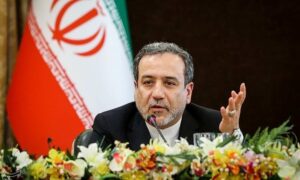
“On the issue of the Strait, the international community shares a common concern over restoring normal and secure navigation through the Strait, and China hopes relevant parties will respond as soon as possible to the strong call from the international community,” Chinese Foreign Minister Wang Yi told Iranian Foreign Minister Abbas Araghchi during talks in Beijing.
Wang also appreciated Iran’s commitment not to develop nuclear weapons. Trump has been demanding that Iran hand over its stockpiles of enriched uranium and commit to not developing nuclear weapons for 20 years.
“China appreciates Iran’s not-to-develop-nuclear-weapons commitment, and affirms Iran’s legitimate right to peaceful use of nuclear energy,” Wang told Araghchi.
Araghchi, on his first visit to Beijing since the US-Iran war began in late February, briefed Wang on the ongoing negotiations with Washington to end the conflict.
“China believes that achieving a comprehensive ceasefire is an urgent priority, while reopening hostilities would be even more undesirable,” Wang said.
According to the Chinese Foreign Ministry, Araghchi said, “At present, priority can be given to promptly resolving the issue of reopening the Strait of Hormuz.”
“Iran will firmly safeguard its national sovereignty and national dignity, while continuing to build consensus through peaceful negotiations and seek a comprehensive and lasting solution,” he said.
“Iran looks forward to China continuing to play a positive role in promoting peace and ending the conflict and supports the establishment of a new post-war regional framework that can balance development and security.”
Wang said China believed that countries in the Gulf and West Asia “should take their future into their own hands”, a remark seen as an attempt by Beijing to reduce dependence on the US for regional security.
“(China) encourages Iran and more Gulf states to engage in dialogue and achieve good neighbourly relations and supports the establishment of a regional peace and security framework led by regional countries, with broad participation, shared interests and common development,” he added.
Separately, the Iranian and Saudi foreign ministers discussed regional developments over the phone on Wednesday and stressed the need to continue diplomatic efforts and regional cooperation to avoid renewed tensions, according to the Iranian Foreign Ministry.
Araghchi’s day-long visit comes a week ahead of US President Donald Trump’s planned trip to Beijing from May 14 to 15 for talks with Chinese President Xi Jinping on a comprehensive trade deal and other issues.
Chinese state media reported that Wang and Araghchi discussed the situation arising from the US blockade of Iranian ports aimed at forcing Tehran to lift its blockade of the Strait of Hormuz.
China is a close partner of Iran and the largest buyer of Tehran’s crude oil.
Araghchi’s visit comes shortly after US Secretary of State Marco Rubio announced on Tuesday that major US military operations against Iran had ended.
Rubio told reporters at the White House that ‘Operation Epic Fury’, the attack mounted by the US and Israel on Iran on Feb 28, had concluded after achieving its objectives.
Rubio earlier urged China to tell Araghchi that Iran’s actions were causing the country to become “globally isolated”. Referring to Araghchi’s visit to China, Rubio reiterated the need for Iran to lift its blockade of the Strait of Hormuz, the critical waterway through which more than 20% of global oil and gas supplies pass.
“I hope the Chinese tell him what he needs to be told. And that is what you are doing in the Strait, causing you to be globally isolated,” media reports quoted Rubio as saying.
“You’re the bad guy in this”, he said, adding that China, more than the US, was suffering from Iran’s actions in the Strait because its export-driven economy depended on shipments passing through Hormuz.
Rubio said it was in China’s interest for Iran to stop closing the Strait and added that many countries wanted to help reopen Hormuz, though some were unable to do so.
Both China and the US want to see an end to the war in West Asia before Trump’s visit.
Beijing has also reportedly been assisting Pakistan, which is mediating between the US and Iran to help end the conflict.
China, which maintains close ties with Gulf countries, is also reportedly advising Tehran to reach an agreement with Washington.
The US blockade of Iranian ports, strongly criticised by China, is putting pressure on Beijing to increase its energy supplies.