
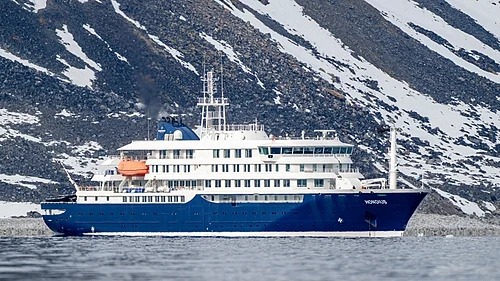

At least two Indian nationals are among the crew members aboard the Dutch luxury cruise vessel MV Hondius, which has reported a hantavirus outbreak with five confirmed cases and three deaths so far, according to the BBC.
Amid concerns over the infections, Director of the Indian Council of Medical Research’s (ICMR) National Institute of Virology (NIV) Dr Naveen Kumar on Friday said the reported cases appear to be isolated and there is no immediate public health threat to India. “The reported hantavirus cases appear to be isolated ones and there is no immediate public health threat to India,” he said.
The luxury cruise ship, operated by Oceanwide Expeditions, began its journey on April 1 from Ushuaia in Argentina and is expected to arrive at Spain’s Canary Islands on May 10.
About 150 passengers and crew members from 28 countries were initially aboard the vessel, but dozens disembarked on the island of St Helena on April 24, according to the BBC report.
The World Health Organisation (WHO) said on Thursday that five of the eight suspected hantavirus cases had been confirmed.
Maria van Kerkhove, an infectious disease epidemiologist at WHO, told a news briefing that the situation is not the same as six years ago with Covid because hantavirus spreads through “close, intimate contact”.
Van Kerkhove said “this is not Covid, this is not influenza, it spreads very, very differently”. She said authorities had asked “everyone to wear a mask” on board the MV Hondius.
Meanwhile, health authorities are racing to trace dozens of people who recently disembarked from the vessel.
Oceanwide Expeditions said 29 passengers from at least 12 nationalities had left the MV Hondius in St Helena, a British Overseas Territory.
The company also said the body of one deceased person, now identified as a Dutch man, was taken off the vessel.
According to WHO, the two Indian passengers were among a small cluster of suspected infections identified aboard the vessel, and health authorities were monitoring contacts and undertaking precautionary measures.
WHO officials noted that hantavirus infections are rare and are generally linked to rodent exposure rather than sustained human transmission.
Hantaviruses are mainly transmitted to humans through contact with infected rodents or their excreta such as saliva, urine and faeces, he told PTI.
People usually get infected by inhaling aerosolised virus particles from rodent urine, droppings or saliva in closed or poorly ventilated spaces such as warehouses, ships, barns and storage areas, he said.
WHO Director General Dr Tedros Adhanom Ghebreyesus said “while this is a serious incident, WHO assesses the public health risk as low”.
Given the incubation period, he said, “it is possible that more cases may be reported”.
Meanwhile, a new suspected case of hantavirus was identified in a British national on the South Atlantic island of Tristan da Cunha on Friday, as efforts continue to trace passengers of the luxury cruise ship hit by the virus and their immediate contacts.
The British health security agency did not disclose further details of the new suspected case on the world’s remotest inhabited island, home to only around 200 people, where the cruise ship made a stop on April 15.