Environment
Why Amarnath’s ice formation is disappearing faster than ever



A shrinking Himalayan ice figure revered by millions has become a flashpoint over climate change, crowd size and who controls the mountain path to reach it.
By the second week of July, the ice formation that pilgrims call Baba Barfani had all but disappeared.
Weeks earlier it stood nearly seven feet tall inside a limestone cave more than 12,000 feet above sea level.
Now it was a faint smear of white against dark rock, gone months before the pilgrimage honouring it was scheduled to end.
The Amarnath Yatra, one of Hinduism’s most demanding pilgrimages, brings hundreds of thousands of devotees each summer through the mountains of Jammu and Kashmir to witness a naturally formed ice stalagmite believed to represent Shiva.
This year’s journey began on July 3 and is scheduled to run 57 days. Four decades ago, it lasted about two weeks.
That expansion, and what it has done to one of the most environmentally sensitive corners of the Himalayas, has become a point of open dispute among pilgrims, scientists, environmentalists and members of Kashmir’s minority Pandit community, who say a sacred site is buckling under a scale of human activity it was never built to hold.
Sanjay Tickoo, president of the Kashmiri Pandit Sangarsh Samiti, remembers a different Yatra.
He first visited the cave in the 1980s, when the trek along the Pahalgam route took nearly two weeks on foot.
Today, that same route can be completed in four or five days. Along the Baltal route, some pilgrims now reach the shrine within 24 hours.

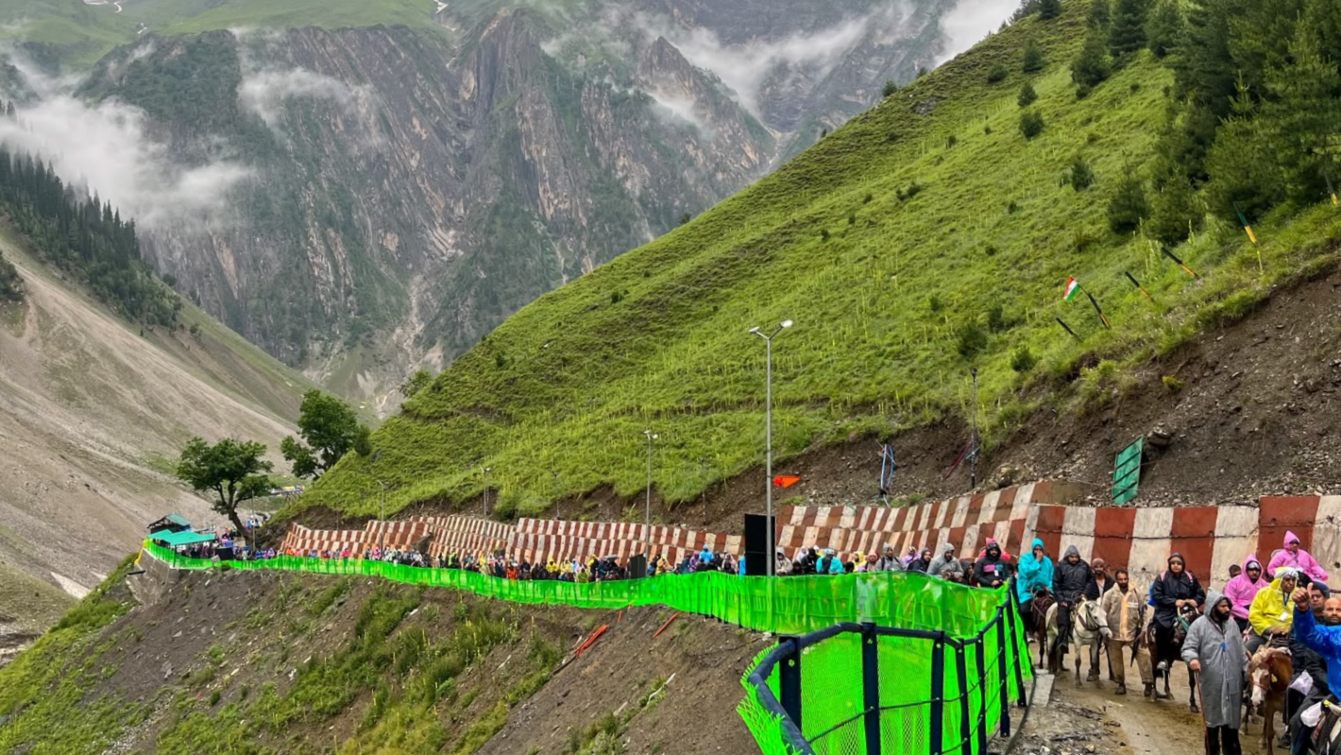
Amarnath Yatra, 2026. [FPK Photos/Umar Farooq.]
“When I visited the holy cave in the 1980s, the Yatra lasted only about 15 days,” Tickoo said. “Today it stretches for nearly two months.”
He believes the pilgrimage’s extended duration, rising pilgrim numbers and the spread of temporary camps and community kitchens, known as langars, have intensified pressure on the mountain’s fragile ecosystem and accelerated the melting of the sacred ice formation.
“The prolonged Yatra and the expansion of temporary infrastructure have disturbed the mountain’s delicate environment,” he said. “That is one of the reasons the Shivling is melting much earlier than it once did.”
Tickoo’s objection extends beyond crowd size. He argues the government has turned what began as a modest act of devotion into something closer to a numbers contest, and he wants that reversed.
“I fail to understand why the government continues to permit such a huge number of pilgrims every year,” he said. “The Yatra should remain a spiritual pilgrimage rather than an exercise in numbers.”
The non-migrant pandit leader wants sharp limits placed on daily pilgrim counts.
He also raises a question of representation.
Kashmiri Pandits, he said, are the traditional custodians of the shrine’s rituals, but the community holds little formal role on the Shri Amarnathji Shrine Board that oversees the pilgrimage.
Tickoo believes 60 percent of the board’s membership should come from the Pandit community, whose institutional memory of the old pilgrimage calendar, he argues, could help restore a slower, more sustainable journey.

![Amarnath Yatra, 2026. [FPK Photos/Umar Farooq.]](https://cdn.freepresskashmir.news/wp-content/uploads/2026/07/Amarnath-Yatra-2026-Umar-Farooq-2.jpg)
Amarnath Yatra, 2026. [FPK Photos/Umar Farooq.]
That argument has found an echo among younger Kashmiris alarmed by what they see on the ground.
Akshay Bhat, a Kashmiri resident whose video documenting conditions near the shrine circulated widely online, described a landscape increasingly overwhelmed.
“The holy Shivling is a delicate natural ice formation, and both changing weather conditions and increasing human footprints have a direct impact on its fragile environment,” Bhat said. “People have turned this ecologically sensitive sacred landscape into a mess, showing little regard for its surroundings.”
Bhat wants the settlements built up around the cave removed entirely, and he opposes a proposed ropeway to the shrine that supporters say would ease congestion but that he believes would deepen ecological harm.
He also points to tree felling and illegal mining nearby, which he says are degrading groundwater and destabilising slopes already prone to landslides.
The young pandit calls the environment “the biggest casualty” of politics in the region and wants policy built around conservation first.
Scientists studying the broader Himalayan climate say the melting fits a documented design rather than standing as an isolated event.
Jayanarayanan Kuttippurath, an associate professor at the Centre for Ocean, River, Atmosphere and Land Sciences at IIT Kharagpur, has spent years tracking temperature shifts across Jammu and Kashmir.
His recent study of the region between 1980 and 2024 found that higher elevations are warming faster than valley floors, with winter months showing the sharpest increases, in some high-altitude zones, nearly double the global average.
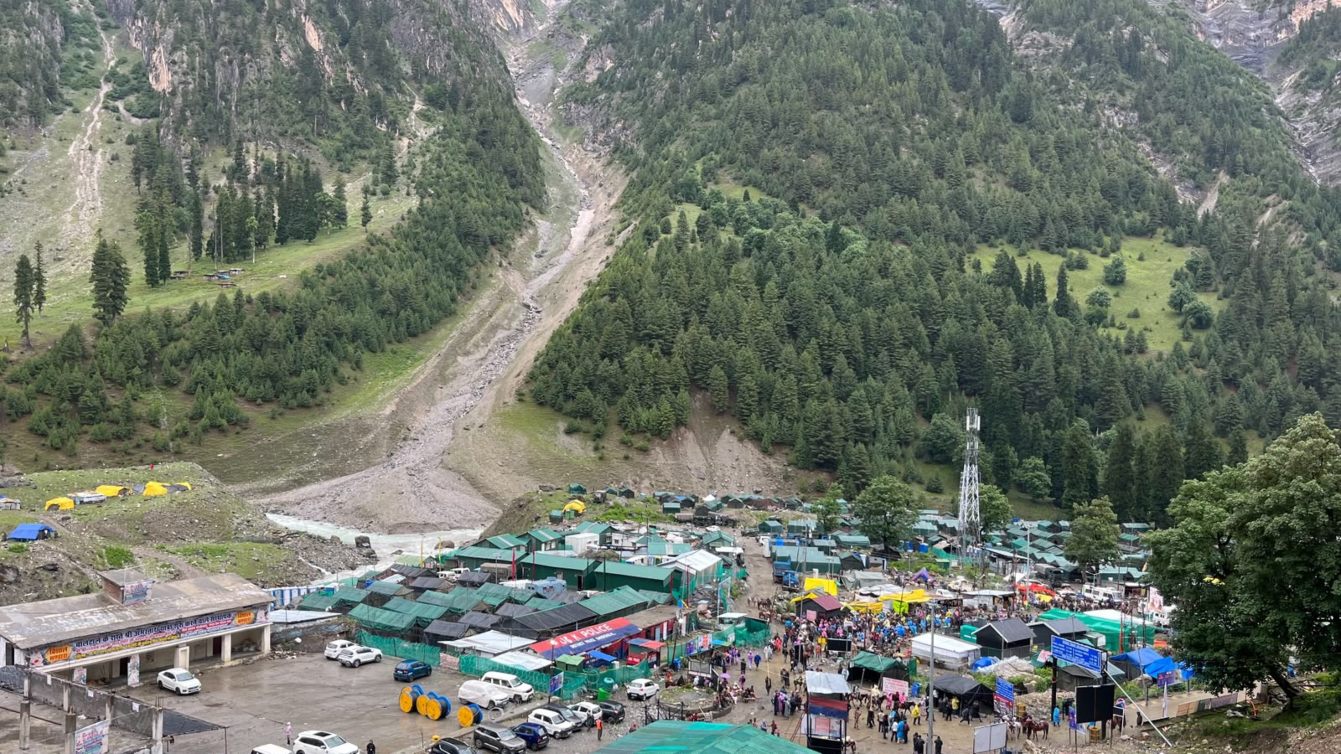
Amarnath Yatra, 2026. [FPK Photos/Umar Farooq.]
“If warming continues unchecked, extreme weather events are likely to become more frequent,” Kuttippurath said. “Just imagine what will happen if all the snow and glaciers in the Himalayas continue to warm.”
The professor described a feedback loop already underway: as snow melts, it exposes darker ground that absorbs more heat, accelerating further melting.
He warned the consequences reach beyond one ice formation. “Glacier retreat threatens water supplies,” he explains, “and the region faces rising odds of landslides, flash floods and erratic rainfall.”
Environmentalist Nadeem Qadri called the early melting of the ice lingam an unmistakable signal.
“Climate change is real and has already knocked at the doors of the valley,” he said.
Qadri is pressing the Shrine Board to commission climate and disaster-vulnerability research and to build the pilgrimage around ecological limits rather than expand around demand.
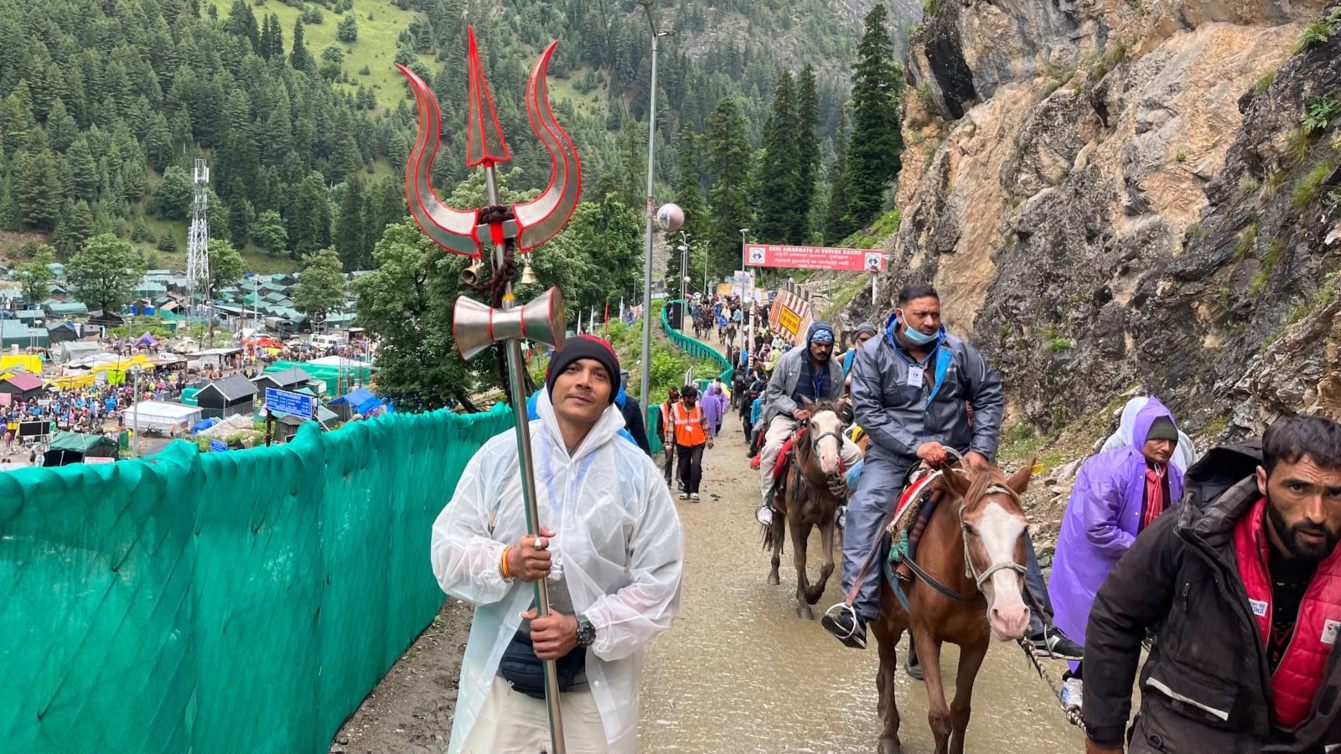
Amarnath Yatra, 2026. [FPK Photos/Umar Farooq.]
Veteran hotelier and environmentalist Faiz Bakhshi points to the near disappearance of the centuries-old Thajwas Glacier as proof the change is already visible across the region rather than confined to one cave.
“Streams that once ran year-round are drying,” he said, “and rainfall has grown unpredictable.”
Given recent disasters in Himachal Pradesh, Uttarakhand and Doda, and Kashmir’s location in a high seismic zone, Bakhshi believes tourism and pilgrimage planning must respect the mountains’ carrying capacity rather than press against it.
Amid these worries and warnings, what remains inside the cave now is less an omen than a measurement.
The ice that took shape slowly over a Himalayan winter is being read, by scientist and pilgrim alike, as evidence of how fast that winter is changing, and how little time is left to decide what kind of pilgrimage the mountain can still bear.