Jammu & Kashmir
Why Kashmir keeps flooding despite a decade of promises



Twelve years after the deadliest floods in Kashmir’s modern history, engineers, geologists and one determined environmentalist say the valley’s rivers are still waiting for the work that was promised to them
Srinagar: Nadeem Qadri keeps a folder of documents from 2017, the year he and the Environmental Policy Group filed a Public Interest Litigation asking a simple question: what had the government actually done to protect Kashmir’s Flood Spill Channel since the deluge of 2014?
The official replies gave this environmental advocate from Kashmir’s saffron town the answer he had been anticipating.

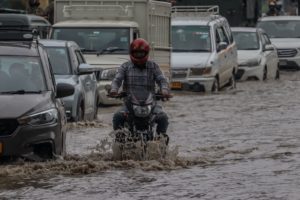
A man rides his bike through a waterlogged road in Srinagar. [FPK Photo/ Umar Farooq]
Much of what was promised after Kashmir’s worst flood in a generation had never happened.
This week, the cost of that inaction came rushing through the bustling bazaar of Beerwah.
The roar came first, and moments later, the Sukhnag stream burst beyond its banks, and shopkeepers along the embankment barely had time to react.
Police shouted for them to abandon the row of shops standing along the water’s edge. Men scrambled to save sacks of merchandise and cash boxes, hauling out whatever they could carry before the current took the rest.
Others stood still and watched years of labour disappear into the brown water. Wooden planks, twisted sheets of tin and entire shop inventories floated past, while families looked on from higher ground, unable to do anything but wait.
A few kilometres away in Khag, the trend repeated itself: mountain streams swollen by torrential rain tore into villages, damaged roads and cut off access to entire settlements.
The Meteorological Department had forecast this, officials had issued red alerts, and the Disaster Management Authority and the Irrigation and Flood Control Department had told people to stay away from vulnerable areas.
Days later, a cloudburst struck Rajouri district in Jammu division, killing residents and deepening a growing sense that extreme weather in the region was intensifying rather than easing.
For people who lived through September 2014, when floodwaters submerged large stretches of Kashmir, killed hundreds and displaced thousands, the scenes felt painfully recognisable.
That disaster produced sweeping promises: rivers would be restored, flood channels would be revived, wetlands would be protected, and systems would be strengthened so the valley would never again face devastation on that scale.
An examination of what happened since, built on interviews with engineers, geologists and specialists who have worked inside Jammu and Kashmir’s flood management system, shows a more complicated picture.
Some interventions moved forward, while many others stalled in bureaucratic delay or were never finished at all.
Ajaz Rasool, a hydraulic engineering expert who worked on river dredging operations in Kashmir between 2010 and 2012, believes the valley let a critical opportunity pass.
He points to Wular Lake, the natural reservoir that absorbs floodwaters during periods of heavy discharge, and says it has lost nearly 30% of its capacity over three decades.
Rasool describes the government’s post-2014 response as a two-phase plan.
“The first phase repaired embankments, protection walls and retaining structures damaged by the floods, though roughly a fifth of that work remains incomplete,” he explains.
“The second phase involved dredging a 27km stretch of the Jhelum between Pampore and Chattabal. Little has been done to clear silt from the flood spill channel itself, limiting its capacity to carry water away during emergencies.”
The expert argues the government dredged the wrong stretch.
The Sopore-Baramulla section, with its steeper gradient, functions as the valley’s natural outlet, he explained, and improving its carrying capacity would have done far more to help Kashmir discharge floodwater quickly. “This stretch requires annual maintenance rather than a single intervention, since erosion continually deposits fresh silt into the riverbed.”
Rasool’s argument mirrors conclusions drawn more than a century ago.
After the 1903 floods submerged large parts of Srinagar, engineers recommended a spill channel that would divert excess water around the city and rejoin the Jhelum roughly fifteen miles downstream.
That channel was eventually built and became one of the valley’s most important safety measures, acting as a relief valve when the main river rises past its limits.
Encroachment, silt buildup and years of neglect have since eroded its function, according to the people who study it closely.
This is where Nadeem Qadri’s documents matter most.
His 2017 litigation revealed that the spill channel, meant to be dredged, de-silted and widened after 2014, had instead become grazing ground for cattle in some stretches and a playground for children in others, spaces that should have been kept clear for water now filled with people and animals instead.
Dr Riyaz Ahmad Mir, a scientist at the National Institute of Hydrology’s Western Himalayan Regional Centre, said the valley has grown more vulnerable since 2014, not less.
“Shrinking wetlands, floodplain encroachment, rapid urbanisation and siltation have combined with climate change to make even moderate rainfall dangerous, and dredging alone will not fix this,” Dr Mir said.
“Kashmir needs restored wetlands, treated catchments, better urban drainage and construction rules that keep people out of flood-prone land.”
Free Press Kashmir asked the Irrigation and Flood Control Department for a full account of what had been done since 2014.
The Chief Engineer deferred to a Technical Officer, who confirmed only that dredging had occurred, offering no data on its scope or current condition.
Meanwhile, Qadri still keeps his folder, and still checks the spill channel when he passes it, half expecting one day to find it cleared and functioning as it was designed to.
“Until then,” he says, “Kashmir will keep discovering the same truth every monsoon season, that the danger was never a mystery. It was simply left unaddressed.”