
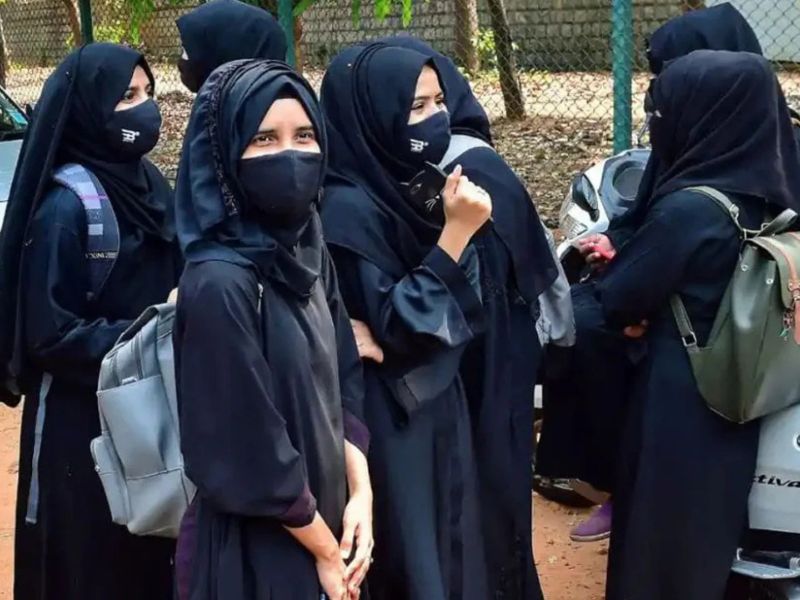

Prayagraj: The Allahabad High Court has held that students cannot claim a right to modify a school’s prescribed uniform based on personal preferences, dismissing a plea by a Muslim student seeking permission to wear a hijab along with her school uniform.
A bench of Justices JJ Munir and Indrajit Shukla passed the order on August 21 while hearing a petition filed by a minor student of Tagore Public School in Attarsuiya, Prayagraj. The student, identified as Sukaina Rizvi, had completed Class X and sought admission to Class XI at the same school.
Through her mother, the student asked the court to direct the authorities to allow her to wear a headscarf in addition to the prescribed uniform. She submitted that she had worn the hijab from Class VI to Class X without objection and argued that it was an essential practice of her Islamic faith.
The court, however, rejected the argument. Referring to photographs from the student’s previous classes, the bench noted that she appeared to be the only student wearing a headscarf, including among students from the same religious community.
The judges also held that wearing a headscarf is not an essential religious practice in Islam. The bench observed that high courts that have considered the issue have consistently held that not wearing a headscarf would not jeopardise a woman’s faith.
The court further held that an unaided private educational institution is entitled to enforce a uniform dress code, provided it is applied fairly, without discrimination and with the objective of maintaining discipline and equality.
Allowing students to make individual changes to the prescribed uniform on personal grounds, the court said, could undermine the purpose of having a uniform and effectively transfer control over school discipline from the institution to individual students.
The school, a private self-financed institution, argued that allowing an exemption for one student could affect discipline and uniformity among its diverse student body. The Uttar Pradesh government and the Central Board of Secondary Education (CBSE) also opposed the plea.
The Allahabad High Court’s ruling referred to an earlier full bench decision of the Karnataka High Court on the hijab issue. That judgment was subsequently considered by a two-judge Supreme Court bench in the Aishat Shifa case, which delivered differing views, leaving the issue without a final determination by the Supreme Court.