
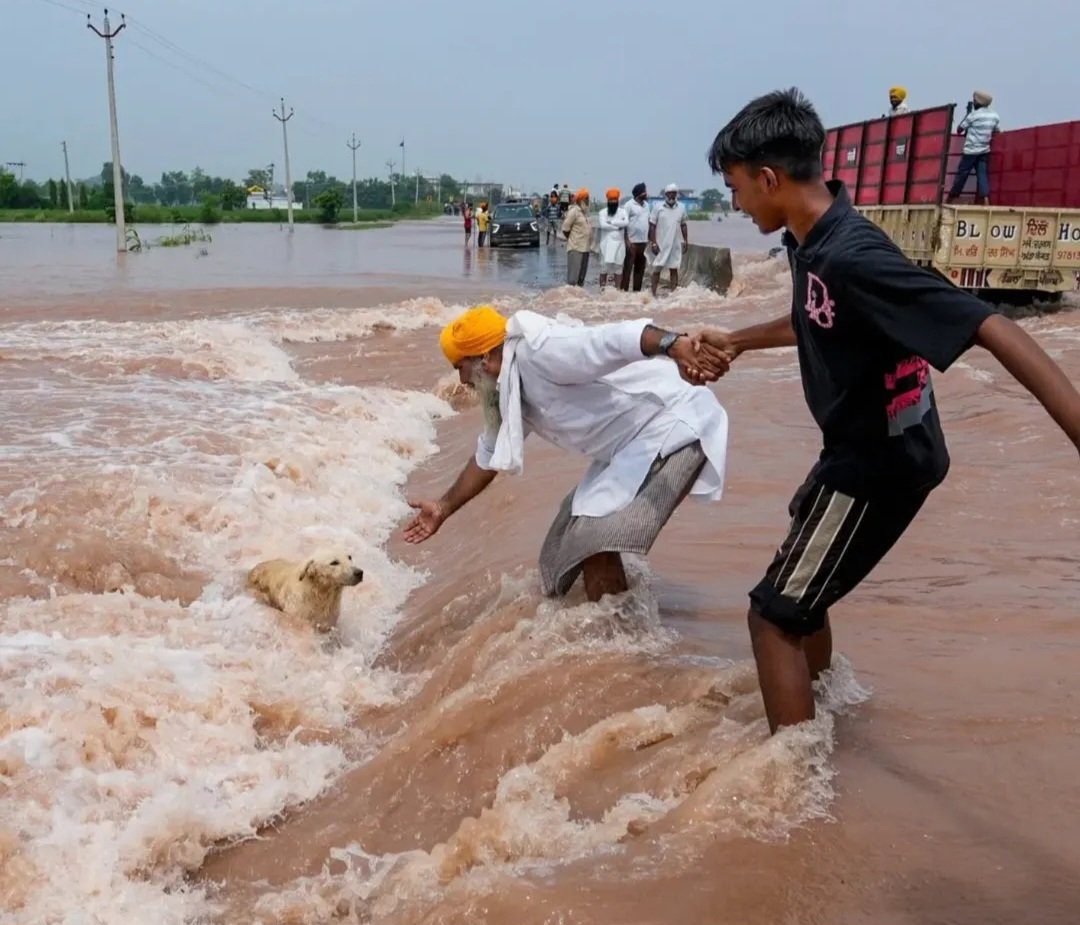

Amritsar: The devastating floods sweeping Punjab have claimed 46 lives and left nearly 4 lakh hectares of paddy fields submerged, raising concerns over the state’s contribution to the Public Distribution System (PDS) and its agrarian economy.
Crops on at least 1.75 lakh hectares of land have already been damaged, while relief and rescue efforts are underway on a war footing by the NDRF, Army, BSF, Punjab Police and local authorities. Over 22,800 people have been evacuated, and 200 relief camps are sheltering more than 7,000 displaced residents.
Punjab Finance Minister Harpal Singh Cheema described the calamity as the worst in five decades, affecting almost 2,000 villages and over 3.87 lakh people. He stressed that the state’s farm economy has suffered a severe blow, with 18 districts reporting widespread crop losses alongside damage to homes, infrastructure and livestock.
“I invested more than ₹4 lakh this season. Sari fasal kharab ho gayi (the whole crop is destroyed). For a week now, water has been knee-deep. How will crops survive?” The Wire quoted farmer Harjit Singh, as saying. A resident of Amritsar’s Ramdas area, Singh watched helplessly as 17 hectares of his paddy fields went under water.
According to the Punjab Agriculture Department, the state had sown paddy across 32.46 lakh hectares this kharif, including 6.8 lakh hectares of Basmati. Amritsar alone has seen 70,000 hectares impacted. Overall, 4 lakh hectares across Punjab remain inundated.
Agricultural economists warn that prolonged waterlogging could lead to total crop loss and fungal infections, reducing both production and procurement. “The varieties of paddy grown here cannot withstand long submergence. Even if some survive, their quality will be poor,” said PAU agronomist Buta Singh Dhillon.
Punjab is India’s third-largest rice producer, contributing around 12% of the country’s total output and a major share of grains to the PDS. In 2024-25, the state produced 11.82 million tonnes of rice. Reports said that the impact on the central pool may be limited as FCI stocks remain high, though prices could rise if waterlogging persists.
Former agriculture secretary Siraj Hussain also flagged the absence of crop insurance in Punjab. “The state never participated in the national crop insurance scheme. This is the time to reconsider,” he said.
While the AAP-led Punjab government has demanded central assistance and clearance of its “pending” Rs60,000 crore, it has accused the BJP of indulging in “photo-ops” instead of providing aid. Union Agriculture Minister Shivraj Singh Chouhan, during his visit to flood-hit areas, assured support and promised a phased recovery plan but faced criticism from state leaders for not announcing financial relief.
Several villages in Amritsar, Tarn Taran, Gurdaspur, Ferozepur and Mansa remain cut off, with volunteers using tractors to deliver essentials. Many farmers, despite their losses, are waiting for the girdawari (revenue inspection) to begin, hoping for compensation.
“If we get some relief, I will try to replant late-season paddy. There is no other option,” The Wire quoted farmer Manjit Singh, as saying resident of Ajnala, as saying.
For now, Punjab’s farmers are grappling with submerged fields, broken homes, and an uncertain harvest, in what is fast becoming the state’s most destructive flood since 1988.