

As calls for a separate Jammu state resurface, history and data show how partition, violence, political power and economic displacement shaped the divide with Kashmir, and why the debate refuses to fade.
Calls for separate statehood for Jammu have re-emerged in recent weeks, articulated by a section of Dogra activists and regional politicians.
The demand is not new.
Variants of it date back to the aftermath of 1947, when the former princely state of Jammu and Kashmir was fractured by partition, war and demographic violence.
The state of Jammu and Kashmir, as it existed in 1947, no longer exists. Pakistan controls a portion of the former princely state, while Ladakh has been separated as a distinct administrative unit.
What remains has been reorganised into two Union Territories, Jammu and Kashmir, and Ladakh, both directly administered by New Delhi, with locally elected authorities exercising limited executive power.
The response from Srinagar has been restrained or dismissive.
Former Srinagar mayor Junaid Azim Mattu has publicly encouraged Jammu activists to pursue their demand, but with a clear boundary: Muslim-majority, Kashmiri-speaking districts within the Jammu division, he argues, are historically part of a Greater Kashmir region and cannot be subsumed into a Dogra homeland.
Whether a separate Jammu state is viable depends less on contemporary rhetoric than on how Jammu itself was historically constituted, demographically transformed and economically repositioned after 1947, and on how power was redistributed in the decades that followed.
Jammu before 1846
Pre-modern Jammu did not exist as a unified political entity. The earliest scholarly reference linking the Dogra (Durgara) hills to Kashmir appears in Rājataraṅgiṇī by Kalhaṇa (c. 1148 CE), which describes Durgara chiefs as neighbouring rulers who intermittently acknowledged Kashmiri suzerainty, supplied tribute or troops, and retained local authority.
Following the Mughal conquest of Kashmir in 1586, the Jammu hills functioned as a tributary zone attached to the Kashmir subah.
After the Afghan takeover in 1752, governors of the Durrani Empire exercised nominal authority over Jammu, extracting tribute while leaving day-to-day administration to Dogra chiefs.
This layered political arrangement ended only in the 19th century. Under Sikh patronage, Gulab Singh consolidated control, and in 1846, the British transferred Kashmir to him under the Treaty of Amritsar.
Critical editions of Kalhaṇa by Aurel Stein confirm Durgara as a distinct neighbouring polity rather than a civilisational counterweight to Kashmir.
Modern historians, including Chitralekha Zutshi and Mridu Rai, situate Dogra sovereignty as late, externally enabled and discontinuous with earlier political formations.
Kashmir historian and jurist Mohammad Yusuf Saraf characterises the 1846 Treaty of Amritsar as a colonial transaction rather than a conquest.
In Kashmiris Fight for Freedom, Saraf writes that the British “sold Kashmir and its people” to Gulab Singh for 7.5 million Nanakshahi rupees, treating territory and population as transferable property following the Sikh defeat.
The result was a composite princely state binding together regions with distinct languages, religions and political histories under a single Dogra administration of the State of Jammu and Kashmir.
Is J&K an artificial construct?
Before 1846, “Jammu” referred to a cluster of hill principalities south of the Pir Panjal range, including Jammu proper, Kathua, Udhampur and Reasi, along with jagirs extending toward the Chenab River.
Large areas later classified as Jammu like Poonch, Rajouri, Doda, Kishtwar and Bhaderwah, historically belonged to the Kashmir–Chenab cultural zone.
These regions were populated by Kashmiri-speaking, Pahari and Dardic communities, with Islam spreading from the 14th century through Sufi networks linked to Kashmir.
In A History of Kashmir, P. N. K. Bamzai documents how these districts were administered from Kashmir under Mughal and Afghan rule.
Zutshi and Rai emphasise that Dogra governance reclassified culturally Kashmiri regions as “Jammu” for administrative convenience rather than historical continuity.
1947 and the remaking of Jammu
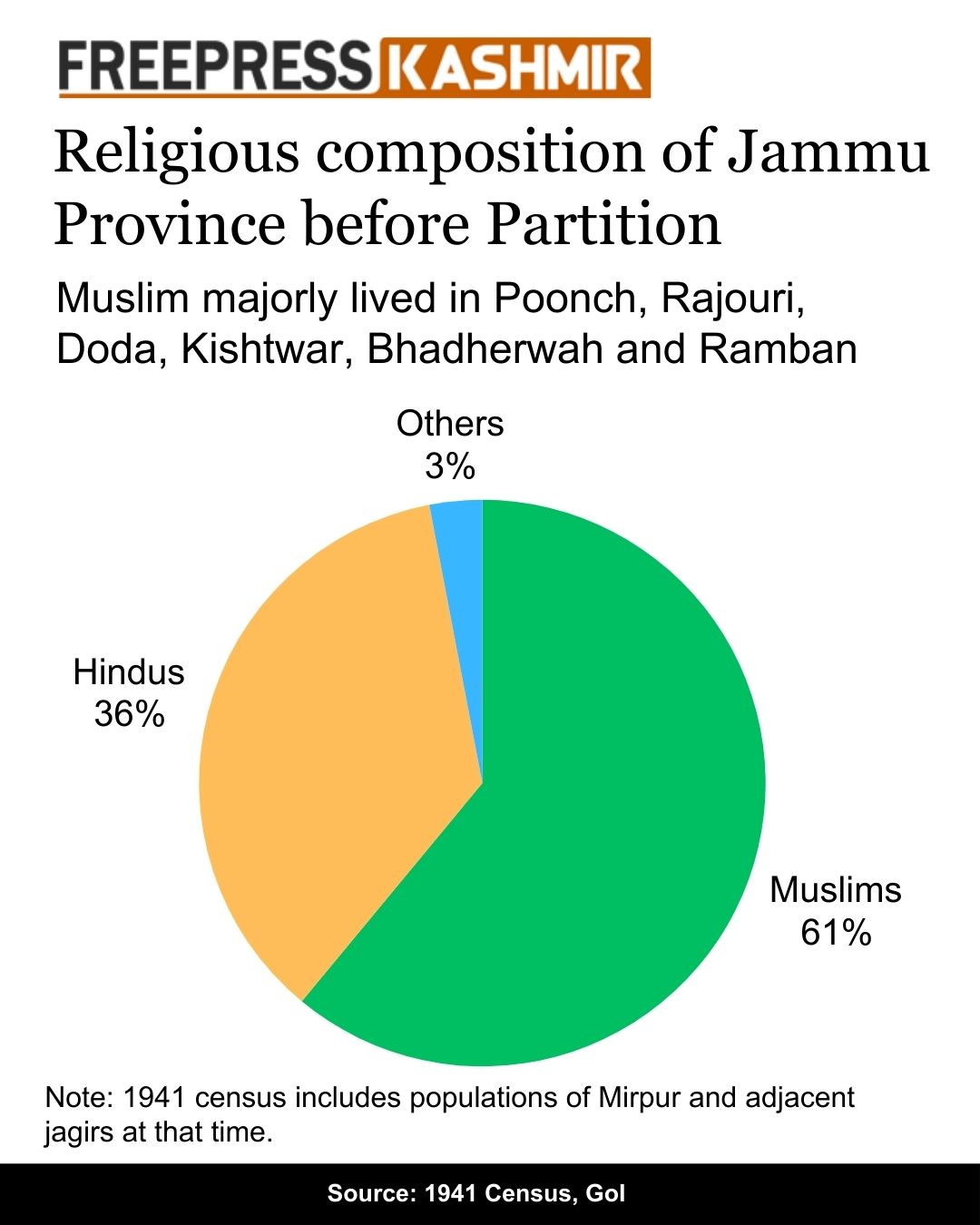
Historians agree that violence in Jammu in 1947 produced a decisive demographic rupture. Ian Copland, Christopher Snedden and Mridu Rai document mass killings, expulsions and forced displacement of Muslims across Jammu, Udhampur, Kathua and parts of Rajouri in October–November 1947.
Using the 1941 census as a baseline, scholars estimate that between 200,000 and 250,000 Muslims were killed or driven into West Punjab, reducing Muslims from a majority to a minority within months. Homes, shops and agricultural land were confiscated or redistributed, restructuring property ownership in favour of non-Muslims.
Copland and Rai describe the involvement of Dogra state forces and armed militias in the pogroms.
In the wider cycle of Partition violence, retaliatory massacres in Mirpur killed and displaced thousands of Hindus and Sikhs, as documented by Snedden.
Together, these events permanently altered Jammu’s demographic and political profile.
The end of Dogra power and Jammu’s political turn
Dogra sovereignty collapsed after the accession to India and the subsequent India-Pakistan war. Under Prime Minister of Jammu and Kashmir Sheikh Abdullah, early-1950s land reforms abolished landlordism without compensation, dismantling the feudal base of Dogra authority in Kashmir and parts of Jammu.
Rai shows that while these reforms redistributed land to predominantly Muslim peasants in Kashmir, they generated resentment among sections of Jammu’s Hindu elite, who experienced the reforms as dispossession and political marginalisation.
From the 1950s onward, demands for a separate Jammu or Dogra Pradesh and, in some cases, merger with Himachal Pradesh, entered regional politics.
This period also marked the consolidation of Hindu nationalist mobilisation in Jammu.
Scholars identify Jammu as an early and enduring base of the Rashtriya Swayamsevak Sangh, shaped by opposition to Kashmiri political dominance and resentment of land reforms.
Contemporary accounts cited by Ramachandra Guha and Rai note public celebration in parts of Jammu following the assassination of Mahatma Gandhi in January 1948, reflecting the depth of post-Partition polarisation.
Electorally, this alignment translated into sustained support for the Bharatiya Janata Party.
In the 2014 Jammu and Kashmir assembly elections, the BJP won 25 of the 37 seats in the Jammu region and entered government for the first time.
The party has since won both Jammu-region parliamentary constituencies, Jammu and Udhampur, in the 2014, 2019 and 2024 general elections. No comparable electoral footprint exists for the party in the Kashmir Valley.
Periodic communal flashpoints have reinforced this political trajectory.
In 2018, the rape and murder of eight-year-old Asifa Bano in Kathua became a national flashpoint when lawyers and political actors in Jammu publicly rallied in defence of the accused, framing the crime through communal and territorial narratives rather than as criminal violence.
The current demographics
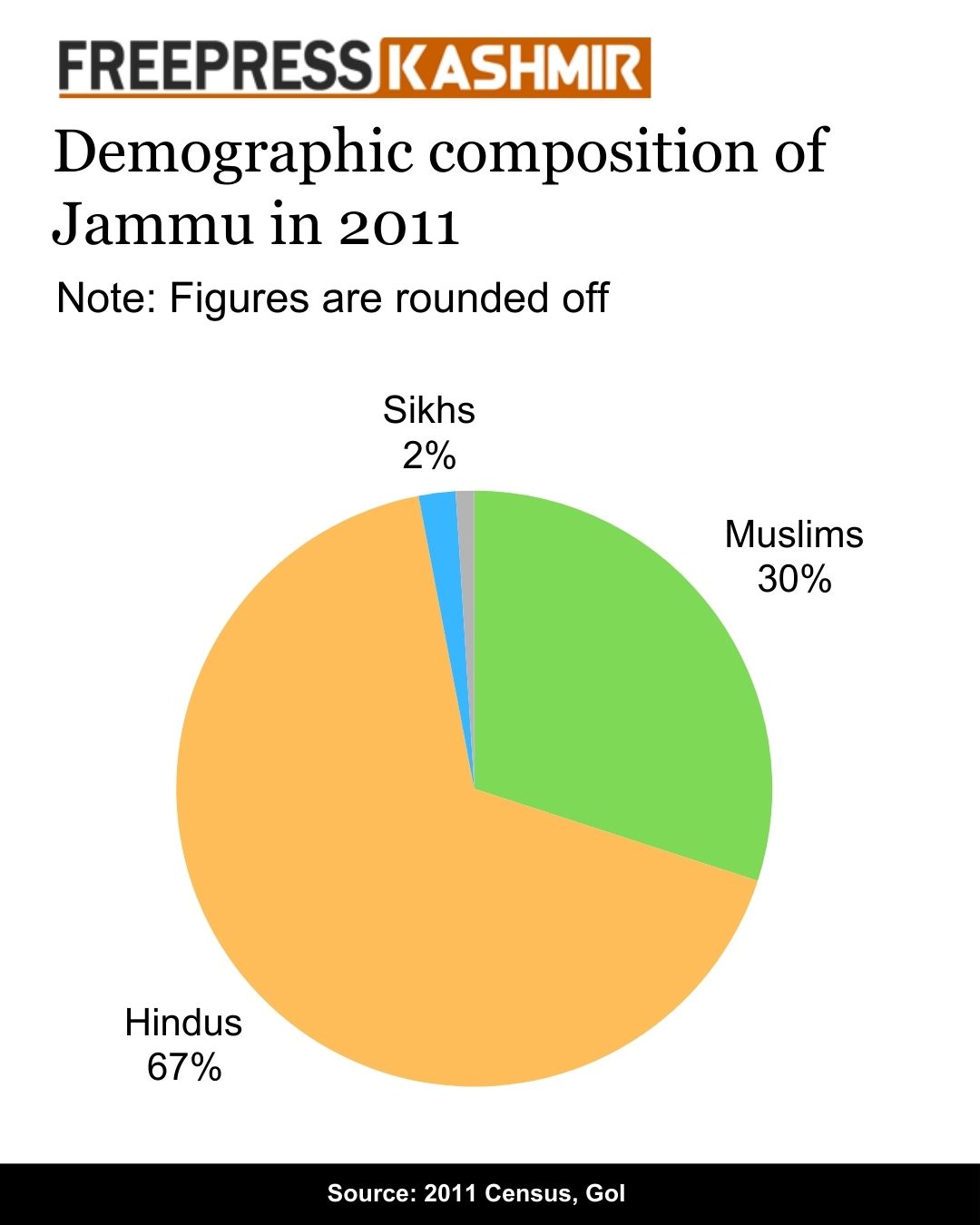
According to the 2011 Census of India, the Jammu division is ethnically heterogeneous, with Dogri-speaking (Dogra) Hindus comprising about 40–45% of the population, and Muslims around 30–33%, a category that includes Pahari- and Kashmiri-speaking communities as well as predominantly Muslim Gujjar–Bakarwal Scheduled Tribes, alongside Sikhs at roughly 4–5% and an estimated 10–12% Kashmiri Pandits and other Hindu migrants concentrated largely in and around Jammu city.
These proportions, however, are likely to change significantly once a new census is conducted.
Economics of the advantage
Economic divergence between Jammu and Kashmir is often cited by advocates of Jammu statehood as evidence that Jammu subsidises Kashmir.
Official data and economic surveys suggest the opposite.
From the early 1990s, sustained insurgency and shutdowns in the Kashmir Valley raised the cost of capital and insurance, effectively excluding manufacturing, warehousing, private finance and large-scale logistics.
Successive state Economic Surveys attribute output losses and investment flight directly to unrest.
Kashmir’s economy narrowed to horticulture, tourism, handicrafts and public employment, with repeated shutdowns imposing cumulative losses running into tens of thousands of crores over three decades.
Jammu, connected to Punjab and national highways and less exposed to sustained violence, absorbed these displaced sectors.
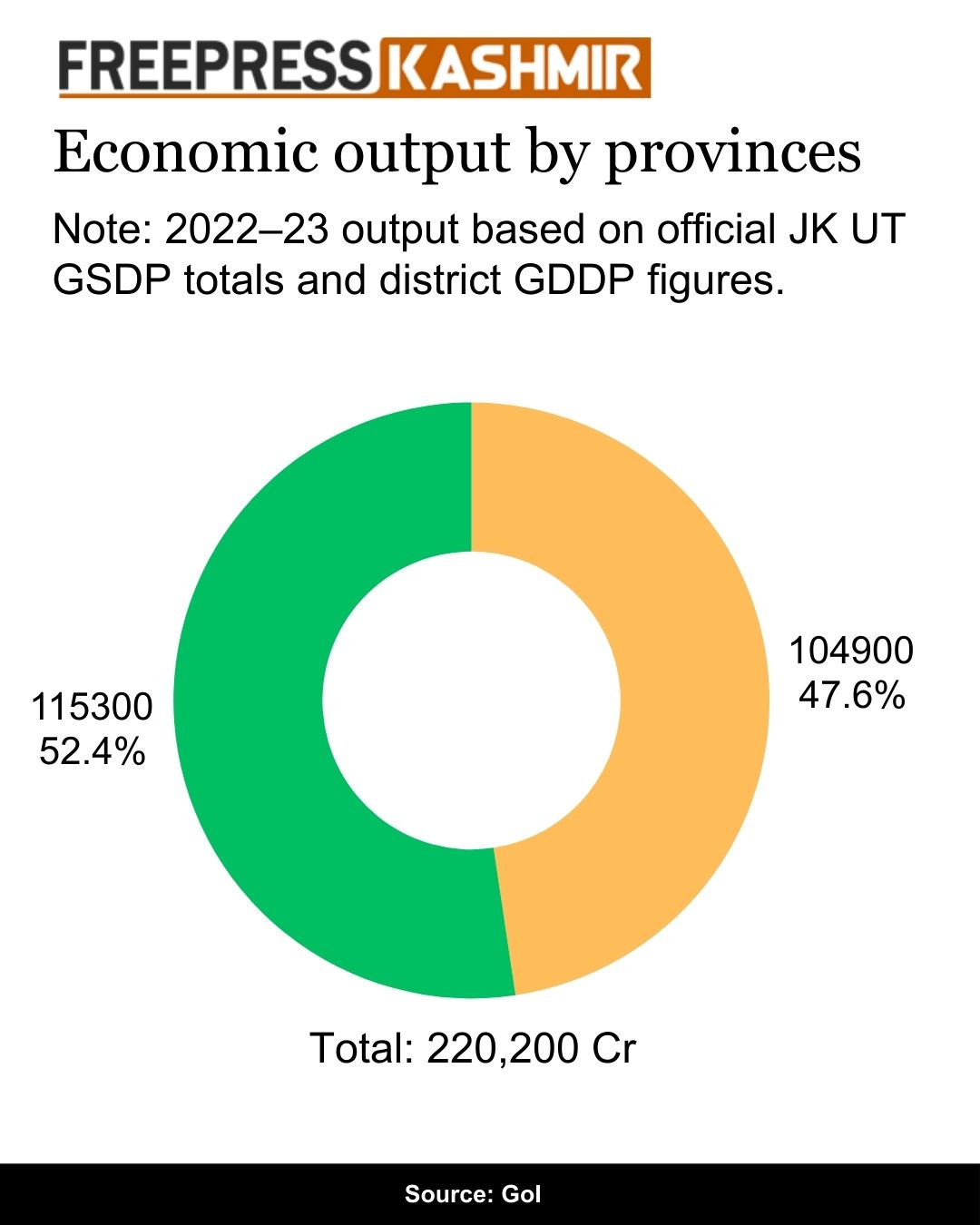
In 2022–23, Jammu district’s Gross District Domestic Product was approximately ₹39,995 crore, compared with ₹32,001 crore for Srinagar district. Services accounted for 60–64 per cent of the Union Territory’s GSDP, with trade, transport, storage, construction and administration disproportionately located in Jammu.
Kashmir dominated export horticulture, producing 1.6–1.7 million tonnes of apples annually, more than 95 per cent of total output, but downstream processing, storage and wholesale trade historically accrued to Jammu.
Estimated economic output of Jammu and Kashmir by province in 2022–23, based on official UT GSDP totals and district GDDP figures.
Subsidies, connectivity and dependence
Because Kashmir lacked all-weather connectivity and rail access, Kashmiri consumers depended on Jammu-based industries and wholesale markets for cement, steel, pharmaceuticals, FMCG goods and public-distribution supplies.
This dependence boosted Jammu’s turnover, tax base and service employment.
According to successive state industrial policy documents and Economic Surveys, industrial incentives including transport subsidies, capital investment support and pre-GST excise relief were implemented more consistently in Jammu, where firms could operate year-round and insure assets.
Post-2019 growth increased aggregate GSDP from ₹1.0–1.1 lakh crore in 2019–20 to approximately ₹2.25–2.65 lakh crore by 2024–25, without reversing this structure.
Rail integration into the Valley, according to Indian Railways and government planning estimates, is projected to reduce freight costs by 30–40 per cent, enabling direct sourcing from Delhi and NCR and expanding cold chains and agro-processing within Kashmir.
Reservations, employment and the long run
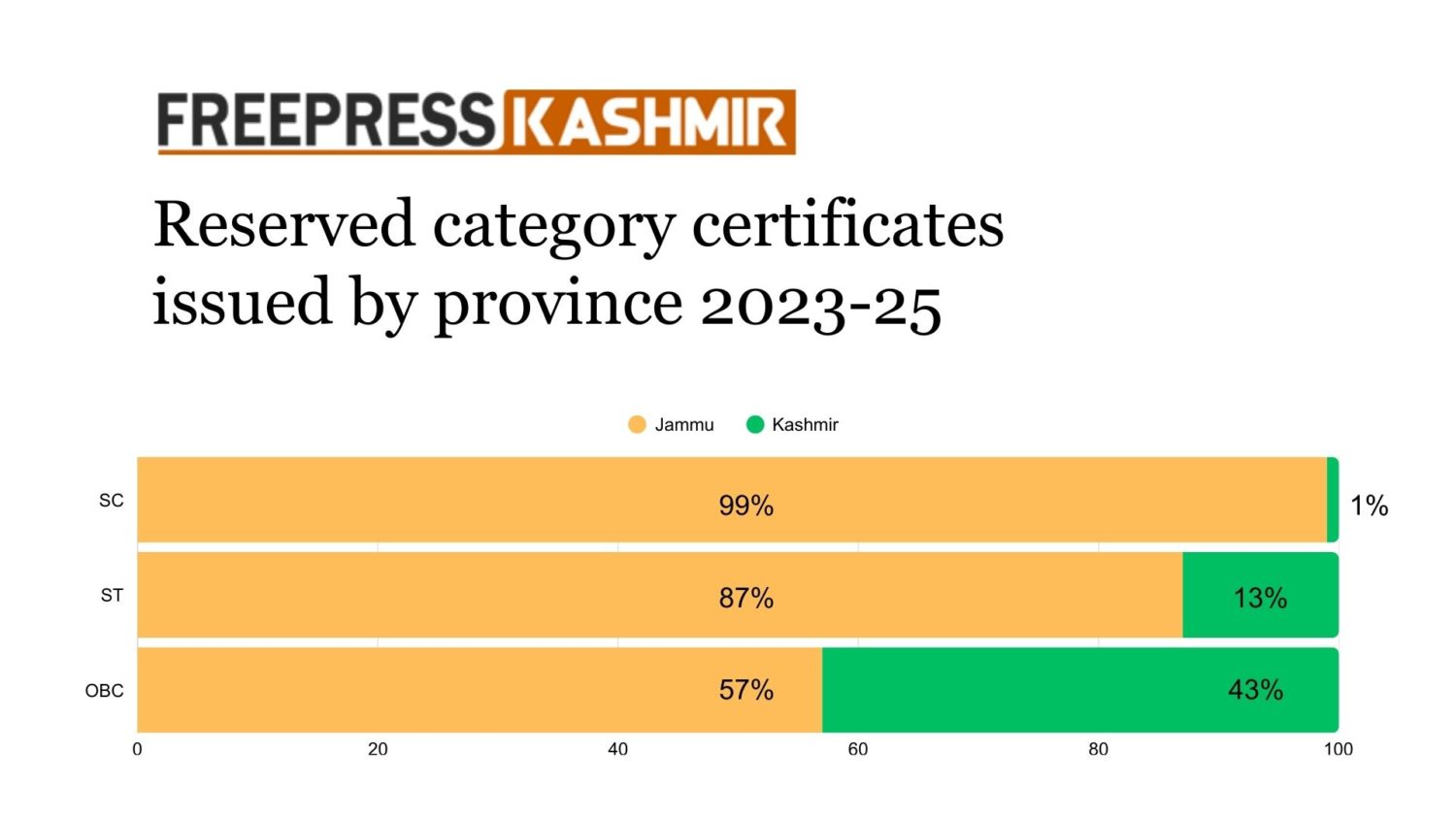
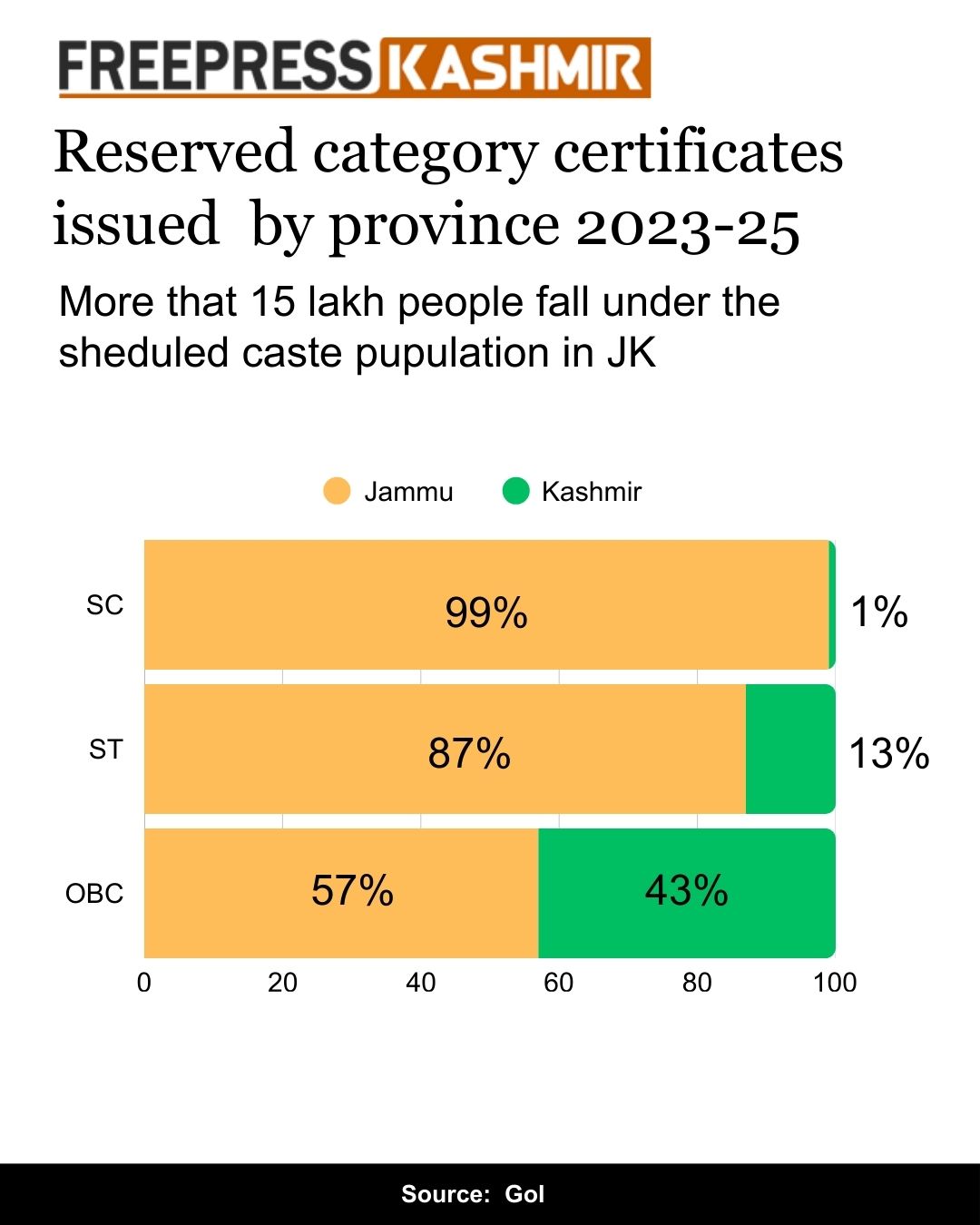
Affirmative-action policy further skewed outcomes. Scheduled Castes are virtually absent in the Kashmir Valley but concentrated in Jammu, meaning SC reservation benefits in public employment accrued overwhelmingly to Jammu over the decades.
While Scheduled Tribes, including Gujjars and Bakarwals, are present in both regions, earlier recognition and administrative access favoured the Jammu districts.
In an economy where government jobs provide the most stable income, this translated into a Jammu-heavy concentration of public-sector employment.
In a future administrative division, reservation benefits, particularly ST quotas, would be internalised within a Valley-dominated applicant pool, expanding access to public employment for Kashmiris.
Who is better off alone?
The data do not support the claim that either region is clearly better off alone.
Jammu’s relative prosperity was boosted, in part, due to Kashmir’s losses, while Kashmir’s underdevelopment subsidised Jammu’s rise.
Separation would redistribute advantages and vulnerabilities rather than resolve them.
Over the long term, improved connectivity is likely to reduce Jammu’s intermediary advantage and allow Kashmir to retain more economic value locally.
Jammu would retain political alignment with the Indian mainstream but lose some of the scale and strategic rents associated with administering a larger, conflict-sensitive region.