
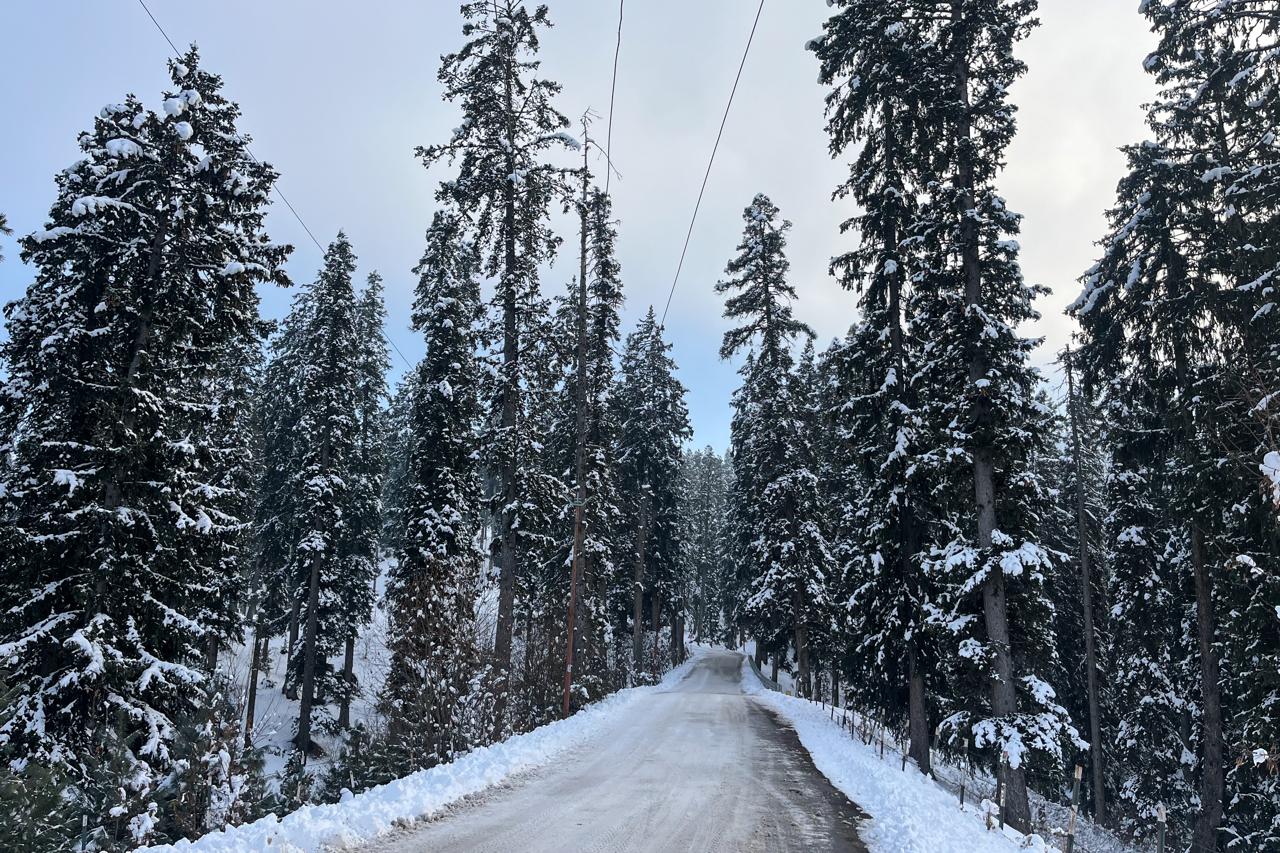

Srinagar: For Kashmir, winter is not merely a change of season. Snow is part of the region’s water system, its agriculture, tourism economy and mountain ecology. That makes the question of how much snow the Valley receives this winter more consequential than the usual seasonal conversation about whether Gulmarg will see a good ski season.
India has just come through a notably deficient southwest monsoon. The 2026 monsoon ended with the country receiving around 13% less rainfall than its long-period average, making it the driest monsoon in more than a decade, according to data reported from the India Meteorological Department. The country received 759.4 mm of rainfall against a long-period average of 868.6 mm.
Against that national backdrop, Kashmir is heading into another winter in which precipitation will matter enormously.
The region’s winter weather, however, cannot simply be read through the monsoon or El Niño. Kashmir’s winter precipitation is closely linked to Western Disturbances — weather systems that travel eastward from the Mediterranean and adjoining regions and bring rain and snowfall to the western Himalayas. The Indian Institute of Remote Sensing notes that these systems are particularly important from December to March and contribute to snowfall, water security and agricultural productivity across the western Himalayas.
That distinction is important because it makes Kashmir’s winter story less straightforward than a simple “El Niño means less snow” narrative.
The current El Niño nevertheless adds another layer of uncertainty. The IMD had warned ahead of the 2026 monsoon that El Niño conditions were developing and that such events are generally associated with weaker Indian monsoon rainfall. Government data also noted that the relationship is particularly pronounced during the latter part of the monsoon.
For Jammu and Kashmir, the immediate concern is not whether winter will arrive — it will — but what kind of winter it will be.
Jammu and Kashmir’s Meteorological Department has indicated that the region could experience a relatively mild and dry winter under the influence of El Niño, while cautioning that one or two significant snowfall spells cannot be ruled out. Director MeT Srinagar Dr Mukhtar Ahmad has also stressed that a definitive winter forecast this far in advance would be premature because atmospheric conditions can change.
That uncertainty is precisely what makes the coming months worth watching.
Kashmir has already experienced a worrying pattern of deficient winters. Data published earlier this year showed that Jammu and Kashmir’s December 2025-February 2026 winter precipitation was about 65 per cent below normal. An IMD-linked study published in MAUSAM has also documented precipitation trends and drought patterns across Jammu and Kashmir over the longer term, underlining the importance of both Western Disturbances and monsoon activity to different parts of the region.
The question, therefore, is not simply whether Kashmir gets snow in December or January. It is when that snow arrives, how much accumulates, and how long it stays.
That matters because snow in the Himalayas functions differently from a short spell of rain. Snow accumulated at higher elevations can remain through winter and melt gradually as temperatures rise. That delayed melt helps sustain streams and water availability beyond the immediate weather event. The IIRS notes that winter precipitation associated with Western Disturbances contributes to water security, agriculture and glacier mass balance in the western Himalayas.
A warmer winter complicates that equation.
Dr Ahmad has pointed to rising temperatures changing the form and timing of precipitation in the Himalayan region. Snow that arrives late or melts quickly does not necessarily provide the same long-lasting benefit as snow accumulated during the colder peak winter period.
For Kashmir’s farmers, that can eventually become a water question. For tourism operators, it can become a business question. For hydropower and communities dependent on mountain water, it becomes a resource question.
And for the Valley’s landscape, it is an ecological question.
This is why Kashmir offers a useful lens through which to view India’s larger climate story after the monsoon. The national rainfall deficit may be measured in percentages, but its consequences are experienced locally — in a mountain village waiting for snow, by a farmer watching water sources, or by a tourism operator looking at a bare slope in what should be the heart of winter.
There is also a danger in treating every unusual season as proof of one particular climate phenomenon. Weather systems are complex, and Kashmir’s winter is governed by several interacting factors. Scientific literature identifies Western Disturbances as a major source of winter precipitation in the western Himalayas, while recent meteorological assessments caution against attributing the region’s entire winter outlook to El Niño alone.
The more useful question, then, is not whether Kashmir is “losing winter”. It is whether the timing, reliability and persistence of winter precipitation are changing — and what that means for a region whose water cycle has historically depended so heavily on snow.
That is a story worth following through the winter.
Because in Kashmir, the absence of snow is never just about a white landscape. It can be an early signal of what the months ahead may hold for water, farms, tourism and the wider Himalayan ecosystem.
Sources: The India Meteorological Department (IMD) and the Ministry of Earth Sciences, including official 2026 monsoon and El Niño assessments; the Indian Institute of Remote Sensing (IIRS) for research on Western Disturbances and their role in Himalayan precipitation; the peer-reviewed MAUSAM journal for research on precipitation trends and drought climatology in Jammu and Kashmir