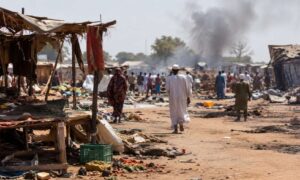


More than 100 people were killed and 113 others injured in a drone strike allegedly carried out by the Sudanese military on a crowded market in Nyala, the capital of South Darfur, a rights monitoring group said on Tuesday, as attacks involving drones continue to inflict heavy civilian casualties amid the country’s ongoing conflict.
Emergency Lawyers, a group monitoring violence in Sudan, said the strike occurred on Monday evening, with women and children reportedly among the victims. The group attributed the attack to the Sudanese military and called for an independent investigation.
Condemning the strike, the group said the attack had turned a civilian marketplace into a scene of mass casualties, adding to the suffering of people caught in the conflict.
Doctors Without Borders, known by its French acronym MSF, said 36 bodies had been brought to its hospital in Nyala, while approximately 150 injured people received treatment in its emergency department.
Nyala is under the control of the paramilitary Rapid Support Forces (RSF), which has been fighting Sudan’s military since April 2023. Both sides have increasingly deployed explosive-laden drones, with attacks affecting civilian facilities, including hospitals, schools, markets, dams and displacement camps.
The United Nations has warned that drone strikes have emerged as a major threat to civilians in Sudan, claiming lives, including those of children, and disrupting essential services.
Drone strike disrupts electricity in Khartoum
In a separate incident, large parts of Sudan’s capital, Khartoum, experienced power outages lasting more than 12 hours on Tuesday after a drone strike hit a major transformer station in Omdurman, near the capital.
The attack on the Al-Markhiyat transformer station disrupted electricity supplies, forcing hospitals and bakeries to rely on generators and affecting water services.
An official from the electricity company told the Associated Press that the strike could impact around 60 per cent of Khartoum’s power supply, with water stations among the facilities likely to face significant disruption.
The official, who spoke anonymously, blamed the RSF for the attack and said it was the second strike on the facility this year.
The state-run Sudanese Electricity Distribution Company confirmed extensive damage and technical faults across the power distribution network, including at major substations and transmission lines. It said repair teams were working continuously to restore supplies, warning that power rationing could continue for an extended period.
Residents described severe difficulties caused by the outages. A resident in southern Khartoum said electricity and water had been unavailable for 17 hours, raising concerns about keeping insulin refrigerated. The resident also warned that bakery closures could worsen bread shortages and drive up prices.
Drone attacks in Khartoum had become less frequent after the Sudanese military recaptured the capital in May 2025. The latest strike, however, has renewed concerns over the security of critical infrastructure.
Sudan’s humanitarian crisis worsens
The conflict began in April 2023 after tensions between Sudan’s military and the RSF escalated into open fighting in Khartoum. The violence has since spread across the country, triggering what the United Nations describes as the world’s largest humanitarian crisis.
According to conflict monitor ACLED, at least 59,000 people have been killed, although humanitarian organisations believe the actual toll could be considerably higher.
Around 34 million people require humanitarian assistance, while more than 67 per cent of the population depends on aid, according to figures cited in the report.
Approximately 825,000 children are facing acute malnutrition. The Integrated Food Security Phase Classification (IPC), a global food security monitoring initiative, has also warned that deteriorating conditions in greater Darfur and Kordofan are increasing the risk of famine.
In a joint statement, more than 30 countries, including the United States and the United Kingdom, along with the European Commission, called on the warring parties to remove all barriers to humanitarian assistance.
As fighting and drone strikes continue, civilians face growing dangers from attacks on populated areas, worsening food insecurity and disruptions to electricity, water supplies and healthcare services.