

You might have heard someone say, “why do you get offended if I wear a firan-kurti like a dress, in my own way? I wear it because I love Kashmiri culture, not because I mean disrespect.”
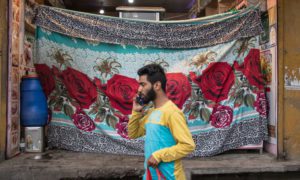
Well, to begin with, the traditional attire of Kashmir is Phyerann (pronounced as “phay-ruhn).
This comment, on the surface, might seem innocent—perhaps even flattering to those who take pride in their culture.
But it’s more than just a simple misunderstanding. It’s an example of cultural appropriation, and understanding its problematic nature requires a deeper dive into the concepts of cultural appreciation, cultural assimilation, and, of course, the elephant in the room—cultural appropriation.
What exactly is meant by culture and its appropriation?
English scholar Sir Edward B. Tylor (1832–1917) was a founding figure of cultural anthropology. Tylor defined culture as “the complex whole which includes knowledge, belief, art, law, morals, custom, and any other capabilities acquired by man as a member of society.”
Cultural appropriation occurs when members of a majority group adopt cultural elements from a minority group in a manner that is exploitative, disrespectful, or superficial.
Often, this adoption is driven by a desire to profit, either financially or socially, without any understanding or acknowledgement of the cultural significance behind the adopted elements.
Instead of appreciating the history, values, and struggles associated with these cultural elements, they are often used as a form of entertainment, fashion, or spectacle, making the original culture appear trivial or laughable.

Cultural appropriation is increasingly getting criticised on a global scale.
Hollywood has often faced backlash for insensitivity toward indigenous cultures. In 2013, Katy Perry was accused of cultural appropriation for dressing as a Japanese geisha.
Similarly, J.K. Rowling faced criticism for using Native American culture in her Pottermore series, particularly regarding “skin walkers” and medicine men.
Adrienne Keene, founder of Native Appropriation, stated, “you can’t just claim and take a living tradition of a marginalised people.”
Kashmir, once a vibrant hub of rich heritage, traditions, and art, is no exception to cultural appropriation and is sadly being reduced to a mere commodity in the hands of cultural appropriators with each passing day.
Appropriation of Kashmiri attire
Locals are often barred from wearing their cultural attire, like the Phyerann, in public spaces like offices, schools, and restaurants.
For instance, a renowned hotel in Srinagar refused a guest and his family service simply because they were wearing the traditional garment with respect.
However, outside Kashmir, people wear the Phyerann as an exotic fashion item and even sell mass-produced versions for high profits.
While wearing the Phyerann by a non-Kashmiri may not necessarily be cultural appropriation; ridiculing locals for wearing it and profiting from selling Phyerann without regard for their cultural significance crosses the line into appropriation.
Not to mention the significant financial losses local artisans face.
These skilled craftspeople create handcrafted Phyerann and luxurious Pashmeen shawls using the highest quality fabrics, pouring time and effort into their work.
Yet, they struggle to find buyers who will pay a fair price, as cheaper, mass-produced copies flood the market.
These replicas, sold at a fraction of the cost, undermine the value of the artisans’ work, leaving them unable to earn a living wage for their craft skills.
Appropriation of the Kashmiri cuisine
Cultural appropriation often seeps into cuisines, especially when traditional dishes are altered to make them more palatable or acceptable to outsiders.
Take Wazwan, one of the most unique and exotic cuisines in the world.
Its origins trace back through the Silk Route, influenced by Persia (modern-day Iran), Uzbekistan, and Afghanistan, ultimately shaping the distinctive style we see today in Kashmir.
Mastering Wazwan takes decades of training for a young chef or waaze, who must hone his skills to eventually become the head chef capable of orchestrating this culinary spectacle.
Beyond its rich flavours, Wazwan is also a visual delight, served on a traditional copper plate called a Tream, which is shared amongst four people.
Non-locals are always welcome to enjoy Wazwan in its original form. However, when the traditional Traem is replaced with a “Wajjwan Thali” to cater to those accustomed to eating in individual servings, the essence of Wazwan is lost.
This alteration strips the dish of its cultural significance and appropriates the tradition, turning it into a commercialized version that lacks its authentic context.
It’s truly disheartening to see how even subtle changes to the names of our traditional dishes—like altering “Riste” to “Ristaa”, “Goshtaabe” to “Gushtabaa”, or “Marstwaangan Qoarme” to “Mirchi-Kormaa”—are slowly eroding the authenticity of our cultural cuisine.
This feels like a gradual dilution of something that holds so much history and meaning.
A personal anecdote highlights the subtle yet significant issue of cultural misrepresentation. One day, my young daughter came home from school, excitedly exclaiming, “Mama! I found a book about Kashmir called ‘Mazzoo Mazzoo’ in my school library!”.
Eager to read it to her, I was thrilled to share a piece of our heritage.
The book’s premise revolved around a popular Kashmiri dish from Wazwan called Marstwaangan Qoarme, a hot and spicy lamb curry.
In the story, the family is faced with the dilemma of unwanted guests who refuse to leave unless they are served this iconic dish.
However, as I read the book, my excitement turned to horror.
The recipe presented in the book featured eggplant as the main ingredient, replacing the traditional lamb.
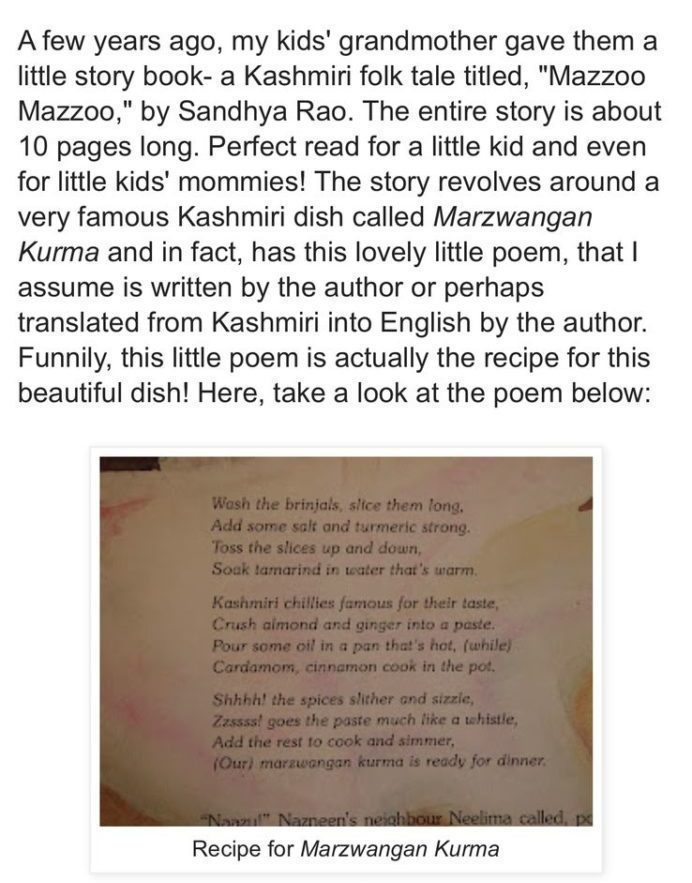
While the focus of the story was likely on the plot for young readers, the casual alteration of such a beloved dish to make it more “acceptable” or “vegetarian” for non-Kashmiri readers felt like a gross misrepresentation.
This was one of the primary reasons I felt compelled to establish a children’s publishing house—The Quillers’ Club—to write Children’s books about Kashmiri culture—authentically and unapologetically—without distorting its traditions for the sake of external comfort.
The true essence of culture lies in its authenticity, and tampering with it undermines the rich history it carries.
Other instances of appropriation in Kashmir
Cultural appropriation has quietly infiltrated various aspects of Kashmiri culture in subtle yet harmful ways.
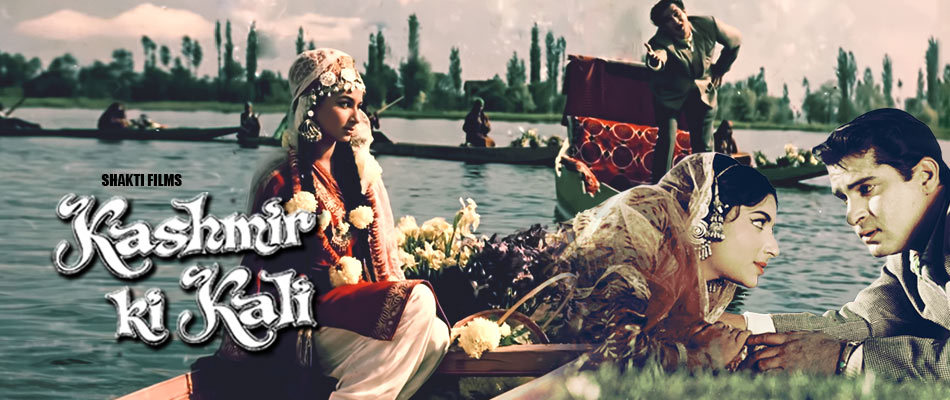
One example is the portrayal of girls wearing the traditional Kashmiri headgear, Qasaab, as background dancers in performances where dance was never part of our tradition.
The Kasaab was never just a prop; it held deeper cultural significance.
Furthermore, transforming traditional folksongs like Bombro Bombro, Rind Posh Maal, and Hukus Bukus Teli Wann Tche Kus into degraded Bollywood versions, rather than preserving their authentic essence, is a disservice to our original musicians and the rich tradition of fine arts.
Similarly, modifying the names of Kashmiri places like Sopar, Kopwor, Batmalyun, and Razay Kadal to Sopore, Kupwara, Batamaloo, and Rajaouri Kadal for ease of pronunciation by non-locals oversimplifies and diminishes their cultural value.
Mocking our accent while donning our prestigious Phyerann and creating reels laced with crass humor, or obsessing over the lighter skin tone of Kashmirs with products for “Kashmiri skin,” further perpetuates stereotypes.
Demeaning Bhojpuri lyrics like “Bhai ki shadi rachayengay, bhauji Kashmir se layengay,” which translates to “We will get our brother married to a Kashmiri girl,” reduce our culture to an object of fetish rather than respect.
View this post on Instagram
Does this mean people from different cultures shouldn’t enjoy what Kashmiri culture has to offer? Absolutely not.
Cultural exchange is vital for growth and mutual understanding.
However, this exchange must occur within the boundaries of respect and genuine appreciation. It’s crucial to avoid causing financial loss to local artisans, mocking their traditional attire and dialect, or reducing the people of Kashmir to mere objects of beauty.
We welcome non-locals to buy Phyerann and shawls from local artisans and to wear them with respect, taking the time to understand their origins and significance.
Similarly, enjoy our Wazwan in its authentic form, without diluting its flavors or names to suit external sensibilities. Culture is a symbol of respect, pride, and heritage. It should be celebrated and appreciated, not appropriated.