

In an increasingly interconnected world, migration has become a part of many people’s lives. Whether for education, employment, or better opportunities, moving away from home often changes the way we view our identity.
For Keashyir living across the globe, distance frequently deepens their connection to their language, traditions, and cultural heritage.
This reflection explores how being far from home can strengthen the desire to preserve one’s roots and why passing that legacy on to future generations matters more than ever.
It is often only when we move away from home that we truly begin to understand the value of our language, culture, and traditions.
Distance creates a sense of appreciation.
We realise that these are not just customs we inherit; they are a part of our identity that we carry with us wherever we go.
Naturally, we also want to pass them on to the next generation.
This realisation comes in different ways. Sometimes it comes from missing home and everything associated with it.
Other times, it comes from observing people from other cultures who proudly preserve their languages and traditions across generations.
They do not feel the need to abandon their mother tongue to fit into society; instead, they ensure that their children inherit both their language and cultural heritage.
As Keashyir, however, we often find ourselves in a different situation. Many of our children grow up speaking Urdu or English, while Kashmiri gradually disappears from daily life.
I do not believe this is simply the fault of parents. The reality is that our social and educational structures have long been built around Urdu and English.
Whether it is school admissions, professional opportunities, or social acceptance, these languages are often seen as essential, leaving little space for Koshur.
Yet, when Keashyir move abroad, something interesting happens. Living far from home often strengthens the desire to stay connected to one’s roots.
Across countries like the UK, Germany, and the United States, many Keashyir families make conscious efforts to preserve their heritage.
Whether it is traditional utensils, food items, clothing, festivals, weddings, or community gatherings, people carry pieces of Kasheer with them wherever they go.
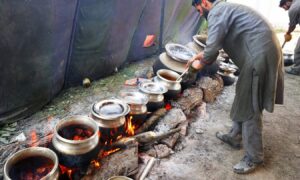
There is another noticeable difference. Back home, when there is a large gathering or celebration, we usually rely on a Waaze to prepare the traditional feast.
But abroad, people often learn these skills themselves.
Men and women alike become excellent cooks, mastering dishes that many would never think of making at home.
From Riste, Goshtab, Yakhyin, Hearisse, Meathi-maaz, Doon-cxhyot and Gandde-cxhyot to traditional bakery items, people proudly learn, prepare, and share these foods with fellow Keashyir.
In a way, preserving the cuisine becomes a way of preserving a connection to home.
What stands out even more is that I have met many Keashyir families whose children were born abroad, yet the parents make a deliberate effort to ensure that Kashmiri becomes their child’s first language.
They understand that language is more than a means of communication. It carries history, memories, values, and a sense of belonging.
Unfortunately, there are also people living in Kasheer who do not see the importance of teaching Koshur to their children.
They may believe that English or Urdu alone will be enough for the future. But one day, those same children may ask a difficult question:
“Why was I kept away from my own language, culture, and traditions?
Why was I not given the opportunity to know a part of who I am? Why did you not teach me the language of my grandparents and ancestors?”
That is a question many parents may find difficult to answer.
Giving a child their mother tongue does not take anything away from them; it gives them an identity, a history, and a deeper connection to where they come from.
Perhaps that is the irony of migration.
Sometimes it is only after leaving home that we fully recognise the importance of preserving what home has given us.
The farther we are from home, the more we value the things that define us.
As the Koshur saying goes, “Ghar wadas baar azzaen sah” — the worth of home is often realised when one is away from it.
No matter where life takes us, we should never forget our roots.
Languages, traditions, food, memories, and culture are not burdens from the past; they are the threads that connect us to our ancestors and to future generations.
You can travel anywhere in the world, but a part of you will always belong to the place you call home.
Our roots are not something to leave behind; they are something to carry forward.
Preserving a language or tradition is not merely an act of nostalgia; it is an investment in the future.
Every generation inherits a cultural legacy and bears the responsibility of passing it on.
The experiences of Keashyir living abroad show that distance can often rekindle an appreciation for identity and belonging.
Perhaps the lesson is simple: we should not wait until we are far from home to recognise the value of what we have. By nurturing our language, customs, and shared memories today, we ensure that future generations remain connected to their heritage, wherever in the world they may be.