

Srinagar: The Group of Concerned Citizens (GCC) on Wednesday submitted a detailed representation to the Jammu and Kashmir Legislative Committee, raising alarm over a wide range of urgent environmental and public health issues in the region.
The group expressed concern over the worsening climate crisis, pointing to unprecedented heatwaves, erratic rainfall, and declining snowfall in Jammu and Kashmir. These changes, it said, stem not only from global warming but also from local factors such as unregulated construction, deforestation, and rising vehicular emissions.
The GCC flagged a lack of transparency around the Union Territory’s revised Climate Action Plan and the progress made toward India’s Net-Zero 2070 targets. It demanded a thorough review of afforestation initiatives and the urgent implementation of low-carbon, climate-resilient development policies.
Vehicular pollution was also highlighted as a pressing issue, with the group noting that Jammu and Kashmir ranks third in the country in terms of household vehicle ownership, at 23%. This has led to a significant decline in urban air quality.
To address this, the GCC proposed introducing an odd-even vehicle movement policy in major cities, expanding and electrifying public transportation through trams and CNG or electric buses, and reviving the Pollution Control Committee, which has seen reduced effectiveness since the region’s constitutional status was altered.
The GCC raised serious questions over flawed or missing Environmental Impact Assessments (EIAs) for major infrastructure projects, including tunnels on the Srinagar-Jammu highway and the Panjtarni–Amarnath route.
It warned that such lapses could lead to increased landslides, soil instability, and water shortages. Exemptions granted to security-related projects, particularly near border areas, often bypass forest and environmental clearances, it said.
The group called for an immediate audit of 5 to 10 key projects to check for EIA compliance and demanded greater transparency in the process.
Another area of concern was the large-scale and unregulated conversion of agricultural land, following recent amendments to the Agrarian Reforms and Land Revenue Acts. The group said this trend threatens long-term food security and ecological balance. It recommended encouraging vertical housing developments while placing stricter limits on the conversion of farmland to non-agricultural uses.
The GCC drew attention to the steady decline of major lakes and rivers across the region. It cited the deteriorating condition of Dal Lake, the underfunded efforts at Wular, neglect of Anchar, and the precarious state of Manasbal.
It also mentioned that rivers such as the Jhelum, Tawi, and Chenab are suffering from encroachments, untreated sewage, and plastic pollution. The group demanded that the government launch dedicated river restoration initiatives similar to the Ganga and Yamuna clean-up drives. It suggested empowering local bodies and NGOs to lead such efforts, citing the recent revival of Khushalsar and Gilsar lakes by the NGO Ehsaas as a successful model.
Glacier retreat was flagged as another urgent issue. The GCC noted rapid melting due to reduced snowfall and rising temperatures and urged the Legislative Committee to enact a Glacier Protection Bill and establish a Glacier and Climate Data Authority to monitor and mitigate the impacts of climate change on the region’s glaciers.
Concerns were also raised about the state of wetlands and wildlife sanctuaries. The group said Ramsar sites such as Hokersar and Surinsar-Mansar were under threat due to encroachments, pollution, and poor management. It requested that the Committee conduct on-site assessments and independently verify data concerning migratory bird populations and wetland health.
Solid waste management, especially plastic pollution, was flagged as a major public health risk. The GCC said the Achan dumping site posed a severe hazard and lacked scientific management.
Dr Fiaz Fazili, a healthcare policy analyst and safety expert, informed the committee that toxic emissions from the site were linked to rising cases of cancer, infertility, respiratory illnesses, and allergies among people living nearby. The group called for immediate testing of toxic gas levels in line with OSHA standards and the issuance of public health advisories.
It also said the existing ban on single-use plastics was not being effectively implemented and advocated for the enforcement of the polluter-pays principle, greater private sector involvement in waste management, and the promotion of biodegradable alternatives.
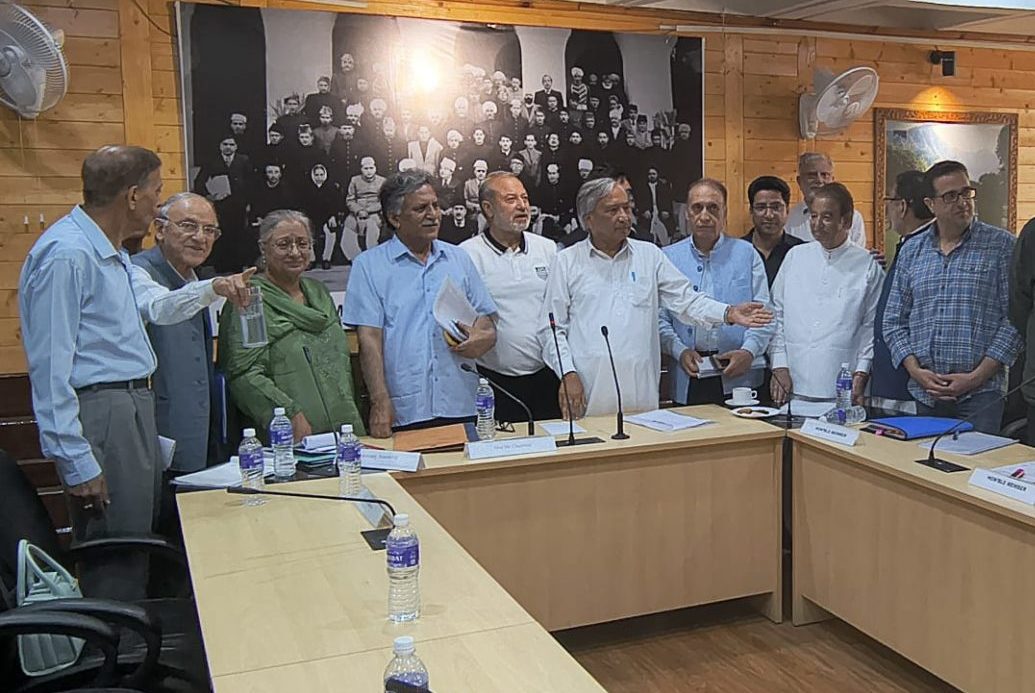
In response, committee chairman MY Tarigami acknowledged the seriousness of the issues raised and assured the GCC of early and prompt action. Former Town Planner Er. Iftikhar Hakim also stressed the need for strong legislative measures to protect water bodies.
In its concluding appeal, the GCC urged the Committee to expedite environmental policy reforms, enforce existing environmental laws strictly, and institutionalise the involvement of citizens, NGOs, and experts in restoration and conservation efforts across Jammu and Kashmir.
The meeting was attended by several Members of the Legislative Assembly (MLAs) from the government side, including M.Y. Tarigami, Peerzada Mohammad Syed, Irshad Kar, Zafar Khatana, Feroz Ahmad, Mushtaq Guroo, and Yudvir Sethi.
Representing the Group of Concerned Citizens (GCC) in the meeting were Khurshid Ahmad Ganai, retired IAS officer, former Advisor to the Governor, and Chairman of GCC JK; G.H. Kango, retired IFS officer and former Principal Chief Conservator of Forests, JK; G.J Nehvi, retired IAS officer and former Chief Secretary; Abdul Rashid Khan, retired IPS officer and former Inspector General of Police; Ab Majid Bhat, a geo-scientist; Ms Naseem Lankar, retired IAS officer and former Divisional Commissioner, Kashmir; Latif-ul-Zaman Deva, retired IAS officer and former Chairman of the Jammu and Kashmir Public Service Commission; Khaleeq-ul-Zaman Butt, former Principal District and Sessions Judge; Syed Kifayat Hussain Rizvi, retired IAS officer and former Chief Secretary; Dr. Fiaz Fazili, healthcare policy analyst; Er Hakim Iftikhar, former Chief Town Planner, JK; Er. Iftikhar A. Drabu, Head of Nordics at ICRC, WSP India; and Mohammad Rafi, former Director/Mission Advisor, School Education, JK Government.