

Kashmir’s vaccine campaigns are buckling under the pressure of high temperatures, misinformation, and poor outreach, leaving a generation at risk.
At 7:30 am, Razia straps on her canvas vaccine carrier and ties a scarf around her face to keep the dust out. The village hasn’t cooled from the night before. The air smells like metal and dry wheat.
She has twelve houses to visit before noon.
By the time the sun climbs over the treeline, the narrow paths between homes in this Bandipora hamlet shimmer with heat. Razia moves fast. The vaccines she carries, doses of measles, polio, and pentavalent, must stay cold. The block health centre freezer has been unreliable for weeks, and the last shipment nearly thawed mid-route.
At one door, a young mother lets her in. The child is silent and skinny. Razia unpacks the vial quickly.
A few homes later, a man steps outside and shakes his head before she speaks. He won’t explain, and doesn’t have to.
“I just write it down,” Razia says, lifting her ledger. “Refused. Try again later.”
Across Kashmir, frontline health workers like her are racing not just against the sun but against a slow-burning crisis in public health: a growing immunisation gap, worsened by heat, distrust, and fragile infrastructure.
On paper, Kashmir seems to be ahead of the curve. The National Family Health Survey (NFHS‑5) shows that between 2019 and 2021, the region reached 86 percent full immunisation for children aged 12 to 23 months, outperforming India’s national average of 76.6 percent.
But field reports and local clinic data tell a less reassuring story.
In Doda, only 66 percent of children received all basic vaccines. In Kupwara and Shopian, field nurses say nearly 30 percent of eligible children never complete the three-round pentavalent course. Many begin the process, then drop out before the second or third dose.
“Most refusals aren’t confrontational,” says a health supervisor in Pulwama. “People simply don’t come back. Or they tell us they’ll do it later. But they don’t.”
The reasons are layered: some rooted in long-standing fears about vaccine safety, others in crumbling logistics that make reliable delivery nearly impossible during the summer months.
Routine immunisations depend on a delicate cold chain, a temperature-controlled supply network that must remain intact from the manufacturer all the way to a remote village doorstep. That chain is fraying.
In June, a freezer breakdown in central Kashmir wiped out a full batch of measles vaccines. Nurses say they were instructed to “dispose quietly” and reorder, but the damage had already spread.
“People heard,” said Razia. “Some families refused vaccines after that. They said, ‘We heard the medicine is spoiled.’ I didn’t know what to say.”
With temperatures hovering near 40°C and electricity cuts lasting four to six hours daily in some villages, vaccine carriers filled with ice packs are simply not enough.
By noon, many workers report that their coolers are leaking and the ice is melting.
“You can’t tell a child’s mother that this shot is life-saving when you’re not sure it hasn’t overheated,” Razia says. “But we give it anyway. What else can we do?”
The mistrust isn’t limited to families. A 2021 study surveying more than 500 health workers across Kashmir found that 31 percent expressed doubts about vaccine safety, and 10 percent had refused vaccines themselves.
“This is a serious red flag,” says Dr. Sadiya Malik, a paediatrician in Srinagar. “When health workers carry the same fears as the people they serve, the system loses credibility at both ends.”
She traces the problem to poor training, sporadic government messaging, and the ease with which misinformation spreads on WhatsApp and YouTube.
“Rumours fill the space where clear information should be,” Dr. Sadiya says. “Side effects get exaggerated. Parents are told that fertility will be affected. Some think the shots are part of a conspiracy.”
India’s flagship Mission Indradhanush and its intensified version (IMI) were designed to fix exactly these kinds of gaps.
Between 2015 and 2021, national full immunisation coverage rose from 62 to 76 percent.
A cost-effectiveness analysis of IMI found that in just 40 districts, 2.2 million additional doses were administered in 2017–18, potentially saving over 1,400 lives.
But implementation in strife-stricken, geographically isolated districts like those in Kashmir has been inconsistent. Local health departments cite shortages of field workers, frozen incentive payments, and rising attrition among ASHA and ANM staff.
“They’re being asked to do heroic work for ₹1,000 a month,” says Dr. Nusrat Wani, another paediatrician based in Srinagar. “It’s not sustainable.”
She wants the government to prioritise localised strategies: community influencers, religious leaders, and female outreach workers trained in cultural sensitivity.
But while traditional vaccines battle heat and hesitancy, newer vaccines like HPV face a different wall: stigma.
In 2024, pilot HPV drives in Srinagar and Budgam saw abysmally low uptake. Despite WHO data showing a jump from 17 to 31 percent global coverage since 2019, Kashmir’s progress has been near zero.
“People won’t even talk about it,” says Dr. Wani. “You mention cervical cancer, and the room goes silent. No one wants to discuss reproductive health.”
Without long-term public education and the support of schools and local leaders, doctors say Kashmiri girls are unlikely to benefit from HPV immunization anytime soon, even though it could save lives decades down the line.
Back in Bandipora, Razia finishes her rounds by late afternoon. She’s been walking since sunrise. Her carrier is light now, only four doses administered.
She pauses under a poplar tree and opens her notebook. Five refusals today. One promise to reconsider. She writes it down and circles it in blue ink.
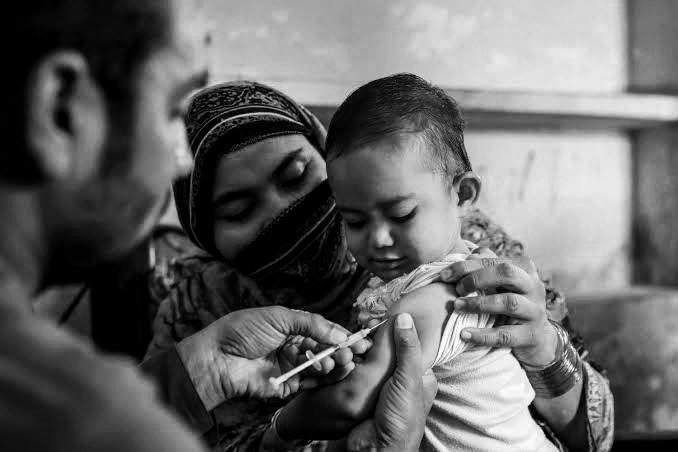
Still, there’s one house, the second one she visited. A young mother steps aside and lets her in. The child, around 15 months, doesn’t cry. Razia pinches the thigh and gives the shot.
In this long summer of missed vaccinations, melting ice packs, and fraying trust, this single shot does more than deliver a dose. It keeps the door open for tomorrow and the day after that.
And sometimes, in a place like Kashmir, that one opening is enough to begin again.