
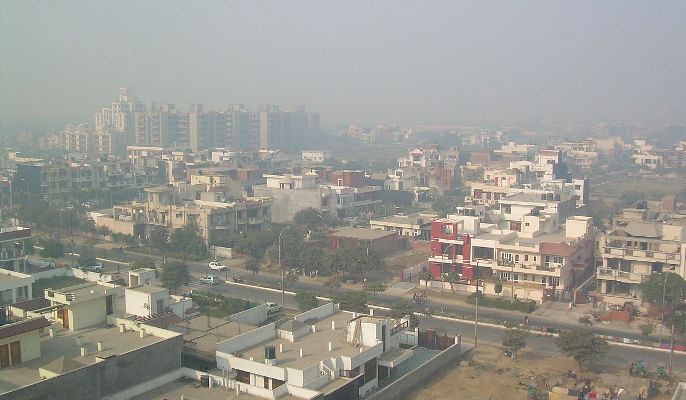

New Delhi: A blanket of smog covered the national capital of India on Diwali morning as Delhi’s air quality index (AQI) slipped into the “very poor” category, crossing the 300 mark.
As per data from the SAMEER app of the Central Pollution Control Board (CPCB), the city’s overall AQI stood at 339 at 9 am, with most of its 38 monitoring stations recording levels above 300.
Among the worst-affected areas were Anand Vihar (414) and Wazirpur (412), both falling in the “severe” category. Other locations, such as Bawana (369), Pusa (371), and Ashok Vihar (394), also reported “very poor” air quality. In contrast, Sri Aurobindo Marg (165) and DTU (198) fared slightly better.
An AQI reading between 0–50 is considered “good,” 51–100 “satisfactory,” 101–200 “moderate,” 201–300 “poor,” 301–400 “very poor,” and 401–500 “severe.”
Following rising pollution levels, the Commission for Air Quality Management (CAQM) enforced Stage II of the Graded Response Action Plan (GRAP) across Delhi-NCR. The decision came after the GRAP Sub-Committee reviewed data from the India Meteorological Department (IMD) and the Indian Institute of Tropical Meteorology (IITM), which warned of further deterioration in air quality.
Earlier in the week, the Supreme Court had permitted the sale and bursting of green firecrackers in Delhi-NCR under specific conditions—allowing their use between 6–7 am and 8–10 pm on Diwali eve and the festival day.
On Monday morning, Delhi recorded a minimum temperature of 20.2°C, with the IMD predicting mist and fog early in the day, followed by a clear sky. The maximum temperature is expected to hover around 33°C.