

Srinagar: In the complex socio-political terrain of modern Kashmir, a troubling new norm has come to define public engagement. This is not a culture grounded in dialogue or intellectual rigour, but one characterised by a collective suspension of disbelief and an uncritical embrace of authority.
We have cultivated a society of spectators who cheer rather than challenge, where the routine duties of officials, politicians, and industrialists are met not with sober evaluation, but with a flood of orchestrated and fawning approval. In our profound yearning for a narrative of success, we have begun to mistake the ordinary for the extraordinary, and in our rush to endorse those in power, we have willingly discarded the very instruments of our empowerment: reason, scrutiny, and the vital capacity to judge when praise is deserved and when it is a disservice.
The primary stage for this phenomenon is the digital world. A photograph of a repaired street, shared by a senior administrator—a basic function of their role—triggers an avalanche of accolades online and in the media. The inauguration of a commercial outlet by a political figure is framed as a pivotal moment of economic transformation. This is not the authentic voice of a contented populace; it is a curated theatre, a chauvinism of progress that permits no alternative perspective.
The deep and layered sufferings that define the Kashmiri condition—the political uncertainty, economic vulnerability, pervasive psychological wounds, and the history of broken covenants—are crudely compressed into a reductive and perilous dichotomy. One must either participate in the sanctioned chorus of “achievements,” or be labelled a defeatist, a “peddler of despair,” an adversary to the vague ideal of a “new Kashmir.”
The critique of those who wallow in perpetual grievance is valid, as it signifies a stagnant engagement with hardship. However, the strategic deployment of this label is what poses the true threat. It fabricates an impossible choice: one must either exist in a state of endless mourning or engage in incessant, unthinking festivity. This false binary systematically eradicates the middle ground—the essential domain of healthy societies where measured analysis, productive critique, and responsible governance can flourish.
By characterising any interrogation of the official story as a capitulation to sorrow, the cheerleaders effectively mute the crucial voices of opposition. They foster an Orwellian reality where the only acceptable sentiment is a compulsory, nationalistic cheerfulness.
The outcome is a communal, and possibly deliberate, act of self-delusion. We hail the launch of an upscale mall as a testament to “normalcy,” while skillfully avoiding discussions about the widespread financial insecurity that places such luxury far beyond the reach of most. We trumpet the arrival of tourists as conclusive proof of a “return to peace,” when business is simmering dangerously below the serene exterior. In this anxious sprint to demonstrate to the outside world—and perhaps to our own selves—that we are “advancing,” we have neglected to pose the essential questions: Advancing towards what? And what is the price of this progression? The izzat and abroo—the honour and dignity—we once sought as a society were never contingent on the superficial shine of a new construction. The applause we hear today seems less a genuine marker of advancement and more a frantic effort to silence the persistent whispers of a troubled history and all-time low business, especially attached to the tourism industry.
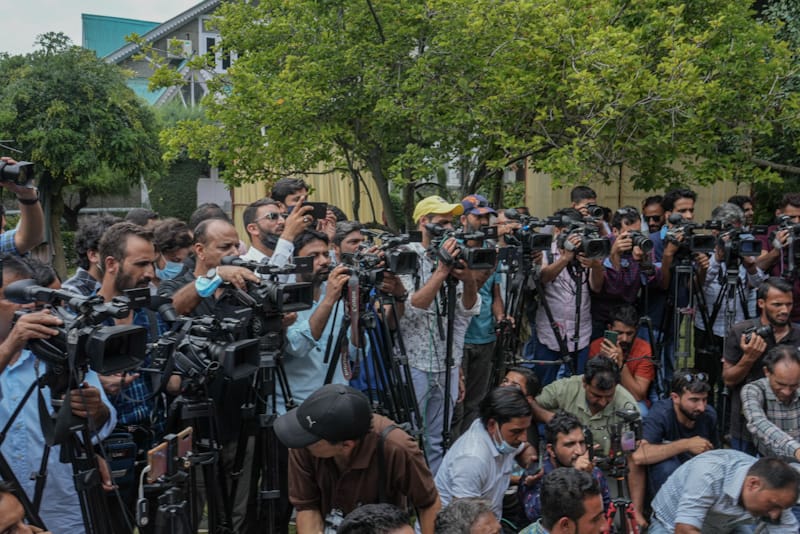
This culture of uncritical acclaim reveals its most damaging form when it emerges from the institution entrusted with being the guardian of public interest: the press. When journalists abandon their role as the fourth estate and instead become enthusiastic promoters for the state or corporate interests, they engage in a profound act of treachery. Their fundamental duty is to question power, to dissect polished narratives, and to champion the cause of the marginalised.
Yet, a significant portion of the media has regressed into a public relations extension for the powerful, converting hard news into glorified promotional content and analytical journalism into paid endorsements. They report the declaration of a development scheme with uncritical fervour, but neglect the essential follow-up reporting: Was it actually completed? Did it exceed its cost? Did it genuinely benefit its intended community?
This is not journalism; it is an abdication of intellect. It substitutes the difficult, and often risky, work of investigation for the simple, rewarding task of publicity. In doing so, it deprives the citizenry of the very oxygen required for an informed democracy. How can a populace make reasoned decisions about its destiny if its key information channels are committed to marketing a polished, fictional account of the present? This cheerleading builds a hall of mirrors where every image is warped to appear favourable. Setbacks are rebranded as “steps forward,” and standard administrative functions are proclaimed as revolutionary triumphs. The public is left to find its way through a hazardous reality without a trustworthy guide, led only by the misleading applause of those who have deserted their duty as custodians of truth.
The drivers of this widespread surrender are multifaceted. For some in influential positions, it is a purely transactional arrangement—a method to gain favour with the powerful in return for access, benefits, or influence. For the growing corporate sector, it is a marketing tactic, associating their brand with a saleable story of advancement and optimism. And for many common people, it is a psychological survival strategy. In an environment of perceived helplessness, adopting and amplifying every glimmer of positivity, however minor, becomes a way to fabricate a more tolerable reality—a buffer against the crushing intricacy and sorrow of their true situation.
Yet, this coping strategy is a pact with dire consequences. By refusing to confront our reality in all its difficult and painful detail, we trade our long-term well-being for momentary emotional comfort. The issues hidden beneath a carpet of celebratory social media posts do not disappear; they intensify. The infrastructure developed without rigorous public scrutiny will eventually decay. The economic plans formulated without critical examination will falter. The political grievances left unspoken will continue to generate a quiet, simmering discontent. The applause of today, no matter how deafening, will be powerless against the crises of the future.
What Kashmir requires at this juncture is not more cheerleaders. It needs independent thinkers, honest, unbiased critique based on ground realities. It needs scrutinisers. It needs journalists with the fortitude to pose the difficult query, to report the unwelcome truth, and to demand answers from the powerful, rather than merely celebrating their most minor accomplishments. It demands a public conversation that prizes integrity over public relations, depth over display, and responsibility over acclamation.
We must rediscover the will to remain silent when silence is appropriate, to challenge when challenge is essential, and to reserve our praise for truly commendable deeds. The road to authentic izzat and abroo is not built upon the empty echo of compelled ovation, but upon the steadfast, resolute, and unwavering pursuit of truth, equity, and rational discourse. Until we master this critical judgment, we remain a community stranded in the audience, applauding fervently for a contest we are inexorably and tragically failing to win.
(The author is a senior surgeon and columnist)