

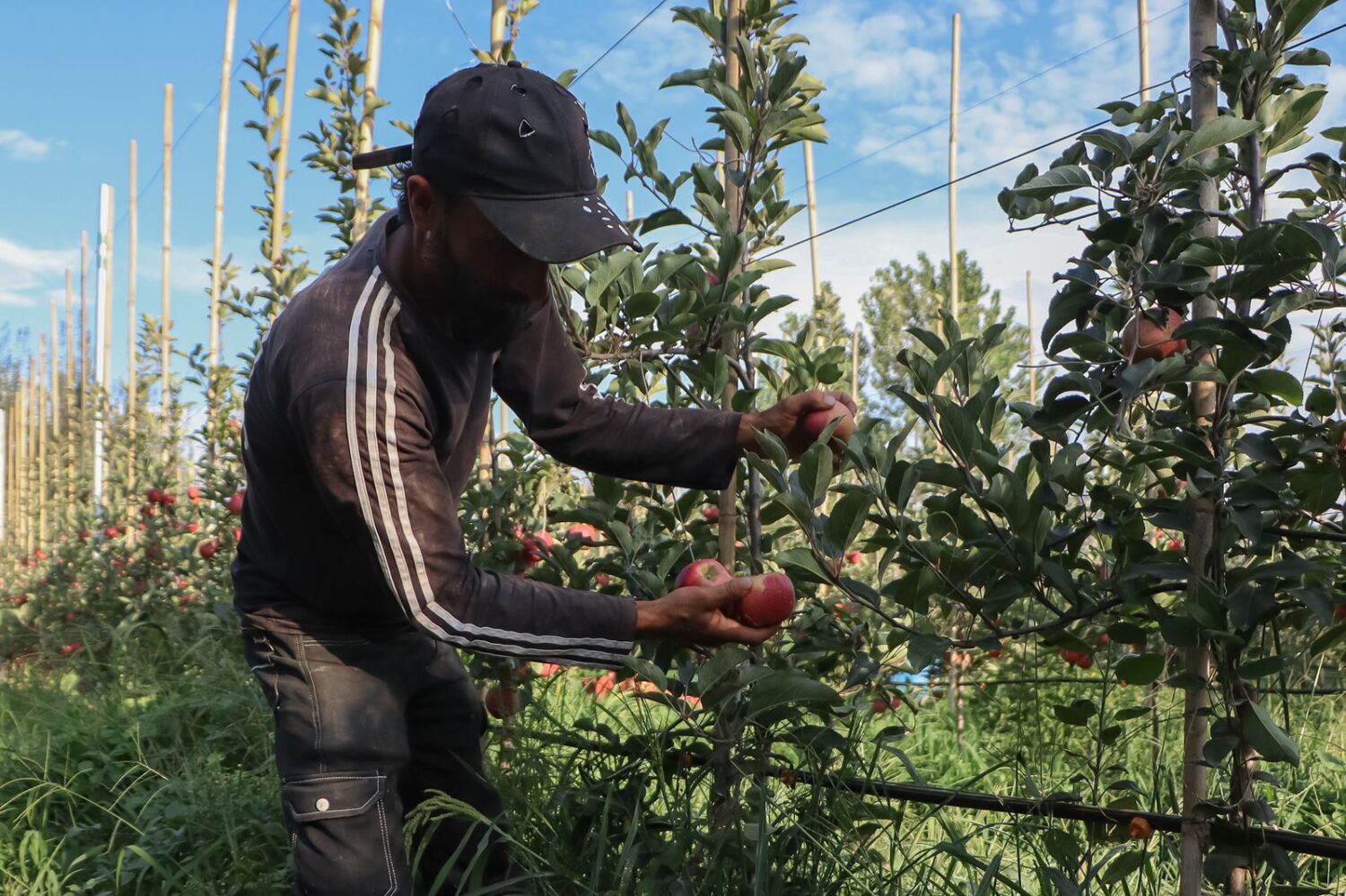

Says 3.5 million livelihoods at stake; apple, walnut growers stare at uncertainty
Srinagar: With rising fears that free trade agreements could flood the market with cheap imported produce, Jammu and Kashmir Congress president Tariq Hamid Karra on Thursday warned that the Union Territory’s horticulture sector — the backbone of its economy — faces an imminent “disastrous collapse” unless the domestic industry is shielded from unfair global competition.
Addressing concerns over the potential impact of such pacts, Karra said the sector, which generates an estimated annual business of approximately Rs 10,000 crore, sustains nearly one-fourth of the region’s population.
“One in every four persons here is directly or indirectly dependent on this sector—be it through orchards, packing houses, transport, cold storage chains, or ancillary activities,” Karra said.
“If we allow imports without adequate safeguards, we are staring at an economic catastrophe.”
According to data shared by the Congress leader, Jammu and Kashmir produces over 27 lakh metric tonnes of fruit from 3.47 lakh hectares, leading the country in several high-value crops. The region contributes between 70 to 75 per cent of the nation’s total apple production—approximately 20 to 21 lakh metric tonnes annually—from the belts of Baramulla, Shopian, Anantnag, Kulgam, and Pulwama.
“This crop alone supports over 3.5 lakh families and earns thousands of crores for the UT exchequer,” Karra said.
In dry fruit cultivation, J&K accounts for a staggering 98 per cent of India’s total walnut production, grown across 50,000 to 60,000 hectares in high-altitude mountainous areas. Other cash crops like cherry, strawberry, and Kashmir saffron add to the sector’s valuation, which exceeds Rs 3,800 crore annually.
Karra expressed serious concern over the potential influx of subsidised American varieties, warning that it could destabilise the local market.
“If these imports come without strong reservations, domestic prices will crash. We are already seeing early signs—walnut prices have dropped by Rs 100 to 150 per kilo in some markets after such announcements,” he said.
He argued that small and marginal farmers, who cultivate on fragmented mountain slopes, cannot compete with the economy of scale enjoyed by large American agricultural operations. “The fallout will be devastating—distress sales, mounting debt, a sharp drop in income, and forced migration from rural areas. The entire post-harvest ecosystem, including transport, cold chains, and processing units, will be hit,” he said.
To assess the situation on the ground, the All India Congress Committee has deputed Himachal Pradesh Chief Minister Sukhvinder Singh Sukhu to Jammu and Kashmir. “He knows the pain of the people associated with this trade,” Karra said. “He has been sent here to understand the gravity of the situation and to articulate the party’s concerns over the adverse effects of these agreements on the region’s economy.”
Karra, while clarifying that the Congress is not opposed to international trade, insisted that vulnerable regions like J&K must not be sacrificed at the altar of free pacts.
“We are not against fair trade. But in J&K, horticulture is not just a commercial enterprise—it is a lifeline. Any agreement that threatens that lifeline must be revisited with the urgency it deserves,” he added. (KNS)