
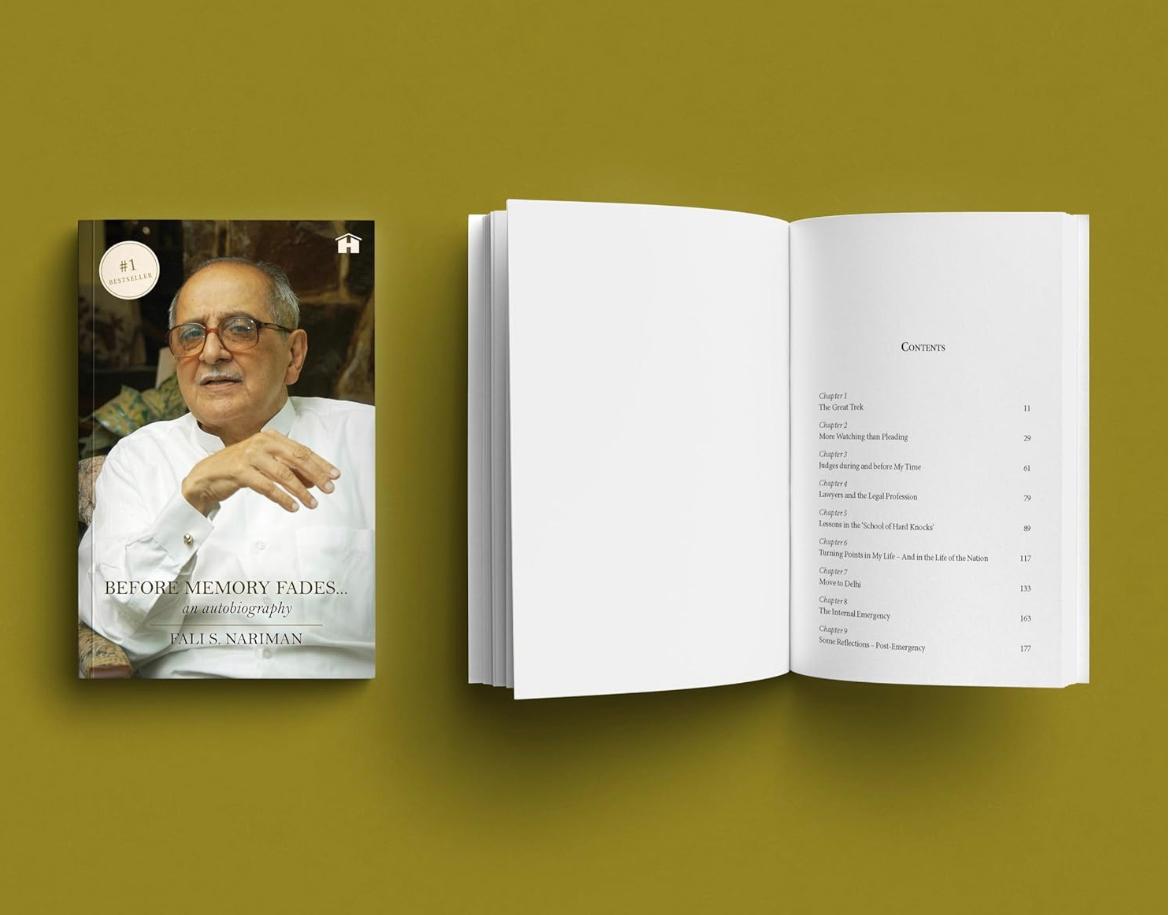

Legal autobiographies offer profound technical insights and revolve around the professional journeys of their author. However, Fali S Nariman’s “Before Memory Fades…” stands as an exceptional work that combines memories with the legal career, while offering a close view of the evolution of India’s judicial system and politics.
Fali S Nariman was born in 1929 in pre-independent India, Rangoon (now in Myanmar). He was a senior advocate of the Supreme Court of India. He was a distinguished constitutional lawyer, author of several books which analyse the Indian legal system and Constitution.
Book: Before Memory Fades…
Author: Fali S Nariman
Publishers: Hay House
MRP: ₹699
Nariman’s early life as a student of law was started at Government Law College, Bombay. Subsequent to his completion of law degree, he joined Sir Jamshedji Kanga’s chamber for practice. Despite having a small working area for the office work, he stayed determined and concentrated on his work.
He describes his days at the chamber, noting that “hustle and bustle there trained me [him] to think and work under most uncomfortable conditions!”
However, the early phase of practice at the Bar remained full of reflection and understanding of the practicality of the legal work for him. For Nariman, the scientific process of osmosis remains appropriate and useful to the young students of the law as “at a Bar, a young lawyer learns much – simply by osmosis.”
Subsequently, he was appointed as Additional Solicitor General (ASG) of India on May 1, 1972 for an office term of three years, which also required shifting to Delhi from Bombay. During his tenure as Additional Solicitor General of India, represented the Union of India in several cases at the Supreme Court.
He was reappointed as ASG of India for another three-years term on May 1, 1975. Later, he resigned from the office following the imposition of Internal Emergency in June 1975. He “drafted, signed and posted to Delhi a one-line letter of resignation” from Bombay.
He was critical to the imposition of Internal Emergency and mentioned in his book that he “even before the council of ministers (the cabinet) met and approved the proclamation of Emergency on the morning of 26 June, it had already been signed the previous night by the president.”
While discussing the lessons of the Internal Emergency, the author argues that one should “not to rely on constitutional functionaries,” citing the President’s readiness to sign the proclamation of Emergency.
One of the famous cases of Bhopal Gas Tragedy in which Fali S Nariman represented Union Carbide Corporation (UCC) in the civil litigation. Despite being recognised internationally for the human rights cases, it outbreaks a criticism for the Nariman.
He appeared firstly before a district court of Bhopal, where the interim compensation was fixed with Rs. 350 crores. Later, the judgments of the lower court were challenged before the Supreme court and in the full and final settlement of all claims US $470 million (then in Indian rupees Rs 615 crore) was brought into court.
Fali S Nariman, being determined towards his profession, served at several internal legal bodies as their president, chairman and member. In 1988, he was appointed as a member of the London Court of International Arbitration (LCIA). He also served as Chairman of the Executive Committee of the International Commission of Jurists (ICJ), from 1995 to 1997.
He received several prestigious honours: in 1991, he was awarded the Padma Bhushan for “distinguished services in the field of jurisprudence,” and in 2007, he was conferred the Padma Vibhushan, India’s second-highest civilian award, “in recognition of exceptional and distinguished service in the field of public affairs.”
In late 1990s, he was nominated by the President of India as a member of the Rajya Sabha on the recommendation of the National Democratic Alliance (NDA) government.
In conclusion, the autobiography – Before Memory Fades – gives you a deeper version of a lawyer’s personal account, courtroom events, and the evolving political and legal system of India. This book is enriched with the anecdotes of the author’s early years, including a striking moment from his time at Bishop Cotton School, where the principal, while bidding farewell, remarked “My boys, I wish you all a life full of difficulties.”
In many ways, this sentiment defines the author’s journey – one shaped by challenges and struggles that ultimately defined his resilience, intellect, and contribution to public life.
(Ayaan Saroori is a freelance writer covering politics, environment, society, and law, and reviews books.)