
Srinagar: The Kashmir Chamber of Commerce and Industry (KCCI) on Monday raised multiple concerns over the implementation of key industrial schemes by the government of India, calling for corrective measures to ensure equitable and inclusive growth in the region.
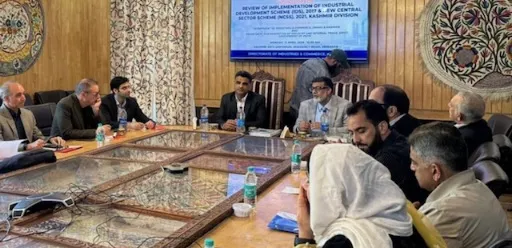
The issues were highlighted during a high-level review meeting of the New Central Sector Scheme (NCSS) 2021 and the Industrial Development Scheme (IDS) 2017 for the Kashmir Division, held at the Kashmir Government Arts Emporium on Residency Road. The meeting was chaired by Rajesh Panwar, Director, Department for Promotion of Industry and Internal Trade (DPIIT), and attended by Director Industries Kashmir Khalid Majeed and other senior officials.
Representing KCCI, Horticulture Sub-Committee Chairman Ashiq Hussain Shangloo presented a detailed account of ground-level challenges faced by industrial units in availing scheme benefits.
While welcoming the Rs 28,400 crore NCSS as a significant policy initiative, KCCI expressed concern over the closure of its registration window on September 30, 2024. The chamber said many genuine entrepreneurs who were in the process of formalising their units were left excluded and urged authorities to reopen or extend the window. It also pointed to delays in departmental clearances in pending cases, which have added to uncertainty among applicants.
KCCI further highlighted a stark regional imbalance in the distribution of benefits. Of the 2,036 units that registered before the deadline, only 953 have been granted eligibility so far. The chamber noted that nearly Rs 20,098 crore of the total outlay is likely to be absorbed by a limited number of large units, leaving a disproportionately smaller share for a much larger number of MSMEs.
Calling this trend contrary to the objective of inclusive development, KCCI demanded a dedicated 25% regional quota for Jammu and Kashmir. It also stressed that Kashmir’s landlocked geography significantly increases logistics and operational costs, which should be factored into policy design and incentive calculations.
Another major concern raised was the exclusion of existing MSMEs from scheme benefits. KCCI said these units, which have sustained local employment over decades, should be brought within the ambit of incentives. It proposed that pending cases be granted at least 25% of the new benefits under any revised framework.
On policy design, the chamber advocated integration of benefits under IDS 2017 and NCSS 2021, arguing that a comprehensive support package—including components such as insurance—would better address the needs of industry in the region.
KCCI also called for a substantial enhancement in the financial outlay if the NCSS is extended, suggesting an increase to Rs 75,000 crore to match the scale of demand and backlog of applications.
Emphasising the importance of stakeholder engagement, the chamber said any revision or restructuring of industrial schemes must involve meaningful consultation to avoid policy gaps and regional disparities.
Officials from DPIIT assured a patient hearing to the concerns raised. KCCI reiterated its commitment to working with the government to develop a more responsive, equitable and sustainable industrial policy framework for Jammu and Kashmir.