
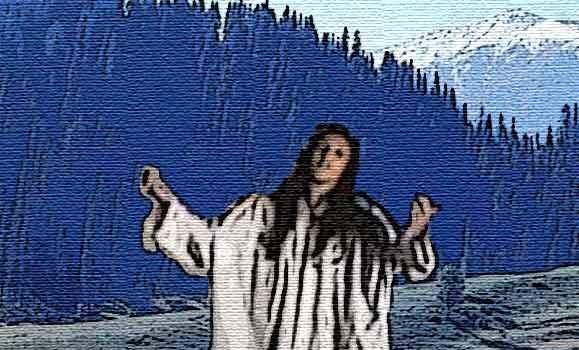

Lal Ded, the fourteenth-century mystic-poet of Kashmir, known variously as Lalleshwari, Lal Arifa, and Lal Ded, composed her vakhs in a language that refuses to stay still.
Her verses reach into Sanskrit, settle into Kashmiri, and occasionally borrow from Persian, producing a poetic language as layered as the valley she walked through barefoot.
Lal Ded wrote at a moment when Kashmir was a meeting point of traditions, Shaivite, Buddhist, and early Sufi, and her vocabulary reflects that confluence.
To read her vakhs closely is to encounter a poet who chose her words with precision, pulling from whichever register gave her the sharpest instrument for the thought at hand.
If we wish to see what Kashmiri looked like before the cloak of Persian descended upon it, it is Lal Ded’s vakhs we must read.
Her poetry preserves a pre-Islamic linguistic surface, native Kashmiri and Sanskrit running together, largely unmediated by the Persian and Arabic borrowings that would reshape the language in the centuries that followed.
The scholar G.L. Tikku, in his work on Persian poetry in Kashmir, notes borrowings that appear even in Lal Ded’s Vakhs— words like pyala (cup), rang (colour), jang (battle), and bazar (market), Persian terms that had already entered the Kashmiri world by her time.
But these are outnumbered by the Sanskrit words she reaches for when speaking of the inner life: anand (pleasure), abhiyaas (practice), aham (pride), akshar (alphabet), brahmand (cosmos), gyaan (knowledge), mudra (gesture), shastra (sacred text), vyekaas (development).
Lal Ded leans toward Sanskrit because Sanskrit carries the philosophical vocabulary of the Shaivite tradition she inhabited.
One of the most striking features of Lal Ded’s vakhs is how she names the Divine. She does not fix on a single name or tradition.
Shiv, brahma, keshava, zanvaa
Kamlaz nath naav deerin yuh
Mya anlyi keestyam bavi ruz
Suva, Suva, suvaa, suh
Shiv, Keshava, Brahma and Gotama
Call him by whatever name you like
May He relieve me of the desire for the world
He is, He alone is, He is in all.
Elsewhere, she reaches for an image of pure immanence: “Shiv chuy zeevyul zaal vehreevyith”— like a thin web, God is spread all around.
The word zaal, a net or web, is native Kashmiri; the philosophical idea it carries is vast.
This is Lal Ded’s characteristic move: a common, tactile word made to hold an infinite meaning.
She also mentions the Rishis — the ascetic order that Sheikh Nooruddin Noorani would later organise, give an Islamic character, and save from extinction, transforming it into the Rishi order that became the soul of Kashmiri Sufi culture.
In Lal Ded’s time, the Rishis were already a recognisable spiritual type, and she honours them in her own terms:
Tim chhi’ne ma’nush tim chhey resh, Yi’man dihe mane ni’she gav.
Those whose self is detached from their Self are not human beings but rishis — the super souls.
Lal Ded names the objects of ritual and royal life with the same specificity that Sheikh ul Alam brings to the natural world.
In one vakh, she lists: “kush, posh, tyiil, dyiph, zal, naa gatshhey”— “grass, flowers, oil, lamp, and water are not needed”. Each word is plain, domestic, exact.
Elsewhere, she catalogues the comforts of the nobility with an eye that is observant rather than envious:
Tsaamar, chhetir, rath, simhaasan
Ahalaad, neety ras, tuli preyienkh
“Hair whisks, canopy, chariot, and throne
Reverly, pleasure of theatre, the cushioned beds”
Perhaps nowhere is Lal Ded’s vocabulary more alive than when she writes about place and landscape.
Marg, meaning meadow, and the suffix carried in place names like Gulmarg, Sonamarg, and Hatchinmarg to this day, appears in her poetry as metaphor:
Gyana marag chayy haakiver
The meadow of knowledge is your kitchen garden.
The word moves between its literal and figurative lives without effort.
In one vakh, she hears the call of a boatwoman at Anchar lake, crying out her wares:
Aan’chaar han’zeni hund gom kanan, Na’dur chu te hya’yu maa
I heard the call of a boat-woman of Anchar, asking if they would like to buy nadur — lotus root.
Trag (pond, preserved in place names like Tragbal and Lal Trag) and shaath (the shore of a river or lake) appear together in one of her most poignant self-portraits:
Saariniy padan kunuy vakhun pyoam
Lalli mya trag gom, lagi kamyi shaathay
All my verses are reduced to one speech,
I, Lal, fell in the lake; what shore did I reach?
She mentions the Sindh river, the sacred site of Mattan, and Harmukh — the mountain associated with Shiva — locating her spiritual journey in the actual geography of Kashmir:
“Harmukh kausar akh sum saras”
From Harmukh to Kausar, the lake had a bridge.
Sum means a lake.
Her eye for the natural world is equally precise.
In one vakh, she observes water taking on its many cold-weather forms — ice-spreads, icicles, falling snow, snowstorm, and avalanche — and turns the observation into a teaching:
Tul-katur shi’sher gaen’t shine-mani te shrani.
Byon-byon sap’ney yem paanch:
Wimar’shuk poore yali khasi ra’w.
Sa’mith sariney ku’nuy gow.
Water assumes various shapes in freezing cold
ice-spreads on freezing water, icicles, falling snow, snowstorms, and avalanches.
This is also true of worldly people: when the sun of awakening falls on them,
they too return to their original shape.
The Kashmiri words for these precise states of frozen water —tul-katur, shi’sher gaen’t, shine-mani, shrani — form a vocabulary of winter that no Persian or Arabic borrowing could have supplied.
They are native, irreplaceable, and kept alive here solely because Lal Ded found them useful for a philosophical point.
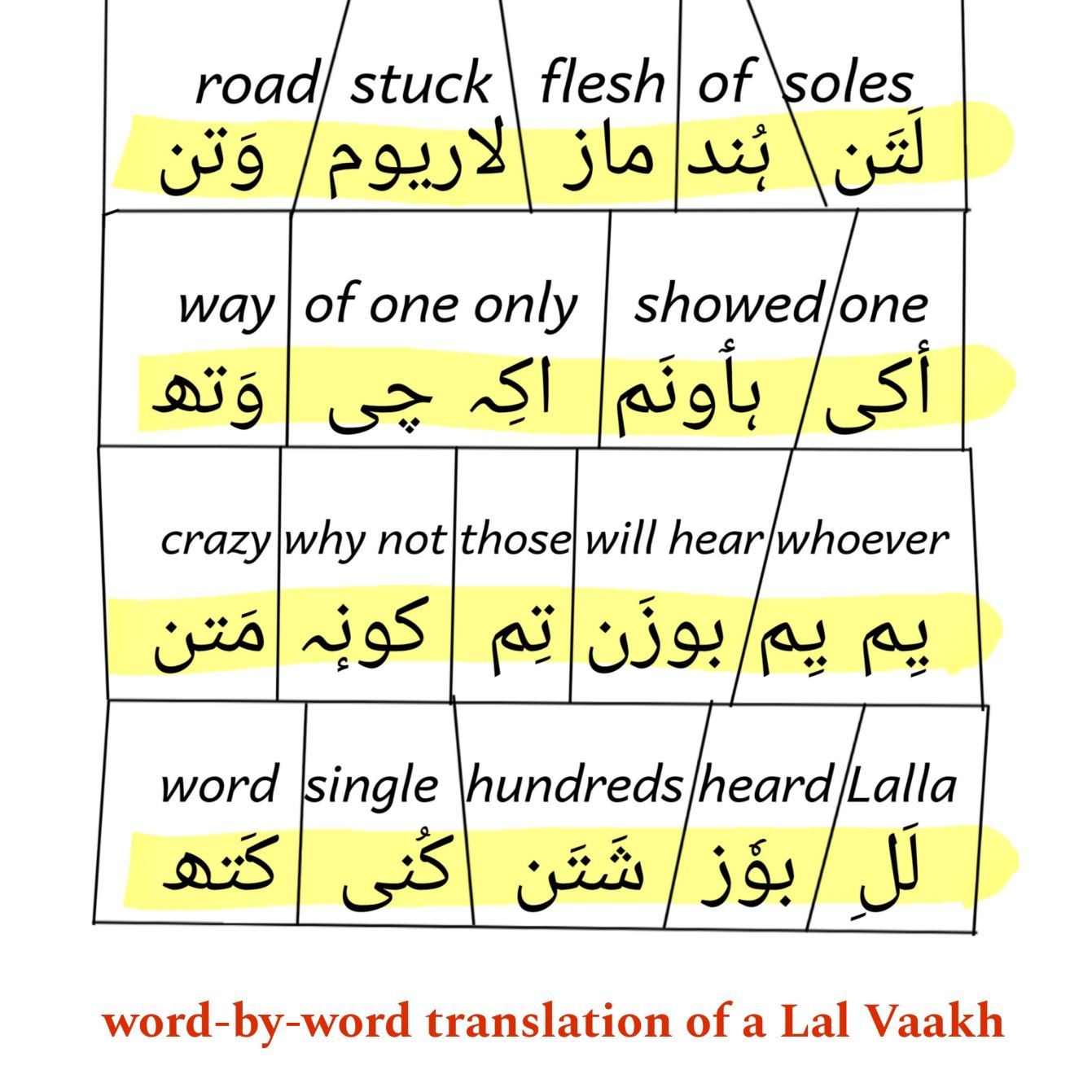
Other words surface briefly and disappear: sodur (ocean), aagur (source), abakh (untutored), mukur (mirror), gnDy (rhinoceros).
Each one is a small door into a Kashmiri that no longer speaks itself aloud.
Lal Ded composed at the cosmic and the ground level simultaneously — and in both registers, she reached for the word that would go deepest.
Taken together, her vakhs form something no formal lexicon attempted: a record of how Kashmiri thought, named, and felt in the fourteenth century, held in place by the discipline of verse and the accident of memory.
That record is still here. It is still waiting to be read as such.
Kyanh’nas ni’shay kyah taam draav — Lal Ded