

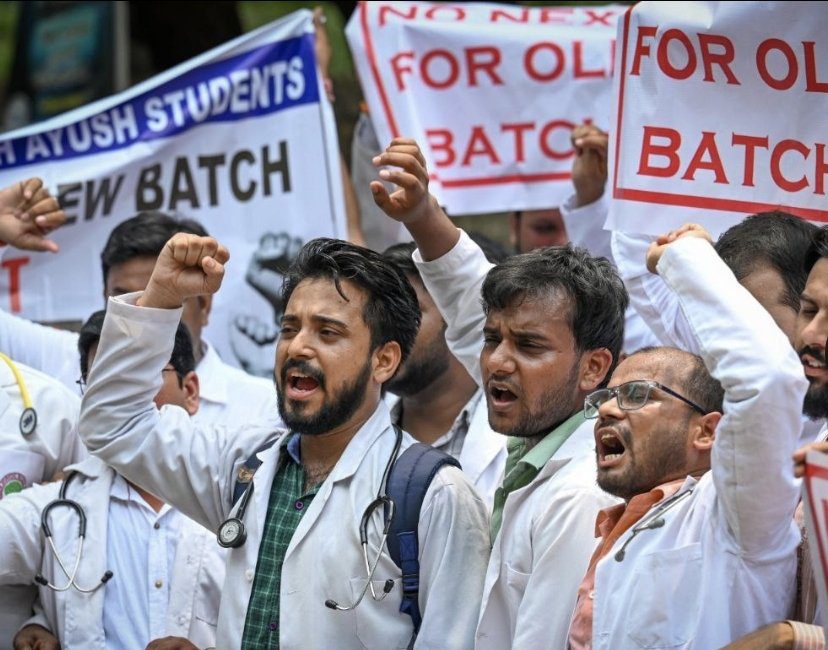

New Delhi: The controversy surrounding the cancellation of NEET-UG 2026 has reached the Supreme Court, with a petition seeking the restructuring or replacement of the National Testing Agency (NTA), court-monitored reforms and greater oversight of future national-level examinations.
According to a report by The Times of India, the petition has been jointly filed by the Federation of All India Medical Association (FAIMA) and the United Doctors Front (UDF), which have argued that the alleged paper leak and subsequent cancellation of the examination exposed systemic shortcomings in the conduct of one of India’s largest entrance tests.
The development comes weeks after NEET-UG 2026, conducted for more than 22 lakh candidates, was cancelled following allegations of question paper leaks. The controversy has triggered protests in several parts of the country, with students demanding accountability and stronger safeguards against examination malpractice.
The Supreme Court had earlier sought responses from the Centre, the NTA and the Central Bureau of Investigation (CBI) on pleas seeking reforms in the examination system. A bench comprising Justices PS Narasimha and Alok Aradhe also directed the NTA to file an affidavit detailing its compliance with directions issued by the apex court following the NEET controversy in 2024.
In their petition, FAIMA and UDF have described the latest episode as a “systemic failure” that has damaged public confidence in the country’s examination system and raised concerns about the agency’s ability to conduct secure and transparent tests.
Among the key demands is the constitution of a high-powered monitoring committee comprising a retired Supreme Court judge, a cybersecurity expert and a forensic scientist to supervise the re-conduct of NEET-UG 2026. The proposed panel would oversee the examination process until a National Examination Integrity Commission is formally established.
The petition also seeks implementation of recommendations made by the K Radhakrishnan Committee, which was constituted after the NEET 2024 controversy, to recommend reforms in the functioning of the NTA.
Among the reforms sought are digital locking of question papers, stronger cybersecurity mechanisms, improved monitoring and transportation protocols for examination material, and a gradual transition from pen-and-paper examinations to a computer-based testing model.
The petitioners have further sought judicial monitoring of future examination processes until authorities certify that adequate safeguards are in place to prevent similar incidents.
The upcoming hearing is expected to address not only the conduct of a fresh NEET-UG examination but also broader questions concerning examination security, institutional accountability and the future structure of India’s national testing framework.