
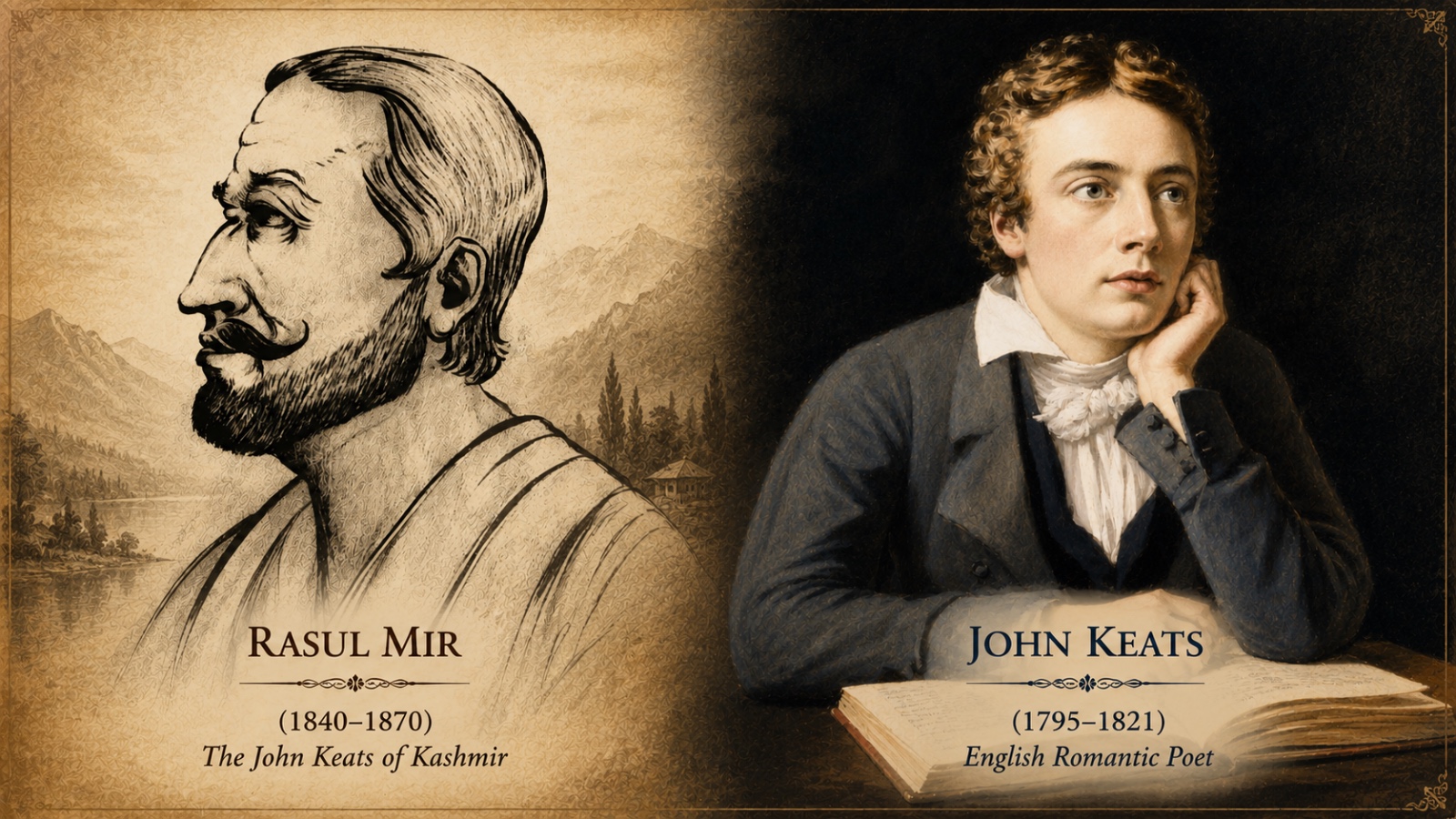

Rasool Mir is one of the most loved poets in Kashmiri literature. He is often called the “John Keats of Kashmir” because of the many similarities between him and the famous English Romantic poet, John Keats.
Born in Dooru Shahabad in south Kashmir around 1840, Rasool Mir is known for writing beautiful poems about love, beauty and human emotions. He played a major role in popularising the ghazal in the Kashmiri language. His poetry touched people’s hearts because it spoke about feelings that everyone can relate to — love, longing, separation and hope.
The biggest reason behind the comparison with John Keats is that both poets were romantics at heart. Keats wrote about beauty, love and the shortness of life. Rasool Mir did the same in Kashmir. His poems describe the joy and pain of love in a simple yet powerful way. He used everyday images from Kashmiri life and nature to express deep emotions.
Another reason is that both poets died very young. John Keats died at the age of 25, while Rasool Mir is believed to have died in his early thirties. Even though they lived short lives, both left behind poetry that continues to inspire people long after their deaths.
Writers and scholars say that Rasool Mir had a special gift for turning emotions into memorable verses. Literary commentator M.J. Aslam noted that Mir was a romantic poet by nature and, like Keats, produced a small but highly influential body of work before his untimely death.
Rasool Mir is also remembered as one of the greatest romantic poets in Kashmiri literature. His poems celebrate love not just as an emotion between two people, but as a feeling that brings out tenderness, beauty and compassion. Many of his verses are still sung and recited across Kashmir today.
Over the years, the title “John Keats of Kashmir” has become widely accepted. Cultural organisations, writers and media reports have used it to describe Rasool Mir’s place in Kashmiri literature. The comparison helps readers outside Kashmir understand the kind of poet he was — someone who wrote with honesty, passion and deep feeling.
At the same time, Rasool Mir was much more than “Kashmir’s Keats.” His poetry was rooted in the language, culture and traditions of Kashmir. He gave Kashmiri literature some of its finest expressions of love and beauty.
That is why Rasool Mir is called the “John Keats of Kashmir” — not because he copied the English poet, but because, like Keats, he had a rare ability to capture the beauty of life and the emotions of the human heart in words that never grow old.
Laalas wantai chus sawaal,
Saalas antane’i bae’liye.
Mad’e chus az chum kamaal,
Ade nai roze’hem kael’iye.
Wad’nah raye’hem jamaal,
Saalas antane’i bae’liye
Translation:
I have a request for my beloved,
Please bring my love to me.Today, my longing has reached its limit;
I can no longer bear this separation.I wish to behold that radiant beauty once again,
Please bring my beloved to me.
Now compare this with John Keats’ “Bright Star”
“Bright star, would I were stedfast as thou art—
Not in lone splendour hung aloft the night
And watching, with eternal lids apart,
Like nature’s patient, sleepless Eremite…”
And later, Keats reveals the true desire of his heart:
“No – yet still stedfast, still unchangeable,
Pillow’d upon my fair love’s ripening breast,
To feel for ever its soft fall and swell,
Awake for ever in a sweet unrest,
Still, still to hear her tender-taken breath,
And so live ever – or else swoon to death.”
Rasool Mir repeatedly pleads to be reunited with his beloved because separation has become unbearable. The beloved’s beauty is his only solace. Keats, too, speaks of a love so intense that he wishes to remain forever in that perfect moment, listening to the gentle breathing of the woman he loves.
Both poets see love as something greater than ordinary affection. It becomes a force that brings both joy and suffering. Their verses are filled with longing, devotion and emotional vulnerability.
There is, however, one important difference. Keats dreams of preserving a moment of love forever, untouched by time. Rasool Mir speaks from within the pain of separation. His voice is that of the Kashmiri lover who cannot endure distance from the beloved and openly expresses his anguish.