Feature
One night in Kashmir: 530 apple trees cut down, ₹40 lakh in debt



A Kashmiri family bet their house on an apple orchard. Someone took an axe to it the night before harvest.
The apples were days from picking.
Abdul Rashid Teeli and his wife had spent June 13 doing what they did every day: walking the rows, trimming the grass, checking the water lines, pressing their fingers into soil they had been reading for four years.
The trees were loaded. Heavy branches bent toward the ground. Some carried two full crates of fruit on a single trunk.
The couple walked home that evening with sore backs and something they had almost forgotten how to feel: certainty.
By the next morning, all of it was gone.
A phone call reached Rashid at a religious gathering in his village of Hatipora, in Kulgam district, south Kashmir.
Someone had broken the gate of his orchard.

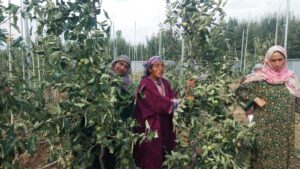
The Teeli family consoles one another after losing what they describe as their life’s biggest investment. [FPK Photo/ Meer Irfan]
He left the gathering, found his wife, and they walked together toward the land, barely one kilometre away, saying almost nothing.
What they saw on the other side of that broken gate has not left either of them since.
All 530 of their apple trees had been chopped down. Fruit-bearing branches covered the ground. The irrigation pipes had been ripped apart. The water motors lay in pieces.
The orchard they had spent four years building with every loan argument with the bank had been turned into a field of stumps overnight.
“It felt like someone had cut down our future,” Rashid said.

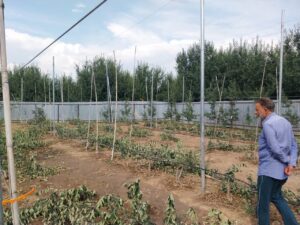
Every step through the orchard reminds Rashid of four years of hard work lost overnight. [FPK Photo/ Meer Irfan]
Rashid did not start as a farmer. He spent years painting houses across Kashmir, picking up carpentry and daily-wage work when the painting dried up. The money came and went. There was never quite enough.
Then, in 2022, he made a decision that would consume the next four years of his life.
He cleared the old apple trees from his four-kanal plot and started from scratch.
The land was levelled, walls went up, a gate was fitted, and irrigation lines were laid.
Then came 530 Italian high-density apple saplings, a modern variety that grows fast, bears fruit early, and commands premium prices at the market.
Each sapling costs around Rs 3,000. The total bill, by the time the orchard was planted and equipped, came to nearly Rs 40 lakh. The family mortgaged their house to cover it.

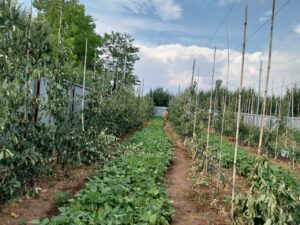
Every chopped tree tells the story of a family’s dream cut short. [FPK Photo/ Meer Iran]
“Everything had to be done scientifically,” Rashid said. “Every stage required money.”
He stopped painting houses, as the orchard demanded full attention.
High-density trees need constant pruning, precise irrigation, and daily monitoring. Rashid and his wife were inside the orchard before sunrise most mornings. They were still there at sunset.
“We looked after every plant like our own child,” his wife said.
Last year, the orchard paid back Rs 4 lakh. This year was supposed to change everything.
The trees were carrying close to 900 crates of fruit, roughly two crates per tree. The family had pencilled in earnings of Rs 12 lakh.
They had started doing the arithmetic on their debts, working out which loans they could finally begin to clear.
On the evening of June 13, they went to bed believing the hardest part was behind them.

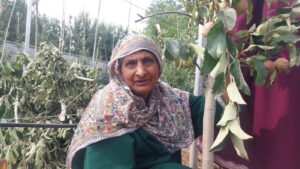
Overcome with grief, Rashid’s mother mourns the destruction of the family’s only hope for financial stability. [FPK Photo/ Meer Irfan]
The full damage, including trees, equipment, and the harvest they never got to pick, adds up to roughly Rs 25 lakh, the family estimates. But Rashid keeps returning to something that cannot be calculated.
The trees had taken four years to reach harvest. The apples consumed countless mornings spent pruning, watering and waiting. The irrigation network stood as proof of difficult meetings with bank officials, the decision to mortgage the family home and the promise that the orchard would one day secure a better future for his children.
“It wasn’t just money,” the agonised apple grower said. “It was our life.”
His mother sat in the courtyard holding a chopped branch, breaking down as she tried to speak.

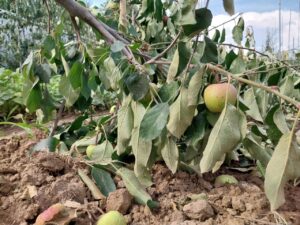
Fruit-bearing branches lie scattered across the orchard, just weeks before harvest. [FPK Photo/ Meer Irfan]
“Our house is mortgaged. We have taken loans, and the bank will come and lock our house. Where will we go?” She stopped, then reached for a Kashmiri phrase, Battas Zahar, that means poison placed in your own food.
“If someone had stolen one year’s crop, we would have survived. But everything has been destroyed.”
Rashid’s father, Abdul Rahim Teeli, died recently, having spent his life in labour with the hope that this orchard would finally lift the family out of hardship. He believed he would see the harvest.
“He never got to see the orchard give us the future we dreamed about,” Rashid said.

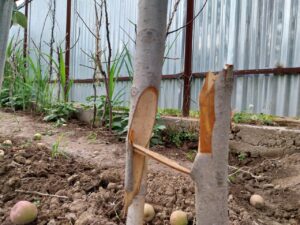
Freshly cut trunks mark the spot where hundreds of apple trees once stood. [FPK Photo/ Meer Irfan]
His younger brother tried to console him while describing the years that went into the orchard.
“My brother painted walls, drove nails, borrowed money and worked through every season because he believed these trees would change our lives,” he said. “Whoever did this did not cut trees. They destroyed our future.”
The destruction has spread fear through the apple-growing communities of south Kashmir, where high-density orchards have become the dominant bet that working families make on their own futures.
The model demands years of investment before a single rupee returns. Growers take loans, mortgage property, and pour labour into land that will not produce for three or four seasons.

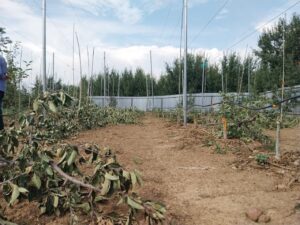
Fresh apples remain on the ground, a silent reminder of a harvest lost before it began. [FPK Photo/ Meer Irfan]
The system works only when the orchards are allowed to survive long enough to pay out.
Police have registered a case and launched an investigation.
A senior cop confirmed the inquiry was underway and that officers had taken cognisance of the incident. The motive has not been established publicly.
Amid the unsolved crime mystery, Rashid routinely walks the rows of stumps now the way a person walks through a house after a flood, touching things, stopping, and trying to understand what is salvageable.
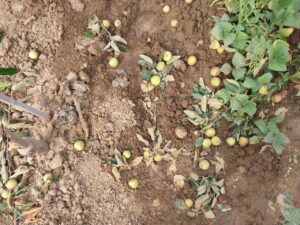
Apples that were weeks away from harvest now lie on the ground beside severed branches. [FPK Photo/ Meer Irfan]
If he plants new saplings tomorrow, he will be 57 or 58 before they reach the stage these trees were at on the morning of June 14.
He bent down near one of the stumps and picked up a fallen apple, still firm and carrying the faint smell of something that almost made it. He turned it over in his hand and looked across the field.
“It took nearly 1500 days to build this orchard,” he said. “But it just took one night to finish it.”