

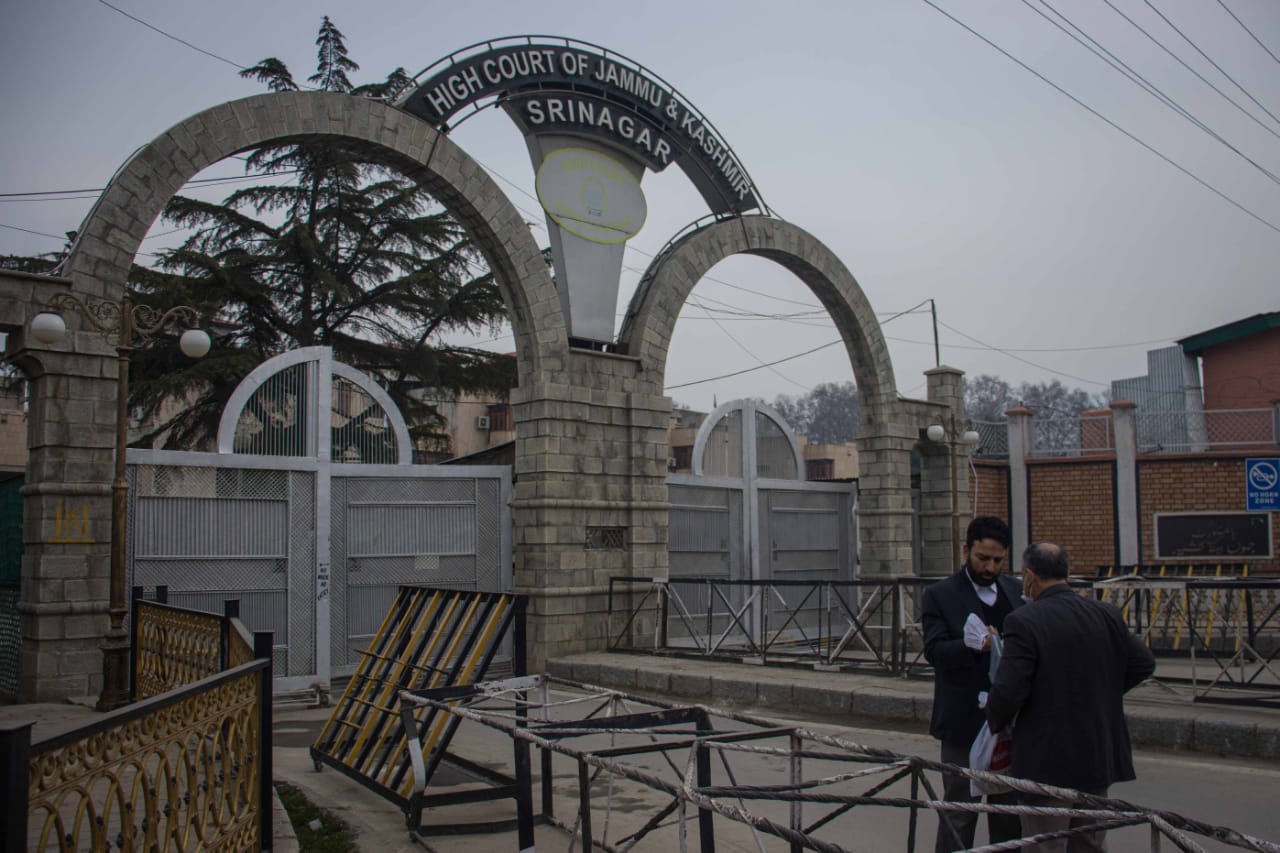

Srinagar: The Jammu and Kashmir and Ladakh High Court has quashed an FIR against a Jammu family, ruling that citizens cannot face criminal prosecution for resisting construction on land that has not been lawfully acquired by the government.
Justice M A Chowdhary observed that the State cannot give a criminal colour to a landowner’s legitimate attempts to protect their proprietary rights.
The ruling came during the hearing of a petition filed by Rajeshwar Singh and three family members. The petitioners had challenged FIR 0157 of 2020, registered at Police Station Bahu Fort, Jammu, under Sections 323, 341, and 186 of the Indian Penal Code (IPC).
The criminal case was filed following their protest against a road construction project passing through land they claimed was never legally acquired.
According to the petitioners, officials from the Public Works Department (PWD) began laying a road across their private land in Trikuta Nagar in the early hours of June 28, 2020.
The family objected to the work, contending that the government had neither completed acquisition proceedings nor paid compensation in accordance with the law.
Later that day, the Naib Tehsildar filed a complaint leading to the FIR, alleging that the family had obstructed public servants and wrongfully restrained official work.
The petitioners argued that the criminal case was a retaliatory measure intended to suppress their opposition and deprive them of their property without the due process prescribed under land acquisition laws.
LTo support their claims, they placed on record a detailed history of litigation concerning the land’s compensation, including earlier High Court proceedings and official acquisition notifications.
Upon examining the case records, the High Court found that the respondents (government authorities) had completely failed to prove whether the land in question had actually been acquired.
Justice Chowdhary noted that the official respondents were “conspicuously silent” on the matter, justifying the Court’s conclusion that the construction activity was being executed arbitrarily without lawful acquisition.
The Bench said that land ownership carries robust constitutional and human rights protections, meaning a landowner cannot be faulted for objecting to unlawful State interference.
“Land being a constitutional and human right, the petitioners had every right to protest and restrain any such interference in their proprietary land,” the Court observed, adding that such resistance cannot be attributed with criminal intent merely because it delayed or obstructed official construction activity.
Justice Chowdhary further held that the criminal proceedings were initiated solely as a reaction to the petitioners resisting the construction work, describing the registration of the FIR as a clear abuse of the judicial process.
“The land of the petitioners having been used for the construction of the road without proper acquisition and, on their protest, registration of a criminal case to implicate them, in the considered opinion of this Court is an abuse of the process of law, which is not sustainable,” the judgment said.
Concluding that the allegations disclosed no criminal intent and arose entirely from a lawful attempt to protect private property, the High Court quashed the FIR alongside all consequential proceedings.