

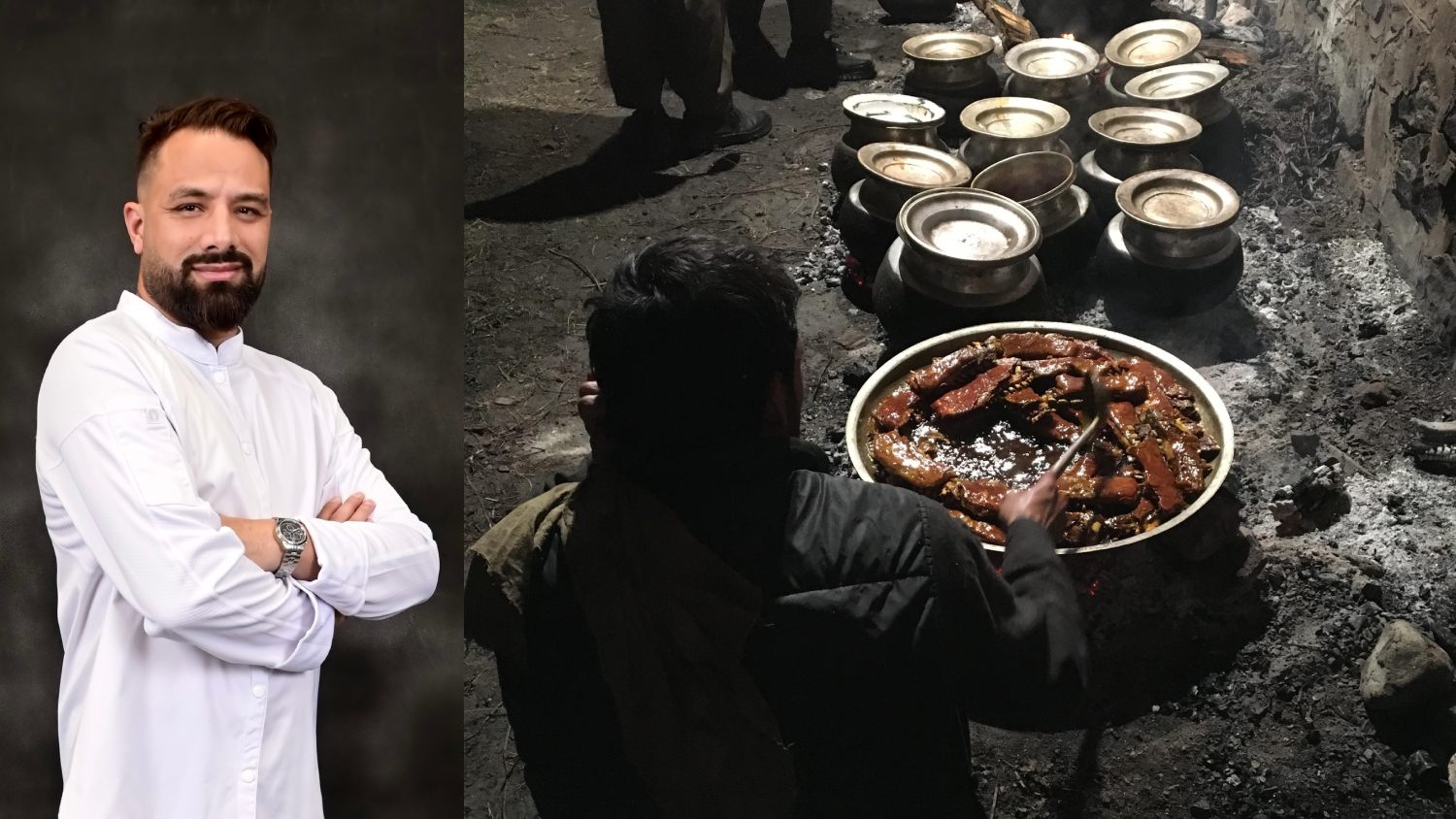

A feast designed to be savoured has become a hurried exercise in abundance. To preserve the soul of Wazwan, hosts, guests and waaze must rediscover the value of patience.
“Kashmiris are so generous in feasts, it left our tummy aching.”
I have heard this line, or some version of it, more times than I can count.
Said with a laugh, meant as a compliment. And every time, I have smiled back while feeling something closer to alarm.
Because I know exactly what is being described. The trai’em arriving like a mountain, every dish stacked on top of the other, riste touching goashtab, tabak maaz buried somewhere underneath rogan josh.
The waaze moving fast, serving fast, already turning toward the next trai’em before the first has been properly attended to.
Guests eating quickly because when everything arrives at once, that is the only way to eat.
And then that familiar ending: fullness without satisfaction, a feast without an experience.
That is not Wazwan. That is Wazwan’s body without its soul.
To understand what went wrong, you must first understand what Wazwan actually is.
It is not a menu. It is not a buffet. It is not a collection of dishes placed before hungry people all at once.
Wazwan is a sequence, a carefully composed conversation between flavours, textures and temperatures, developed over centuries and refined by generations of master chefs called wouste waaze, each passing their knowledge to the next through years of apprenticeship and devotion.
The meal is served with the sarpoash on top. It is covered to preserve it from the flies and is started with a Bismillah.
The tabak maaz is already present: crisp, rich, a declaration of intent.
Then arrives the riste, delicate and subtly sweet, a conversation opener. Its relatively bland flavour is often enjoyed with the gande tsyott.
The rogan josh follows, deep and complex, building on what came before.
Between dishes come the radishes, quiet and cleansing, resetting the palate before the next course speaks.
And finally the goashtaab, the grand closing statement, the dish that tells you the feast is not just finished but complete.
Remove the sequence, and you remove the meaning.
Stack everything at once and mix the tsyettins, as we do now, and you have not served Wazwan. You have buried it.
But here is what nobody wants to say openly. The burial has three willing participants, and none of them intends any harm.
The host is the first. He has spent weeks planning this day.
His family kept a vur burning through the night, 24 hours of slow cooking, the wouste waaze supervising every stage with a care and devotion that most modern kitchens will never understand.
And then on the day itself, that same host becomes the greatest threat to the experience he worked so hard to create.
The logistics are brutal. In just a few hours, the ladies and gentlemen must be fed, then the workers, the extended family, and everything must be cleared and the hall reset before the groom’s family arrives.
The pressure is enormous. So the host does what feels natural. He pushes.
A word to the waaza here, a look there, a quiet “finish this trai’em”.
Speed becomes the measure of success, not the quality of the experience.
He also carries a deep anxiety particular to Kashmiri hospitality: that a guest who waits is a guest who has been insulted.
Making someone wait feels like a failure of honour. So he rushes, not out of carelessness but out of genuine love.
And it is precisely that love, expressed as urgency, that dismantles the ceremony he funded.
The guest carries his own share of the responsibility.
Somewhere in recent years a new habit arrived at Kashmiri weddings: the takeaway bag.
Meat packed in plastic to carry home. And the moment that bag enters the picture, something shifts at the trai’em.
The guest is no longer fully present. He is already thinking about what goes in the bag, calculating his portion, managing his plate before the waaza moves on.
Four people who should be sharing one trai’em in unhurried fellowship become four individuals with separate agendas.
And if the waaza takes his time, if he tries to serve with the care the food deserves, the guest complains. Why is he so slow?
That complaint reaches the host. The host tightens. The waaza moves faster. The sequence collapses.
The waaze himself, and I say this with full respect for his craft, has in many cases stopped fighting for the ceremony.
Overwhelmed and pressured, working across multiple trai’ems at once, he has adapted to the system around him rather than resisting it.
He stacks because everyone expects him to stack. He rushes because everyone is watching him rush.
The role of conductor, the person who controls the tempo and protects the integrity of the experience, has been quietly surrendered.
I have spent my career in professional kitchens, from Atlantis in Dubai to the galleys of Etihad and Saudia at 35,000 feet, and one truth has never changed.
A chef is only as good as the last dish that goes out.
But how that dish reaches the table determines everything. Does it arrive with a smile or with a rush?
That single moment, that last mile between the kitchen and the guest, is where 24 hours of love either lives or dies.
Wazwan is the most profound example of this truth I know.
The overnight fire, the hand-ground spices, the master chef’s lifetime of knowledge poured into a copper pot, all of it can be undone in the 30 seconds it takes to stack a trai’em without thought.
The trai’em was never designed for speed. It was designed as a leveller.
Four people, regardless of wealth, background or social standing, eating from one plate with their hands in unhurried fellowship.
As journalist Muzamil Jaleel once wrote, “when Wazwan and the custom of communal eating were introduced, it was a statement against the rigid social hierarchies of the time. Eating together from one plate was a revolutionary act of equality dressed as a meal.”
You cannot feel that when you are managing an avalanche of dishes. You cannot taste the goashtaab when it is sitting cold beneath three other preparations.
You cannot be present with three strangers at a copper plate when your mind is on a plastic bag.
The ceremony becomes logistics. The philosophy becomes a stomachache.
So let me offer something practical, because this piece is not meant as a complaint. It is meant as a proposal.
Reduce the spread to fewer intentional dishes. Not because we are being less generous but because we are being honest about what Wazwan has always been.
The non-negotiable core is seven dishes: tabak maaz, riste, rogan josh, dhaniwal korma, aab gosh, marchwangan korma and goastaab.
Add one or two seasonal preparations depending on what is available and at its best, such as nadur or haakh.
These are the dishes that define Wazwan’s identity and soul. Everything beyond them, accumulated over years of competitive hosting, is noise.
Then give the waaze one dish of his own. A Waaza Special. One preparation of his choosing, his signature, the dish that carries his name rather than just his labour.
This single addition transforms him from a caterer back into a chef.
It gives him pride and ownership and a reason to care deeply about how every dish before his arrives at the trai’em. It also means that every Wazwan becomes slightly unique, a living tradition rather than a frozen ritual.
Close always with phirni and kahwah. Without exception. The closing ritual is as important as the opening dish. It is the full stop at the end of a sentence that took 24 hours to write.
And rethink the timing of the takeaway bag. I know this will be the most uncomfortable proposal because it will be read as a withdrawal of generosity. It is not.
I am not arguing against sending guests home with meat.
The custom of giving comes from a beautiful place, the wish to treat a guest as family rather than a visitor.
I am arguing against asking guests to think about that bag while they should be tasting the gushtaba.
A guest calculating his portion mid-meal has already left the trai’em in his mind.
The fix is simple: pack it separately, in the kitchen, and hand it out at the door as people leave, the way mithai or a return gift would be given at any other wedding.
The generosity stays completely intact.
What disappears is the distraction it currently causes at the trai’em, and the extra dishes cooked purely to fill those bags, which is often what inflates the spread well beyond what any one person can enjoy.
Generosity that interrupts presence is not generosity. It is distraction wearing generosity’s clothes.
The arithmetic that follows is simple. Fewer dishes means the waaza is focused rather than scattered.
Focused means each preparation receives the attention it was cooked with.
The host’s costs come down: less meat, fewer copper pots in use simultaneously, no plastic, less waste.
The timeline pressure eases. The waaza moves with purpose rather than panic.
And the guest, freed from the tyranny of abundance, finally tastes. Actually tastes. Sits with three others at a copper plate and is present. Feels, perhaps for the first time, what the trai’em was always designed to create.
The host currently spends more money to create a worse experience.
That is the uncomfortable truth at the centre of all of this.
Generosity redefined is not generosity reduced. It is generosity matured: from abundance as performance to experience as gift.
The waaza spent 24 hours preparing to meet his guests. The least we can do is give him 20 minutes of patience at the trai’em.
Anayat Rahman is programme director at Batterjee Medical College, Jeddah, and a PhD candidate in Food Service Management at Management and Science University, Malaysia. He has served as executive chef in-flight at Saudia Airlines and Etihad Airways and writes on culinary heritage and cultural identity.