
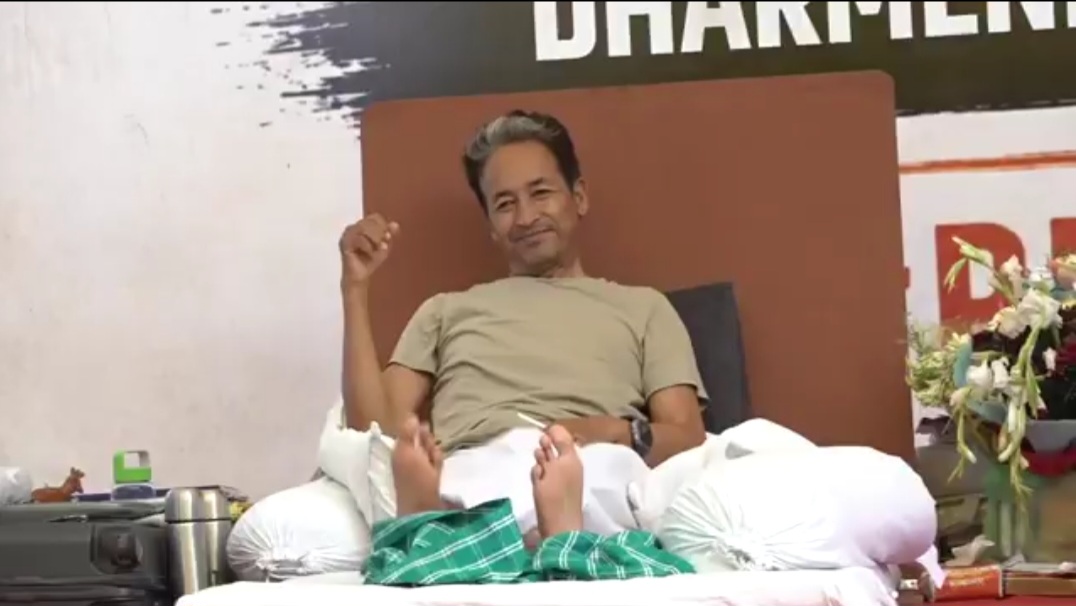

New Delhi: The Delhi High Court, during a special Sunday sitting, refused to grant interim relief to activist Sonam Wangchuk by allowing his transfer to a private hospital of his choice. His wife, Dr Gitanjali Angmo, had moved the plea.
Justice Mini Pushkarna held that the Government’s decision to shift Wangchuk from the Jantar Mantar protest site, where he has been on a hunger strike since June 28, to Safdarjung Hospital was not arbitrary, Live Law reports.
“Because Mr Sonam Wangchuk on his own volition did not check himself into any hospital facility, the Govt was within its rights to take such action as already stated,” the Court observed.
The Court noted that doctors at Safdarjung Hospital were closely monitoring Wangchuk and had only administered ORS without sugar and potassium chloride tablets with his consent. It held that no force had been used and his bodily autonomy had not been violated.
Accepting the GoI’s submission that Wangchuk’s wife and brother had access to him and had been provided a separate room, the Court said no interim order was required at this stage. It issued notice on Angmo’s writ petition and directed the Centre to file its reply within three days.
After the order was dictated, Additional Solicitor General (ASG) Chetan Sharma requested that the order record that doctors would have the right to undertake any medical intervention necessary to save Wangchuk’s life. Justice Pushkarna initially added that “Mr Wangchuk will cooperate with doctors in administering any medical intervention, as doctors feel.”
Senior Advocate Kapil Sibal objected, arguing that the observation could permit treatment without Wangchuk’s consent. Justice Pushkarna clarified that she was not issuing any such direction and proposed adding “if he chooses”. The ASG argued this could allow Wangchuk to refuse even water. The observation was eventually deleted. Sibal also sought the removal of police personnel from Wangchuk’s hospital room, while the ASG denied that police were present.
Appearing for Angmo, Senior Advocate Kapil Sibal argued that after the Delhi High Court’s July 16 order, Wangchuk was shifted to Safdarjung Hospital on July 18, where he allegedly had no access to his doctors or lawyers.
“No access to his doctors, his lawyers. We don’t know prescriptions given to him,” Sibal submitted.
He argued that since Wangchuk was neither under detention nor facing any criminal allegation, he should be free to choose his hospital. Sibal informed the Court that Medanta Hospital had agreed to admit Wangchuk and undertook that he would get admitted there if permitted.
Opposing the plea, ASG Chetan Sharma said Wangchuk’s health had deteriorated after his 18-day fast, necessitating police intervention. He told the Court that doctors from Safdarjung Hospital and AIIMS were monitoring Wangchuk’s condition.
“Even the President of India takes treatment from AIIMS,” the ASG said, adding that Wangchuk and his family should have “complete faith in the integrity of the doctors”.
“They have absolutely no reason to have any sort of remotest doubt…he has been taken care of…but he has to cooperate with the attending doctors as also with what the division bench of this Court observed,” he submitted.
The ASG said Angmo had access to Wangchuk but opposed granting access to lawyers.
“This is a hospital, not a court. What sort of prayer is this? This is befuddling,” he said, while also offering that Wangchuk could be shifted to AIIMS if the family still had doubts.
The Court also interacted with Dr Akshay, Additional Professor, Emergency Medicine, AIIMS, who informed the bench that Wangchuk had started taking ORS without sugar and potassium tablets orally but had refused intravenous fluids.
The doctor said Wangchuk’s potassium, sodium and sugar levels were borderline and his body had entered the “ketosis” phase.
Responding, Sibal maintained that Wangchuk was not under detention and asked, “Is a citizen not entitled to go to a hospital of his choice? How can the Government object?”
Justice Pushkarna questioned whether the Court had a duty to protect Wangchuk’s health after an 18-day fast and in view of the earlier division bench order.
“Is it not the Court’s duty to take care of his health when he has fasted for about 18 days and there is a division bench order?” she asked, adding that no treatment was being administered forcefully.
Sibal reiterated Wangchuk’s right to choose his hospital, saying he had previously fasted for 35 days in Ladakh without complications.
“I want to be in an environment where I want to be, where my family, friends and lawyers can visit me,” Sibal submitted.
The ASG replied that the Government had to exercise extra caution given the extraordinary circumstances.
“Whatever happens to him, it will have consequences. So the Government has to be circumspect, and extra conscious,” he said.
Dr Kavita, Medical Superintendent of Safdarjung Hospital, told the Court that Wangchuk had not expressed confidence in the hospital from the outset, leaving the doctors’ “hands being tied.”
Angmo alleged before the Court that Wangchuk was surrounded by police personnel and that officers were eavesdropping during her conversations with him. She also questioned the hospital’s assessment of his potassium levels.
According to the petition, Wangchuk’s potassium level was recorded at 4.3 mmol/L on July 17. After his transfer to Safdarjung Hospital, doctors allegedly informed the family that it had dropped to 2.9 mmol/L, requiring urgent intervention.
Angmo claimed the hospital delayed providing a blood sample for independent testing by around 10.5 hours. The subsequent private laboratory test allegedly showed a potassium level of 3.6 mmol/L, which the petition says casts doubt on the claimed medical emergency.
Addressing Angmo, the ASG said, “This is not an activist forum; this is a court. Don’t be obdurate. Activism can rest.”
She replied, “Nobody can hold me to a place against my wish unless we are detained.”
“The activist in you has taken over,” the ASG responded.
The petition contends that Wangchuk has been “illegally and unconstitutionally confined” under the guise of medical intervention after being forcibly removed from his hunger strike at Jantar Mantar. It argues that the July 16 High Court order only directed health monitoring and did not authorise his removal, confinement or denial of access to his lawyers and treating doctors.
It further claims there was no FIR, arrest order or preventive detention order justifying his continued stay in hospital. The plea alleges that medical intervention is being used to prevent Wangchuk from continuing his peaceful hunger strike and to suppress his rights under Articles 19 and 21 of the Constitution.
The petition seeks Wangchuk’s immediate release, permission to shift him to a hospital of his choice, unrestricted access for his wife, lawyers and treating doctors, disclosure of all medical records in real time, and a direction that no medicines, intravenous fluids or any other medical intervention be administered without his informed consent.