
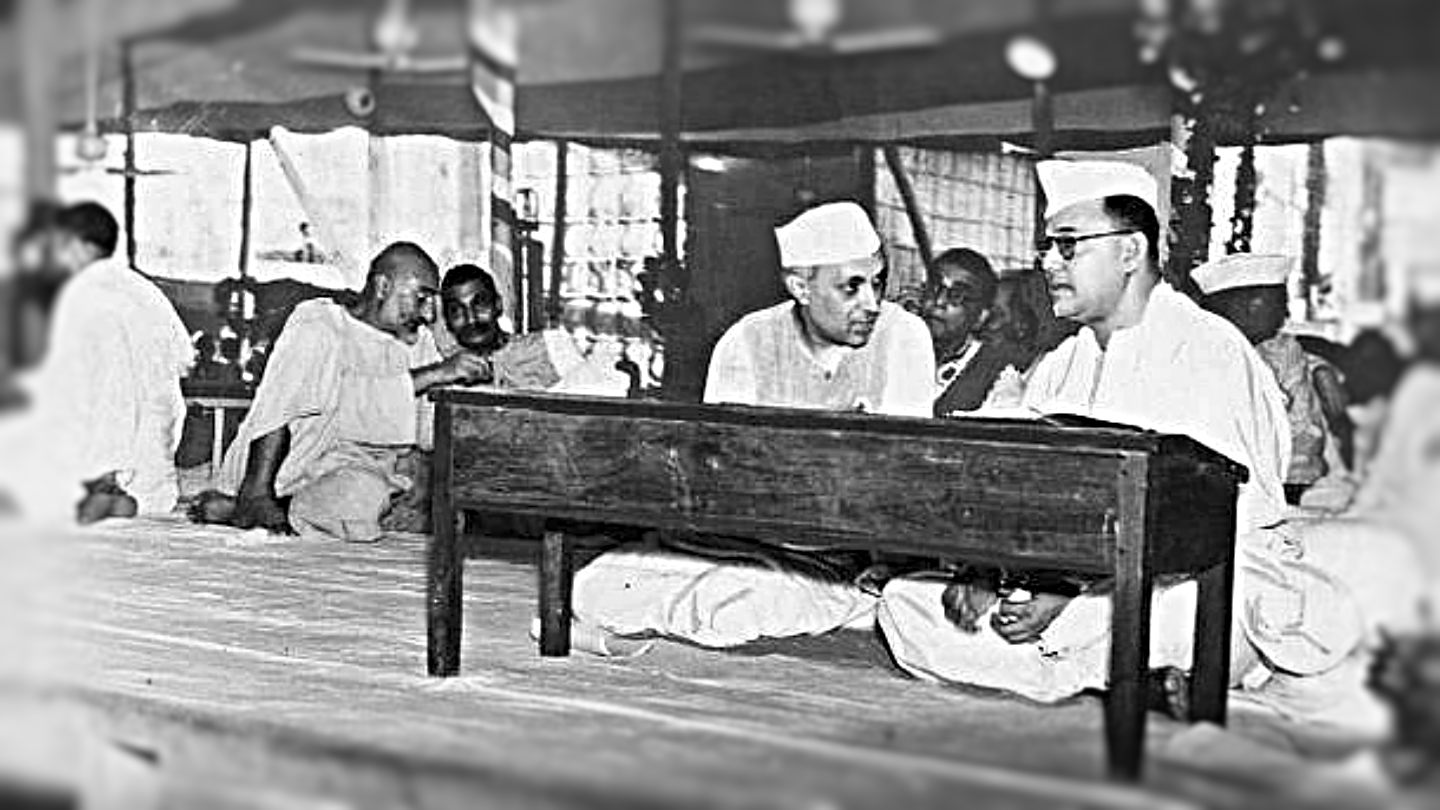

Rudrangshu Mukherjee’s book examines the friendship, disagreements and shared nationalism of two of India’s most consequential leaders.
In contemporary discussions of pre-independent India and its national movement, two men of great stature are generally confined to the boundaries of political controversies.
However, both leaders were more concerned with the future of an independent India and the welfare of its people, despite enduring long periods of imprisonment, personal hardships, and challenges within their families.
Their sacrifices reflected the courage, determination, and vision they possessed in their struggle to free their country from British colonial rule.
Rudrangshu Mukherjee, in his book Nehru and Bose: Parallel Lives, draws an outline of the lives of Jawaharlal Nehru and Subhas Chandra Bose.
In the introduction, the author proclaims, “This book tries to tell this complicated story of two men caught in turbulent times, testing their convictions sometimes against each other but always for India and its freedom.”
It shows that the book intersects two different lives with one firm vision in their minds–the idea of freedom for India. It dismantles the propaganda of converting the political differences between the two men into personal rivalries.
Both Jawaharlal Nehru and Subhas Chandra Bose were born within eight years of each other to their fathers, Motilal Nehru and Janakinath Bose, respectively.
Coincidentally, both fathers were “successful lawyers”.
In his childhood, Jawaharlal was taught Sanskrit by the renowned scholar, Ganganath Jha and other subjects by a young Irish-French theosophist, FT Brooks.
However, Jawaharlal was drawn more towards English literature, science and theosophy than Sanskrit.
Later, when Brooks stopped tutoring him, this influence gradually faded after having led Jawaharlal “to think, consciously and deliberately, of religion and other worlds.”
In a sharp contrast, Subhas’s adolescent years saw his admission to Ravenshaw Collegiate School, which boosted his self-belief and confidence.
He immersed himself in the writings of Vivekananda and Ramakrishna, and “did not stop at reading their works.”
Moreover, Jawaharlal went to Europe for further studies and was “caught up in the whirl of London life,” while Subhas’s was exactly the opposite: he was coordinating the student groups at Presidency College and was surrounded by controversy from his youth.
However, both men, who went to Europe for their studies, would in the coming years emerge as nationalist leaders and serve the single cause.
Entry into politics
Jawaharlal’s entry into politics was not a spontaneous incident.
In 1916, he met Gandhi, who was “in the process of establishing himself in Indian politics.”
In 1919, following the Rowlatt Satyagraha and the violence that erupted due to police action, Jawaharlal was drawn into political action and became part of the Congress enquiry team.
In 1920, Jawaharlal had his first encounter with the “rural world and rural people of India” when hundreds of peasants came to Allahabad to draw the attention of prominent politicians to their plight but found Jawaharlal instead.
He promised to visit them within a couple of days and encountered the misery of village life in India. His “wanderings among the kisans” also established him as a mass leader.
In contrast, Subhas went directly from London to Bombay, where the national struggle was underway; he met Gandhi and discussed the future course of the movement.
As the conversation between the two progressed, it left Subhas “depressed and disappointed.”
However, there were other figures who inspired him and he found in them “ a man who knew what he was about…and who could demand from others all they could give.”
He would later “emerge as the critic of Gandhian politics,” a position that eventually put him at odds with “Congress national leadership and with Jawaharlal.”
However, both had now emerged themselves in politics.
Subhas had spent a year-long period in prison in Burma, while Jawaharlal had been beaten by the police.
The pangs of hunger that Subhas had endured in prison and the lathi blows that scarred Jawaharlal’s back were the autographs “of the sacrifice the two young men were willing to make for their cause of nationalism.”
However, both men had accepted Gandhi’s leadership.
For Nehru, Gandhi was like a “gift of divine providence,” while, for Subhas, Gandhi was a “human being who equivocated.”
In the early years of their political activism, Jawaharlal and Subhas were also actively involved in the Congress’ efforts to mobilise youth and workers’ movements.
Jawaharlal travelled to different parts of the country and addressed youth gatherings on imperialism and capitalism.
Moreover, he travelled to Jharia to attend his first annual session of the All India Trade Union Congress.
During this period, Bose was also “fully involved in youth and working-class movements.”
He addressed the political situation at a session of the All India Youth Congress. Mukherjee notes that Nehru actively encouraged students to participate in the national movement.
He cites a footnote from Subhas’s The Indian Struggle, in which Bose wrote that “he and Jawaharlal were among the few public men who encouraged the students at the time to organise themselves.”
Mukherjee employs these episodes to underline an often-overlooked aspect of their political relationship. Despite their later ideological disagreements, both Nehru and Bose shared a common commitment to mobilising India’s youth and working classes.
The differences
The strain in the relationship between Jawaharlal and Gandhi, on the one hand, and Subhas, on the other, began to emerge after the completion of the first term of the Congress presidency in 1938.
Subhas, as Jawaharlal had earlier served two terms as Congress president, sought a second term.
Gandhi’s first choice for the presidency of the next session, however, “was Abul Kalam Azad.”
Nevertheless, after Azad withdrew following Subhas’s “substantive objections,” Bose secured Congress nomination.
He was subsequently elected Congress president for a second term despite Gandhi’s unwillingness to support his candidature.
It clearly shows Subhas Chandra Bose’s political stature and the credibility he commanded as a leader.
Jawaharlal, however, was closer to Gandhi’s position. He advised Subhas not to “stand for re-election,” believing that the capacity of both for effective work would be lessened by holding this office (the presidency) at such a stage.
In reaction, thirteen out of fifteen members of the Congress Working Committee resigned in solidarity with Gandhi.
Jawaharlal, however, did not formally resign but issued a separate statement distancing himself from Bose’s position and declined to serve on the new Working Committee. This deeply pained Subhas.
Mukherjee draws the entire episode around Gandhi’s dissent from Bose’s re-election and Jawaharlal’s advice against persisting with the presidency under such circumstances.
However, Subhas was not prepared to reverse the course he had set during his first term and remained determined to secure a second term.
His insistence precipitated a crisis within the Congress and stained his personal relations with both Gandhi and Nehru.
Seeking reconciliation, Subhas wrote to Jawaharlal while attempting to resolve his differences with Gandhi.
Bose remarked to Jawaharlal that “for some time past you have developed a tremendous dislike for me.”
Meanwhile, mutual understanding and cooperation between the two continued to deteriorate.
Subhas found himself in the unusual position of being the Congress president without the support of a Working Committee.
After prolonged attempts at a compromise within the Congress, he resigned, and the “exit from the office as Congress president thus became a fact.”
Nevertheless, Subhas continued to work for the same national cause irrespective of holding office.
Writing to his wife, Emile, he concluded that “I have not lost anything by resigning. As a matter of fact I have become more popular now.”
Meanwhile, the All India Congress Committee passed two resolutions restricting any individual from undertaking satyagraha without permission of the party.
These measures were intended to curb the radicalism associated with Subhas and the newly formed Forward Bloc.
Bose opposed both resolutions. Jawaharlal, in turn, criticised Bose’s opposition and observed that “such protests were disruptive and encouraged factionalism within the party.”
The strain in their relationship further intensified when Suhas wrote to Jawaharlal explaining his position on the formation of the Forward Bloc in a letter that contained a “personal attack on Jawaharlal…”
In response, Jawaharlal preferred to reiterate his previously stated views on the Forward Bloc while refusing to be “provoked.”
The controversy between the two subsequently became public and “caused a rift in the personal relation…”
They never wrote to each other again, marking the end of a long political friendship.