

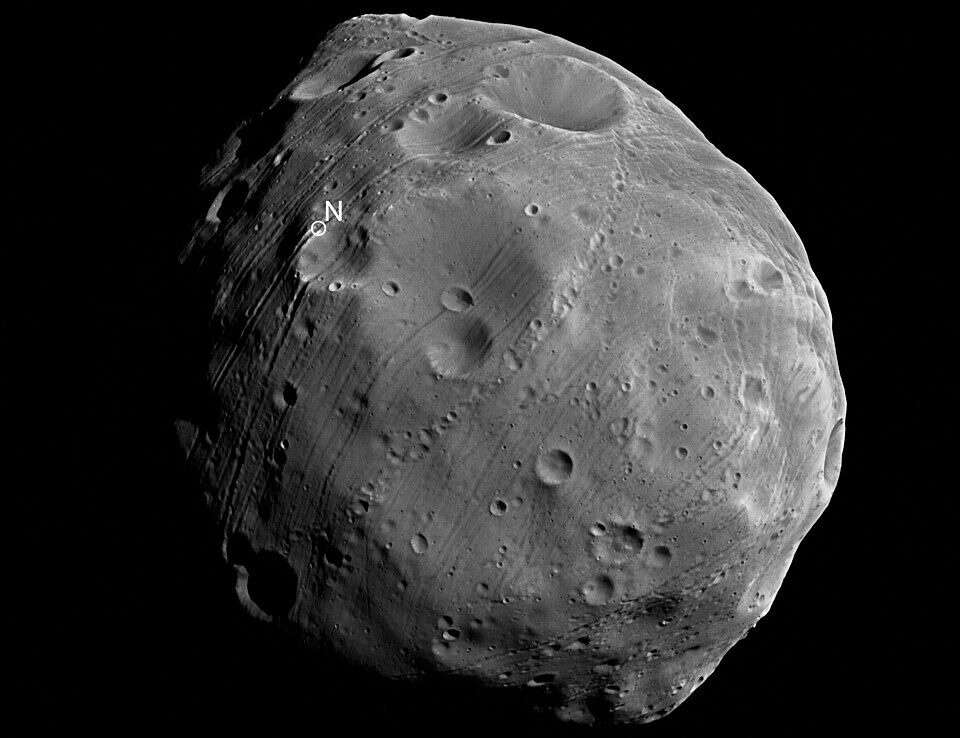

Japan is preparing to launch the world’s first mission to collect and return samples from Phobos, one of the two small, irregularly shaped moons orbiting Mars. The ambitious five-year mission aims to uncover how the Martian moons formed and could also offer insights into the origins of life in the solar system, AP reported.
The Japan Aerospace Exploration Agency (JAXA) plans to launch the spacecraft aboard Japan’s H3 rocket on Tuesday as part of its Martian Moons eXploration (MMX) mission.
Scientists believe samples from Phobos could help determine whether Martian moons could serve as bases for future human missions to Mars. The US, China and other countries are working towards sending astronauts to the red planet.
Yasuhiro Kawakatsu, project manager of the MMX mission, said the findings could provide valuable information for future Mars exploration.
“Despite their potential importance, Martian moons have never been fully investigated,” Kawakatsu said. “They are known as the most important unclimbed mountains in the solar system.”
Japan is leading the international mission with equipment and communication support from the National Aeronautics and Space Administration (NASA) and other national space agencies.
Although dozens of missions have explored Mars since the 1960s, its two moons, Phobos and Deimos, remain largely unexplored. Several Russian attempts to land on Phobos, including a mission launched in 2011, have failed.
The moons are named after the Greek mythological figures representing fear and terror, sons of Ares, the Greek god of war, whose Roman counterpart is Mars.
Scientists have proposed two main theories about their formation. One suggests that the crater-covered moons formed from debris produced when a large celestial object collided with Mars. The other proposes that they are asteroids captured from elsewhere in the solar system.
JAXA scientists believe analysing soil samples from Phobos could help resolve the mystery.
“We can almost certainly come to a conclusion by analysing soil samples,” said Kiyoshi Kuramoto, principal investigator of the mission.
Phobos was selected primarily because it orbits closer to Mars than Deimos and could contain more material originating from the planet. JAXA estimates that approximately 0.1% of the samples collected from Phobos could consist of Martian material.
Measuring about 27km across at its widest point, Phobos orbits Mars at a distance of roughly 6,000km, completing three orbits each day.
Kuramoto said studying Phobos could also help explain the origins of Deimos, as both moons are believed to share a similar history. The mission will also conduct a flyby of Deimos to gather observations.
The journey will cover an estimated 500 million to 600 million km, although Mars comes within approximately 55 million km of Earth at its closest approach.
Following its launch aboard the H3 rocket, the spacecraft is expected to reach the Mars region around August 2027. It will spend approximately three years observing Phobos, gathering scientific data and collecting samples before beginning its return journey to Earth in 2031.
The MMX spacecraft comprises three modules dedicated to propulsion, exploration and return. Only the return module will travel back to Earth carrying the collected samples.
The spacecraft will carry 13 scientific instruments, including a rover jointly developed by France and Germany, NASA’s sampling equipment and a gamma-ray measuring instrument.
It will also carry a deep-space communication device from the European Space Agency and a Japanese radiation monitor designed to collect information useful for future human missions to Mars.
The French-German rover, named Idefix, is expected to land on Phobos ahead of the main spacecraft. During its planned 100-day mission around 2029, it will examine the moon’s surface and provide information to support subsequent Japanese sampling operations.
Data gathered by the rover will help the spacecraft identify a relatively smooth and level landing site.
JAXA scientists aim to collect at least 10g of soil through two sampling attempts using Japanese and US technologies.
NASA’s device will use pressurised gas to lift surface dust into a collection container, while JAXA’s coring system will extract material from approximately 2cm below the surface.
During the first landing, the spacecraft will collect surface and subsurface samples using both systems. A second landing will focus on gathering additional material from beneath the surface.
Scientists believe collecting samples from different locations could improve the chances of detecting possible traces of ancient microbial life originating from Mars.
Landing on Phobos presents significant technical difficulties because its gravity is only about one two-thousandth of Earth’s gravity.
To prevent excessive bouncing during touchdown, the spacecraft’s exploration module has four-legged landing gear fitted with shock absorbers.
The Idefix rover is also designed to operate in extremely low gravity. Its wheels can maintain traction on the surface, and the rover can right itself if it overturns. According to JAXA, it will move “at a snail’s pace”.
Once collected, the samples will be sealed inside a heat-protected capsule designed to withstand re-entry into Earth’s atmosphere.
The return module is expected to land in Australia in 2031, after which the samples will be transported to Japan for scientific analysis.