

New Delhi: Protests at Jamia Millia Islamia continued after the university agreed to hold students’ union elections following a nearly two-week-long agitation, with protesters demanding a fixed timeline for the process, withdrawal of disciplinary action and accountability for alleged mistreatment by campus security personnel.
According to Hindustan Times and The Indian Express, the agitation began on October 12, when students launched a sit-in and hunger strike demanding the restoration of the Jamia Millia Islamia Students’ Union (JMISU), which has remained defunct since 2006. The university’s last student union election was held in 2005.
On Monday, October 26, the administration issued a written order stating that elections would take place 15 days after the students’ union constitution is approved. It also announced the revocation of suspension and show-cause notices issued during the protest and promised an inquiry into the conduct of security personnel.
However, students said the order did not resolve their principal concerns because it did not specify when the constitution would be approved or provide a definite date for elections.
Why are students protesting?
The central demand is the restoration of an elected students’ union, which protesters say would provide students with democratic representation and a formal channel to raise grievances concerning the university administration.
According to Hindustan Times, students have cited problems involving admissions, hostel accommodation and mess facilities as examples of issues that need effective student representation.
The protesters are also demanding a time-bound election schedule, the withdrawal of disciplinary proceedings against students involved in the agitation and the resignation of the university’s Chief Proctor. They have raised concerns about the treatment of protesters by security personnel.
The Indian Express reported on October 26 that students sought a commitment that the union constitution would be drafted and approved by December 20, followed by an election notification within 15 days. They also objected to a provision requiring students to publicly apologise for allegedly defamatory statements, actions or social media posts directed against the administration.
Lubaib Basheer, one of the protest organisers, told The Indian Express that the agitation would continue until the administration provided a fixed timeline and addressed the outstanding demands.
Why has the university’s announcement failed to end the protest?
The university’s October 26 order was issued after negotiations between officials and student representatives. According to The Indian Express, the order linked the election schedule to the approval of the union constitution but did not set a deadline for that approval.
Students have argued that this leaves the electoral process uncertain. They have also said that revoking suspensions and show-cause notices does not necessarily resolve other disciplinary measures, including campus bans and rustication.
The apology provision has emerged as another point of contention. Protesters have objected to being asked to apologise for their participation in the agitation, maintaining that peaceful protest is a legitimate right.
The university, meanwhile, has maintained that the constitution must be prepared in accordance with applicable regulations, relevant court rulings and the Lyngdoh Committee recommendations governing student union elections. A university official told The Indian Express that the process would involve drafting the constitution, preparing electoral rolls and then announcing elections.
Protests escalate amid police deployment
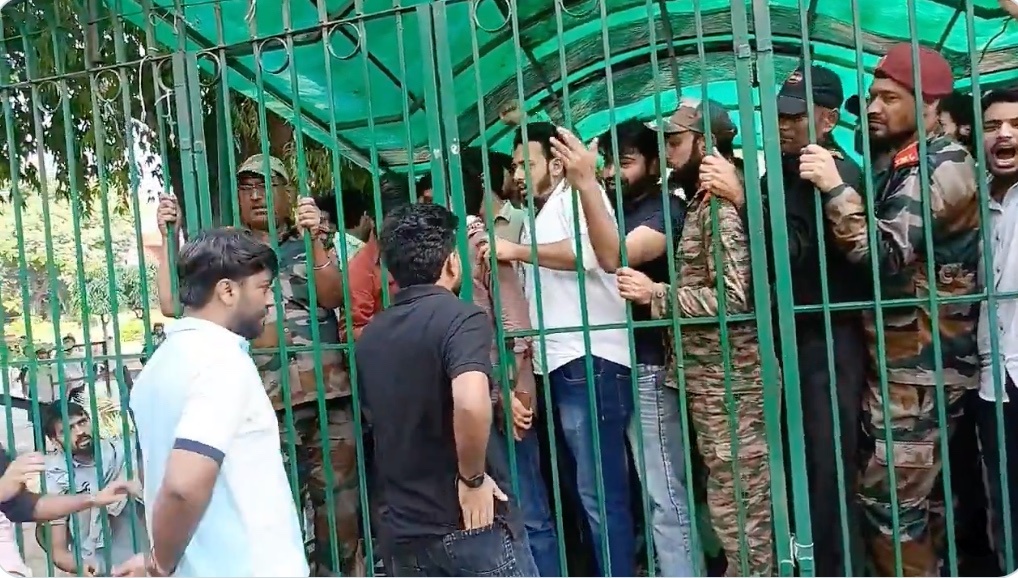
The agitation intensified over the weekend, with clashes between protesters and security personnel reported at the university.
The Times of India reported on October 25 that the university moved classes online and restricted campus access after tensions escalated around the hunger-strike site at Ghalib Lawn. The administration said the decision was taken as a precaution to safeguard students and academic activities.
The Indian Express reported that hundreds of students gathered on Sunday, October 25, while security personnel were deployed around the campus. Some students attempted to enter the university premises by climbing boundary walls after access was restricted.
On October 26, Hindustan Times reported fresh protests following the election announcement, with students demanding the appointment of a chief election officer and a faster, clearly defined electoral process. The newspaper also reported that several protesters were detained by Delhi Police.
According to Maktoob Media, students continued their agitation on October 26 and alleged that protesters were being prevented from entering campus. The outlet also reported that the administration had directed hunger-striking students to vacate the protest site, warning of disciplinary and legal consequences.
These accounts describe allegations by protesters and reported police action; they should not be treated as independently established findings of misconduct.
What happens next?
The immediate question is whether the administration will agree to a binding timeline for approving the students’ union constitution and conducting elections.
Students have called for the constitution to be finalised by December 20 and elections to be notified within 15 days of its approval. They have also sought the withdrawal of all disciplinary measures linked to the protest and rejected the demand for a public apology.
The university’s October 26 order represents a commitment to resume elections, but the lack of a deadline for approving the constitution remains a major point of disagreement.
As of the latest reports reviewed for this article, the dispute remains unresolved, with students insisting that the protest will continue until their outstanding demands are addressed.