
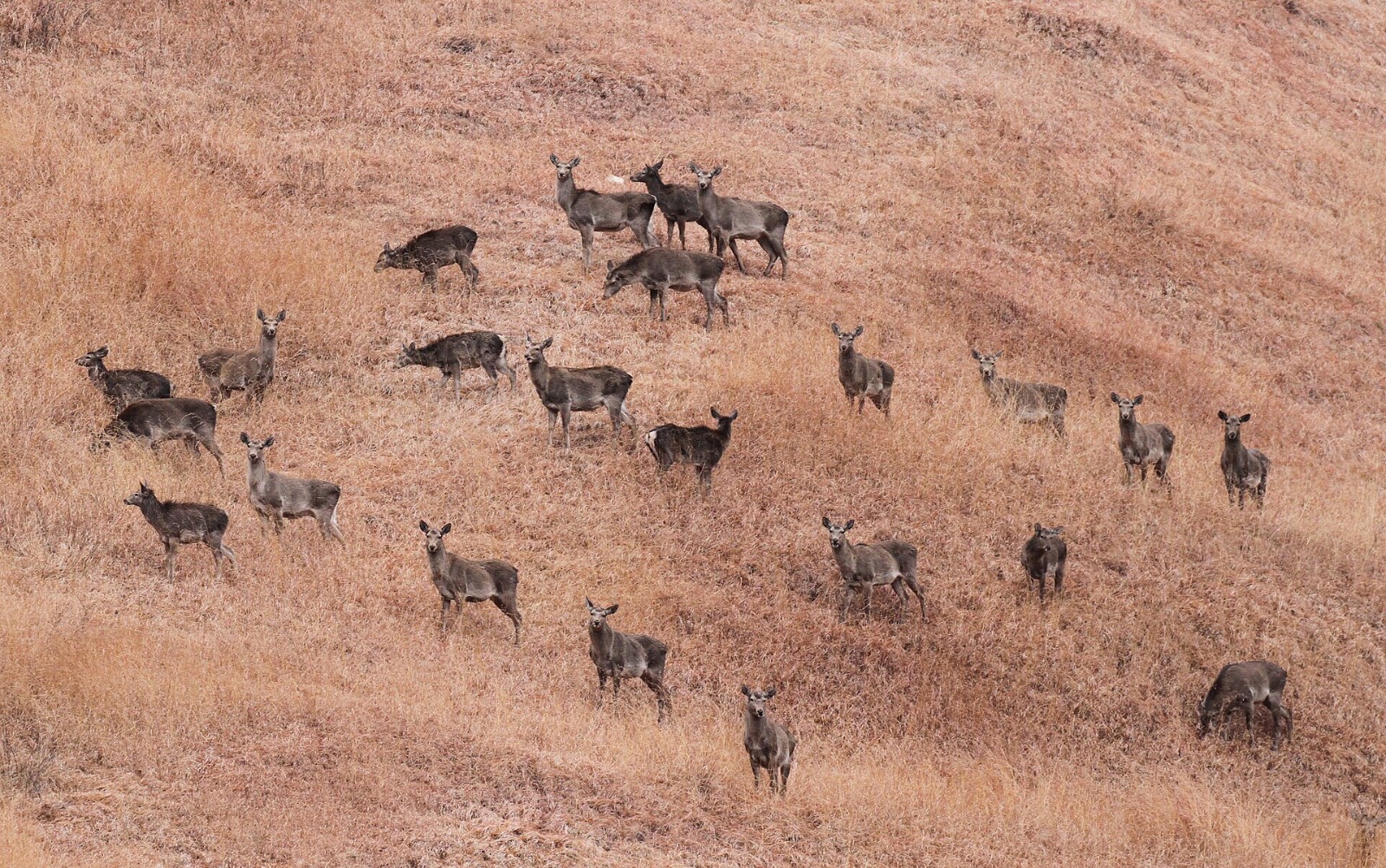

Historically, the Kashmir stag, also known as the Hangul, was found throughout the Kashmir
Valley. Its habitat extended from Burzil Pass near Astore to Chamba district in Himachal Pradesh, and from the Pir Panjal passes to Drass.
Today, however, the Kashmir stag has been practically restricted to Dachigam Wildlife
Sanctuary. Occasionally, it is also spotted in the hilly areas of Anantnag, Pulwama, Ganderbal,
and Bandipora, apart from Srinagar.
Historical range
In 1965, E P Gee wrote in his paper that “there are reported to be a few, perhaps only half a
dozen, hangul in the Chamba District of Himachal Pradesh.” By the 1970s, the hangul had disappeared from this region as well.
Similarly, near Burzil Pass in Astore, the last recorded sighting of a Hangul dates back to 1955, and it has not been seen there since. However, on this side of the LoC, in Gurez, Hangul are still occasionally sighted today.
In Neelum, too, the last sighting dates back to 1950s, with no subsequent official reports from
the area.
This clearly indicates that the species' geographical range has shrunk. The same is true of other districts in Kashmir, including Budgam, Baramulla, Kupwara, Shopian, and Kulgam. There have been no reports of Hangul sightings in Drass, Kishtwar and Bhaderwah for decades.
Historical population
Along with its geographical range, the Hangul population has also declined dramatically. These
figures clearly illustrate how its population has dwindled over the past century.
According to estimates, between 1,000 and 2000 Hangul deer inhabited Kashmir in 1901, at the
beginning of the twentieth century. Hangul population between 1969 and 1970 range from not more than 180 individuals (Schaller 1969) to 140-170 (Holloway 1971). The population has
never crossed the 1,000 mark, even to this day.
Today, the Kashmir stag population stands at 327 individuals. According to an official census
estimate from 2007, only 127 Hangul remained in the Kashmir Valley. Recovering from 127 to
327 individuals is a significant achievement, but in the broader picture, we have not made
particularly remarkable progress.
During this same period, considerable efforts have been made elsewhere in the world to rescue similarly threatened animals from extinction. For instance, in the India, the population of an animal called the Indian swamp deer has reportedly increased from 66 to 3000 individuals through conservation efforts. This demonstrates how effective dedicated conservation measures
can be.
So, where exactly is Kashmir going wrong?
Restoring the Hangul’s Historic range and migration routes
There are several issues that need to be addressed. First, we must restore the Hangul’s historical migration routes across Kashmir, particularly the major corridor connecting Gurez-Dachigam-Pahalgam-Kishtwar.
One of the biggest obstacles along this route is Sonamarg, where highways and other roads make it difficult for these animals to move between habitats. Wildlife overpasses could be constructed above highways to facilitate their movement.
Large wildlife bridges, potentially at least 50 metres long, could help the Hangul cross these barriers safely, allowing it to reach Gurez and Tulail and thrive there.
Similarly, establishing a wildlife sanctuary in the Tulail (Gurez) and Lolab-Chandaji area of
Bandipora and Kupwara could help the Hangul population double within a relatively short
period.
The same approach should be adopted in Kishtwar. Historical routes connecting Kishtwar with Dachigam must also be restored.
By establishing a network of protected areas throughout this landscape, we could reopen an extensive corridor for the Hangul, allowing it to move freely and thrive across a much larger geographical range.
Even within Dachigam itself, the Hangul does not enjoy complete freedom from disturbance.
Dachigam must remain an environment where the Hangul can live without disturbance—human disturbances.
If the Hangul’s presence can be successfully restored through the Banihal Pass, its population could once again extend towards the Pir Panjal range. Similarly, if connectivity is restored through Razdan Pass, the species could eventually return to Lolab as well.
Ultimately, the key issue is habitat connectivity. The Hangul’s traditional routes have been
severely disrupted by construction activities, highways, roads, roadside eateries, bahaks, and the establishment of camps.
These disturbances have made it increasingly difficult for the species to access its former habitats. In many of these areas, the Hangul may now be reluctant to venture at all.
There are government sheep farms in Dachigam, from which diseases can spread to the Hangul, and competition for food also increases. There are other government offices and army camps in Dachigam.
The water in the streams here is also drying up. Therefore, there is a need to expand
the areas of Dachigam, so that the Hangul can get a larger area to thrive and reproduce.
We should also take advantage of the technological advancements made around the world and use them to support Hangul conservation. International experts could be consulted to help develop effective strategies for increasing its population and restoring its habitat.
The Hangul is perilouslyt close to extinction. Its population could collapse following even a
single epidemic or other major disturbance. Even a relatively minor disruption could cause its already fragile numbers to decline further.
Unless we restore its habitat, reconnect its historical migration routes, and protect it from further disturbance, the future of the Kashmir stag will remain deeply uncertain.