

They are averse to conforming to societal norms, understand discrimination and subjugation, and sometimes even exhibit their desire for liberty. But somehow, miraculously, they struggle to remember their own individuality and liberty, only to accommodate men in their lives and forgo their liberty in the bondage of marriage by making one sacrifice after another.
Most of these acts are canvassed as sacrifices mandated by religion from a pious and righteous woman. The genesis of her characters begins with rebels who don’t conform to patriarchy but mature into reluctant conformists who eventually make peace with the very same controlling system. The reluctant rebel in her work is only a rebel when her rebellion is approved by society, including its men, who are also her tormentors.
Her work has gained prominence over the years, and besides novels, it has also been adapted into screenplays for multiple famous Pakistani dramas. Umera Ahmed’s prominence cannot be denied, and her writing prowess cannot be ignored. To be fair to her, she has raised some important problems in her work, ranging from class disparity to gender issues, religious identity, etc.
Despite all this to her credit, Ahmed should not be immune to a critical analysis of her work. Even if she starts by using a sympathetic and friendly tone towards women, she has struggled to transform it into a redeeming plot of their emancipation from gender-based violence and patriarchy in a male-dominated society.
Sometimes, she brings tears to the eyes of her readers when they read about her female characters. She is able to induce a sense of sympathy for them through her writing, and she also succeeds in reawakening the very patriarchal tropes that create the fundamental basis for their pain and suffering.
We notice a similar flip-flop in Dar-e-Nijaat. The famed Pakistani drama revolves around a female character, Zaryab, whose ambitions and their social significance, given her gender, are noteworthy to begin with. An extraordinary, affluent and highly educated woman who is set to enrol herself in Harvard Business School, Zaryab is the definition of a woman who has everything one could only imagine in their distant dreams. This side of her character represents a strong, intelligent, and opinionated woman.
On the other side, she has an insecure and sexist man named Zamil in her life. To maintain his sense of gender security and dynamics, Zaryab is willing to give up her own academic ambitions. The character is strong and has everything she needs to seek an independent future, given the privilege she has, but her servility to a man’s emotions and insecurities convinces her to let all of it go in an instant.
It is understandable that choosing love is an individual’s personal choice, and Zaryab is also entitled to it. However, the uncomfortable question here is whether she should choose Harvard or Zamil. She could be successful, intelligent, and extraordinary, but it all boils down to bringing all of it to the negotiation table when Zamil’s emotional needs as a man enter the conversation.
Further the show progresses, the more we understand Zamil as an envious, toxic, and very insecure man who is unsettled by Zaryab’s excellence and success. He simply cannot reconcile with it, and this creates the basis for the friction between the duo.
Instead of dissecting his insecurities, Umera Ahmed makes Zaryab reassure, accommodate, and redeem Zamil from his own toxicity and insecurities. She has to walk on eggshells when it comes to her ambitions and Zamil’s shallow insecurities.
Even the name itself is quite interesting: Dar-e-Nijaat. One might take it to signify liberation and emancipation. But emancipation from what exactly? Is liberty subject to the bondage of a marriage with a seemingly “suitable man”? Is it a matter of somehow finding spirituality and letting everything go? Is liberty bereft of women’s personal ambitions, or is it inconsiderate towards their education? Is their own professional career of no significance? Above all, does Umera Ahmed’s definition of an independent and powerful woman leave no place for existing as an individual without the equation of romantic relationships with men?
Zaryab’s character arc doesn’t make you wary of her heartbreak; rather, it demands that you ask whether her own intellectual ambition was worth existing irrespective of the emotional demands of her relationship with Zamil. She is one in a million who has secured admission to one of the most illustrious educational institutions in the world, and yet the narrative around her character doesn’t even give this aspect the seriousness it deserves. Ahmed spends much of her time dwelling on her romantic disappointments, which are not her own in the first place.
Dar-e-Nijaat is not her only contradiction. Just like Dar-e-Nijaat, Umera Ahmed creates a character, Kashaf Murtaza, in Zindagi Gulzar Hai, which is unarguably one of her most famous works. Kashaf has a humble beginning; she puts up with the toxicity of her father, who eventually goes on to abandon her because her mother couldn’t bear him a son. Kashaf is shown as someone who understands gender discrimination through the experiences she has had as a first-hand recipient of this social evil. The story also reflects on Rafia, Kashaf’s mother, who braves all odds to educate her daughters. Kashaf’s tenacious attempt to break the ice and achieve economic independence goes beyond her ambition and is an act deeply rooted in resistance in an insensitive society that offers no remedy to women’s financial woes.
Umera Ahmed’s critical sketch of Zaroon’s chauvinism remains the strongest pivot of the drama’s feminist elements. Kashaf doesn’t relent, nor does she eulogise male dominance. She goes on to challenge the very premise that is used as a medium by men to control women. Despite all this, Umera Ahmed fails to steer the narrative as a women-centric edifice of their existence and places marriage as a paramount responsibility in contrast to individuality and aspirations. The professional focus that Kashaf receives initially does not continue with the same vigour and is slowly replaced by her compliance with the emotional trauma of marriage. The story loses its ethos as it struggles to remain coherently attached to the beginning of the drama. The existence of the relationship, envy, domestic compromises, and trust issues receive more attention as the story progresses.
One cannot object to the representation of marriage in her literature, but the way Umera Ahmed distributes the moral and emotional responsibility here raises many questions. Zaroon is repressive, toxic, and a male chauvinist at heart, and his character undergoes the ideal development with the passage of time. On the other hand, Ahmed also places the responsibility of accommodation, trust, and compromise on Kashaf. Zaroon is given ample time to improve, whereas Kashaf is made responsible for guaranteeing the survival of their relationship.
Umera Ahmed spoke to The Indian Express in 2020, where she admitted that Zindagi Gulzar Hai deliberately steered clear of breaking the glass ceiling from a feminist standpoint. She revealed that retaining some conservative social underpinnings in it was a conscious decision to maintain its popularity. That interview reflects how dissecting patriarchy also demands one’s intention and willingness to challenge it. Literature can paint a picture of the problems in society, but those problems should not be used to place women within those limitations.
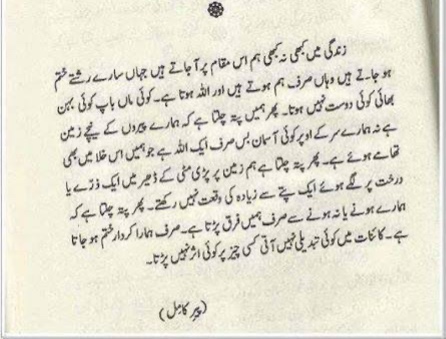
The issues with Umera Ahmed’s writing are further galvanised in Peer-e-Kamil and Aab-e-Hayat. In Imama Hayat, Ahmed inculcates rebellion as a key ingredient against familial coercion to maintain her religious identity. She doesn’t surrender her opinions and stands up to her oppressive family structure. The element of resistance needs to be acknowledged, and to dismiss it solely because of a religious outlook would be sheer intellectual dishonesty.
So, after taking the first step towards agency, it is expected that the character will move beyond that initial act. The future of women depends on the narrative that will allow them to construct their own identities. Imama’s professional ambition comes under question within the larger narrative. Despite being a doctor, her professional life doesn’t receive much attention, while Salar’s professional, intellectual, and economic projection gets considerable attention in Aab-e-Hayat. Men have a free pass to evolve through material pursuits; they can have a dynamic public identity, whereas women are explained through relationships, spiritual resurgence, and domestic duties.
Umera Ahmed generally relies on religion to develop her female characters in her works. If religion is not an impairment, why can’t she let her female characters be spiritually committed, professionally ambitious, financially strong, and intellectually fulfilled? Why does she have to showcase female spirituality from a perspective of self-denial and position men as strong, ambitious, and inclined towards material ambition and success? That is the underlying problem.
Understanding the depiction of a woman’s suffering and imagining her emancipation are two entirely different things. A perception can be presented as sympathetic towards women while, at the same time, passing off their suffering as a test of faith that they have to endure with patience. In 2017, an academic study by Muhammad Akbar Khan and Shazia Riaz Dar was published in Meyar. They examined Meri Zaat Zarra-e-Benishan, a novel by Umera Ahmed, from a feminist critical perspective. The study argued that although Ahmed apparently advocates for oppressed women, the narrative in the novel gradually falters and condemns them to subordination.
It becomes a matter of fate and destiny for them, which they have to endure and live with. Saba’s self-flagellation, her objectification, and her insignificance in her own eyes were examined in another study published in the Human Nature Journal of Social Sciences. It revealed the enormous mountain of unrealistic and unjust expectations placed upon her.
It becomes evidently clear that sympathy and actual attempts at emancipation for women differ by great margins. Making an audience cry for an oppressed woman while completely overlooking the mechanisms of her oppression, ignoring the social structures responsible for it, and celebrating a pious and chaste womanhood pans out very badly for a serious writer who herself happens to be a woman.
Umera Ahmed not only reinforces the prevalent conservative stigmas and stereotypes about women, but she also uses her characterisation to divide them into the morally upright and evil, desirable and undesirable. The woman of virtue exhibits patience, is modest, forgives, and is spiritually awake and conscious. Conversely, a morally corrupt and compromised woman is associated with vanity, materialism, and enjoying too much liberty, freedom, and self-desire. She reduces female choices while handing over an abundance of the same to her male characters.
Men are allowed to make mistakes; they are allowed to transform, and their flaws are shown as stepping stones towards a redeemed future. She doesn’t expect moral discipline from them from the beginning, nor does their suffering transform into a cautionary life lesson of any sort in Umera Ahmed’s world of fiction.
A writer with philosophical and intellectual honesty has to allow her female characters to breathe and rebel limitlessly against injustice and subjugation without using subtle misogynistic tropes. If a character has the ability to confront her father, question patriarchy within her family, and call out male chauvinism, then she should be allowed to shake the roots of the very social arrangement and structure that governs her life and ensures her subordination. Female independence cannot be conditional, nor can it be dismissed once it starts to challenge the conventional idea of marriage and domestic life.
Popular fiction has a large part to play in this matter. Stories are not cooked in an ideological vacuum. They plant ideas that drive people into believing what is acceptable and what is not. They define the limits of morality and piety. If we characterise educated women as bulwarks of sacrifice who give up their ambitions at the very instance when society tests their emotional maturity in terms of relationships, and when their worth is weighed on the scale of patience and self-denial, then such a work of literary fiction warrants critical examination.
Umera Ahmed could like her own gender, she could have sympathies with it, and she could write emotionally charged stories about women’s suffering. But the question still remains: Is she ready to imagine the individuality of a woman who is entitled to her opinions and ambitions? Is she willing to recognise and celebrate a woman who is completely fine with her imperfect choices, complicated desires, and futures that do not have men at their centre?
Education alone is not a sign of empowerment; wealth alone doesn’t define gender privilege. So, using such things at the beginning of a novel does not actually prove the point that the majority of Umera Ahmed’s work tries to establish. The destination of the character could be a worthy indicator to gauge empowerment in these sensitive and nuanced matters. This remains Umera Ahmed’s major limitation in most of the protagonists in her novels. They desire and dream, but when the plot matures, their dreams and desires are stripped away from them.
They are allowed to imagine resistance to patriarchy, only to later reconcile with it in a “respectable” compromise. Sensitive literature with women as its central characters has to let female characters imagine a world beyond enduring the status quo. They have to imagine a world without men deciding their choices and the meaning of a purposeful life socially, financially, and politically.
(Sheikh Imran is a Jammu and Kashmir-based writer and freelance columnist. He can be reached at [email protected].)