

There was a time when evenings in Kashmir brought children out of their homes and into the neighbourhood streets, courtyards and open spaces. Once their schoolwork and daily chores were done, they would gather with friends, carrying a few marbles, a wooden stick or simply the excitement of playing together. What began as a casual gathering would soon turn an ordinary patch of ground into a lively playground, filled with laughter, friendly competition and the carefree spirit of childhood.
These were not organised sporting events, nor did they require expensive equipment. They were everyday games that formed an important part of growing up. Long before smartphones, video games and indoor entertainment became common, traditional sports and outdoor activities provided children with countless hours of recreation. Many of these games have gradually disappeared from the daily routines of younger generations, making their history worth revisiting.
One of the familiar games of that period was gilli-danda. Played with two wooden pieces, one short and another longer, it tested a player’s timing, accuracy and coordination. The smaller piece was placed on the ground and struck with the longer stick, sending it into the air before another powerful hit propelled it forward. Other players would attempt to catch it or measure the distance it travelled, depending on the rules followed by the group. The game could be organised almost anywhere, provided there was enough space to play.
Another favourite was kanche, or marbles. Small, colourful glass balls held considerable attraction for children. Players would make a small target or circle in the soil and attempt to strike particular marbles using another marble. A successful shot required a steady hand and a good understanding of distance. Children often developed their own playing techniques, and the game could continue for long periods without requiring anything beyond a few marbles and a patch of ground.
Pithoo, commonly known in different parts of the subcontinent as seven stones, was another popular group activity. A small pile of flat stones was arranged in the playing area. One team tried to knock the pile down with a ball, while the opposing team attempted to prevent them from rebuilding it. The players had to move quickly, communicate with teammates and avoid being struck by the ball. Its combination of speed and strategy made it particularly enjoyable for groups.
Kho-kho and kabaddi also occupied an important place in the sporting experiences of many children. Kho-kho required players to chase their opponents through a marked playing area, using quick movements and carefully timed decisions. Kabaddi, meanwhile, combined physical strength, breath control and tactical thinking. A raider had to enter the opposing team’s territory, attempt a touch and return safely. Both games demonstrated that athletic ability could be developed without sophisticated sporting facilities.
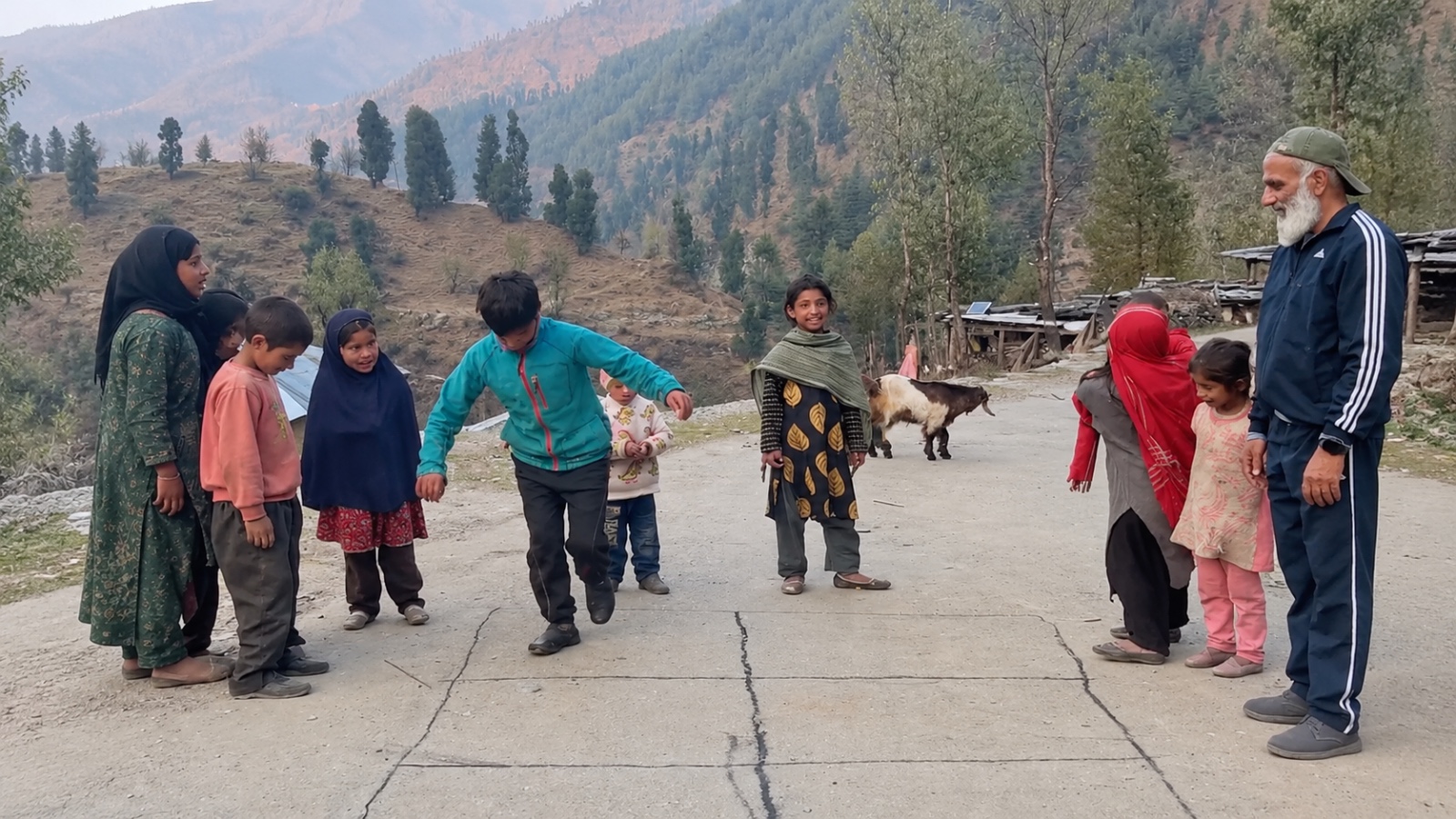
Hopscotch was another familiar activity, particularly among younger children. A series of numbered boxes was drawn on the ground, and players hopped through them on one foot while trying not to cross the marked boundaries. Although simple in appearance, the activity required balance and concentration. Hide-and-seek offered an entirely different experience, turning familiar surroundings into places of discovery. A wall, staircase, courtyard or nearby tree could become the perfect hiding place.
Some games were closely connected with the changing seasons. During winter, when snow covered rooftops and open spaces, children found different ways to entertain themselves. Snowball games and friendly competitions became part of the seasonal experience. These activities were not necessarily formal sports, but they reflected the ability of children to find recreation in their surroundings and make use of whatever nature offered.
The traditional sporting culture of Kashmir was not limited to children’s games. Wrestling, particularly in its traditional forms, has also had a place in the region’s physical culture. Wrestling demanded strength, stamina, discipline and technical understanding. The sport carried an appreciation for physical training and the ability to compete through skill rather than equipment. Traditional wrestling practices also connected sporting activity with community gatherings and local sporting interests.
In rural areas, open fields and village spaces provided opportunities for informal competitions. Children and young people often played football and cricket with improvised equipment, while other groups participated in running and physical contests. The boundaries between organised sport and casual recreation were not always clearly defined. A friendly match could begin spontaneously and attract spectators from neighbouring households.
What distinguished these traditional games was the freedom with which children participated. They did not always wait for an adult to organise an activity or provide instructions. Players selected teams, decided the rules and worked out disagreements as they arose. Older children frequently introduced younger ones to unfamiliar games, helping them understand the techniques and traditions associated with each activity.
These experiences also offered lessons that extended beyond the playing area. A child who lost a game had an opportunity to accept disappointment and prepare for another attempt. Someone who broke a rule had to face the objections of teammates. Players learned to cooperate, take turns and recognise the abilities of others. Such experiences formed part of everyday social development without requiring formal lessons.
However, the environment in which children grow up has changed considerably. The widespread availability of smartphones, television and digital entertainment has introduced new forms of recreation. Many children spend a significant part of their leisure time indoors, engaging with online games and social media. Digital platforms have their own entertainment value, but they cannot fully reproduce the experience of physical interaction and spontaneous outdoor play.
The availability of open spaces is another important consideration. In several residential areas, expanding construction and limited playground facilities have reduced opportunities for children to gather and participate in outdoor activities. Even when young people wish to play, finding a suitable and safe place can be difficult. This is particularly relevant in densely populated neighbourhoods where recreational spaces compete with other urban needs.
Changing family routines and academic pressures have also influenced children’s leisure activities. School assignments, tuition classes and competitive examinations leave many young people with limited free time. Parents naturally want their children to perform well academically, but physical recreation should not become an unnecessary casualty of educational expectations. A balanced childhood needs opportunities for learning as well as movement, play and social interaction.
Modern sports, meanwhile, have opened new possibilities for young people across Kashmir. Football academies, cricket clubs, martial arts centres and school competitions are helping children explore their abilities in structured sporting environments. Young athletes now have opportunities to receive professional coaching, participate in tournaments and pursue ambitions beyond their immediate neighbourhoods. These developments represent an encouraging chapter in the region’s sporting journey.
Traditional games should not be viewed as competitors to modern sports. Both can exist alongside one another. A child interested in football can also enjoy pithoo, while a young athlete training in a sports academy can participate in kho-kho or kabaddi during school activities. Introducing traditional games does not require abandoning contemporary sporting opportunities. Instead, it can broaden the range of experiences available to children.
Schools could play an important role in making this possible. Annual sports days could include traditional competitions alongside athletics, football and cricket. Teachers could invite older community members to explain how particular games were played and demonstrate their rules. Such activities would allow children to experience these games rather than simply encounter their names in conversations or books.
Local sports clubs and community organisations could also arrange neighbourhood tournaments. Small competitions in gilli-danda, kanche, pithoo and kho-kho could encourage participation across age groups. These events would not need elaborate arrangements. Clearly marked playing areas, appropriate safety measures and basic equipment would be sufficient for many activities.
Parents and grandparents have another valuable contribution to make. Their memories provide a connection to a sporting culture that younger generations may never have experienced. Instead of describing these games only through stories, they can introduce children to the actual methods of playing them. This exchange can create meaningful opportunities for different generations to spend time together.
There is also a need to document traditional games systematically. Their local names, variations, rules and regional differences could be recorded through interviews, photographs and short educational videos. Some games may have different names in different parts of Kashmir, while their playing methods may vary from one village or neighbourhood to another. Recording these differences would help preserve a valuable part of the region’s recreational history.
Kashmir’s sporting identity has room for both its emerging athletes and the ordinary games that shaped earlier generations. The development of modern facilities and professional training deserves attention, but sporting progress should also recognise the importance of accessible recreation at the community level.
Perhaps the best way to understand the value of these games is to remember what they meant to those who played them. For many, they were not simply activities to fill an afternoon. They were occasions to meet friends, discover new skills, settle friendly rivalries and enjoy the freedom of childhood.
The challenge today is not to recreate the past exactly as it was, but to ensure that its most valuable experiences are not lost. A generation growing up with modern technology should also have the opportunity to discover the pleasure of a simple outdoor game.
The future of sport in Kashmir can embrace modern stadiums, professional coaching and international ambitions while keeping its traditional roots alive. Sometimes, all it takes to begin that journey is a small open space, a few children and a game that their grandparents once played.