

“He has put a knife on the things that
held us together and we have fallen apart”
For decades, that line from the novel Things Fall Apart by Nigerian author Chinua Achebe has survived because it speaks to societies far beyond colonial Nigeria. It speaks of places where neighbours no longer see each other as part of the same community, but only through religion, identity and fear.
India, today, increasingly feels like such a place.
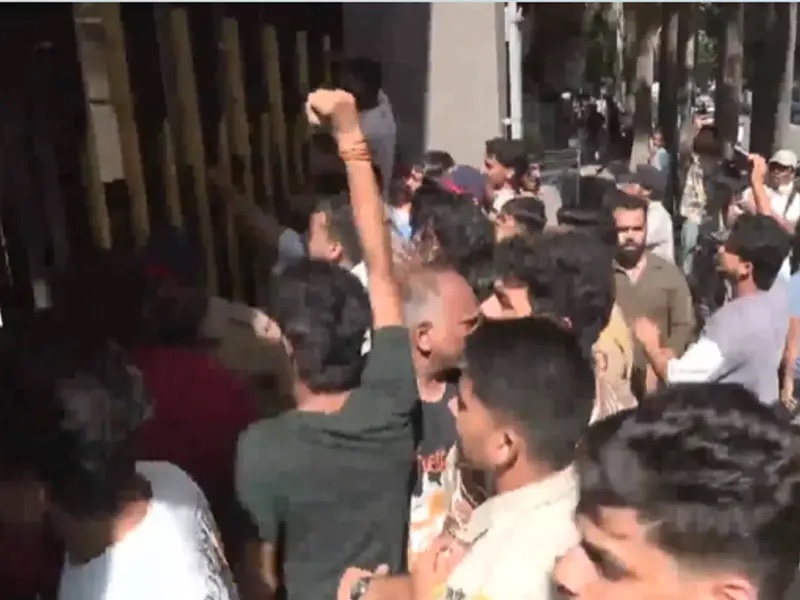
Recently, in Mira Road near Mumbai, a dispute over goats brought for Eid al-Azha spiralled into communal tension. Soon after, in Dindoshi, another housing society witnessed protests over sacrificial animals. A pig was brought by Hindus near one protest site as a provocative counter-symbol. Police arrived, political workers arrived, outrage arrived. What disappeared almost instantly was the possibility of ordinary conversation.
At first glance, these appear like small local disputes. But societies do not fall apart dramatically in the beginning. They fray quietly, inside housing societies, school WhatsApp groups, television studios and neighbourhood arguments. The collapse begins not with violence, but with suspicion becoming normal.
Achebe understood this long ago.
In Things Fall Apart, the tragedy of the Igbo society is not merely colonial intrusion. The deeper tragedy is internal fragmentation. Fear, insecurity and wounded pride weaken the community from within long before it collapses externally. The centre weakens emotionally before it breaks politically.
India’s fractures today often follow the same pattern.
Every festival now appears capable of becoming a flashpoint. A procession, a slogan, a loudspeaker, a prayer, a social media post, even food habits — everything is increasingly interpreted through the lens of communal identity. Public life feels permanently tense, as though coexistence itself has become a negotiation rather than a shared instinct.
In India, according to a Guardian May 25 report, anti-Muslim sentiment has increasingly moved from the fringes towards the political mainstream. Inflammatory rhetoric, mob violence, discriminatory legislation and the growing marginalisation of Muslims are all evidence of a climate that has been encouraged and insufficiently challenged by political and international leadership. What emerges is not merely prejudice, but the normalisation of exclusion under the language of nationalism.
Earlier this year, the India Hate Lab (IHL), a project of the Center for the Study of Organized Hate (CSOH), released its 2025 annual report documenting 1,318 in-person hate speech events targeting religious minorities, primarily Muslims and Christians, across 21 states, one Union Territory, and the National Capital Territory (NCT) of Delhi in 2025. This represents a 13% increase from 2024, and 97% increase from 2023, when 668 such incidents were recorded.
The hate speech events were classified under the United Nations definition of hate speech and encompassed conspiracy theories, calls for violence and arms, appeals for social or economic boycotts, demands to seize or destroy places of worship, dehumanising language, and speeches targeting Rohingya refugees living in India.
A total of 1,289 speeches, or 98%, targeted Muslims, either explicitly in 1,156 cases or alongside Christians in 133 cases, marking a nearly 12% increase from 2024. Hate speech targeting Christians was recorded in 162 incidents, accounting for 12% of all events, either explicitly in 29 cases or alongside Muslims in 133 cases. This reflects a 41% increase from the 115 anti-Christian hate speech incidents documented in 2024.
“A man who makes trouble for
others is also making trouble for himself”
Like the Igbo society in Things Fall Apart, the danger for India today is not just political division, but the slow normalisation of fear and suspicion in everyday life. Across many parts of the country, Muslims increasingly find themselves questioned over what they eat, where they pray, what they wear and even how they celebrate their festivals. From housing society disputes over Eid sacrifices to hate speeches, lynchings, bulldozer politics and social boycotts, the message often feels the same — that one community must constantly explain its place in the nation.
Achebe’s novel reminds us that societies do not break in a single moment. They weaken slowly when people begin seeing each other only through identity and distrust. The damage of such division never remains limited to Muslims alone; it changes the moral character of the entire country. A nation can survive economic crises and political instability, but it becomes far more fragile when citizens stop trusting one another.
Achebe’s protagonist, Okonkwo, is ultimately consumed by fear: fear of weakness, fear of losing control, fear of change. That fear hardens him until he can no longer understand the world around him. Societies often behave the same way. In trying to aggressively protect one identity, they end up weakening the larger social fabric that once allowed many identities to live together.