
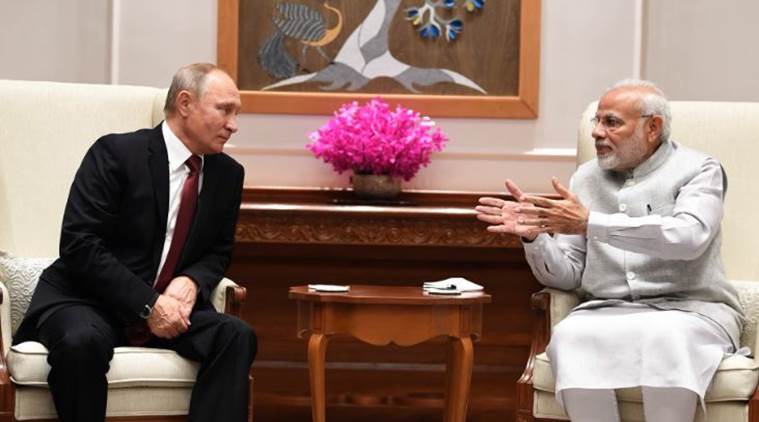

Russian President Vladimir Putin has said Moscow would not interfere in the “delicate” relationship between India and China, expressed confidence that New Delhi and Beijing would resolve their long-standing border disputes peacefully, strongly backed India’s independent foreign policy and offered deeper defence cooperation, including joint production of the fifth-generation Su-57 fighter jet.
In a wide-ranging interaction with heads of leading global news agencies, Putin praised Prime Minister Narendra Modi and Chinese President Xi Jinping and said both leaders were committed to addressing bilateral issues through dialogue.
“This is a delicate, multi-faceted relationship between India and China, and interfering into them is not a good idea. Of course, we interact with both our friends — both India and China,” Putin said.
“President Xi and Prime Minister Modi are both trying to resolve all the issues of mutual interest, including the border issue,” he said.
Highlighting Moscow’s strategic equilibrium in Asia, Putin said Russia’s partnerships with both India and China had evolved naturally and independently of each other. He said Russia’s growing cooperation with India did not come at China’s expense, just as its close ties with Beijing did not affect its relationship with New Delhi.
Putin also recalled the origins of the Russia-India-China trilateral framework.
“At one point, I suggested that leaders of India, China meet in Russia and that’s how Russia-India-China was established. We had things to talk about, to agree upon,” he said.
Referring to India-Pakistan relations, Putin said, “We are well aware of the intricacies of the issues concerning the border between India and Pakistan.”
Asked about Pakistan’s relationship with China, he said, “I don’t think so,” when queried whether Pakistan was under China’s control.
“Pakistan is a large country which has multi-faceted ties with different countries,” he said, adding, “Of course, for Pakistan, it is very important to take into account the cooperation with China.”
On India-Russia relations, Putin said, “India is one of the leading economies of the world that has showed the highest rate of economic growth. This is not something that comes out of the blue. This is result of the hard work that the government of India has been doing under the leadership of Prime Minister Narendra Modi.”
“We hope that in upcoming years, we will reach USD 100 billion in mutual trade. We have all the foundations to work more actively and to reach more ambitious goals. And we are not only talking about our plans in energy sector as new platforms will emerge in terms of hydrocarbons,” he said.
Putin identified clean energy, pharmaceuticals and hydrocarbons as key sectors for expanding trade and investment ties.
Sounding critical of Western efforts to pressure India over its ties with Russia, Putin said such attempts were counterproductive.
“Everyone has understood that putting pressure on Prime Minister Narendra Modi (and India) that has the largest population in the world, is detrimental for international relations and for bilateral relations. It doesn’t matter where this pressure comes from,” Putin said.
“We don’t see any negative consequences,” he added.
Putin also rejected suggestions that India’s growing engagement with the United States could undermine ties with Moscow.
“I don’t think this is a case. We are glad that India is developing its relations with all the countries, it’s a great country, a large economy, the largest democracy, it is only natural that it develops its economy in accordance with its interest with those countries that it deems necessary,” he said.
Russia considers India a “reliable partner” and sees no negative consequences arising from New Delhi’s relations with other countries, he added.
On defence cooperation, Putin cited the successful co-development and co-production of the BrahMos supersonic cruise missile and said Russia was ready to share critical technologies with India.
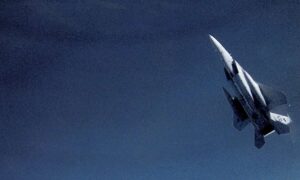
He renewed Moscow’s offer to jointly develop and manufacture the Sukhoi Su-57 stealth fighter aircraft.
“We proposed our Indian friends to work together on technology, the fifth generation technology….we are ready to work with India in this field to supply (fighter) aircraft,” he said.
Elaborating on the proposal, Putin said Russia had earlier invited India to participate in development of the aircraft.
“As for the Su-57, we offered our friends from India to jointly develop this machine, a fifth-generation aircraft. I think it’s the best to date. But our Indian friends said, ‘well, let’s see’,” he said.
“In principle, this could have been our (Russia-India) product. We made it independently. And we are ready to work with India. To work and develop. There will be no restrictions whatsoever,” he added.
India and Russia had held discussions for nearly 15 years on a joint Fifth Generation Fighter Aircraft (FGFA) programme. However, India informed Russia in 2021 that it did not wish to proceed, primarily because of the project’s estimated cost of around USD 30 billion.
India is now pursuing its indigenous Advanced Multirole Combat Aircraft (AMCA) programme, though the platform is unlikely to enter service before 2035. Government sources indicate New Delhi is considering procurement of at least two squadrons of Su-57 aircraft if they meet operational requirements.
Putin also expressed Russia’s willingness to cooperate with India on air defence systems.
“The same goes for the air defence system,” he said, adding that Moscow was prepared to work with India on air defence hardware and related technologies.
India currently operates Russian-origin S-400 air defence missile systems, which played a key role during Operation Sindoor. Of the five S-400 units contracted under a USD 5 billion deal signed in October 2018, four have been delivered, while the fifth remains pending.