
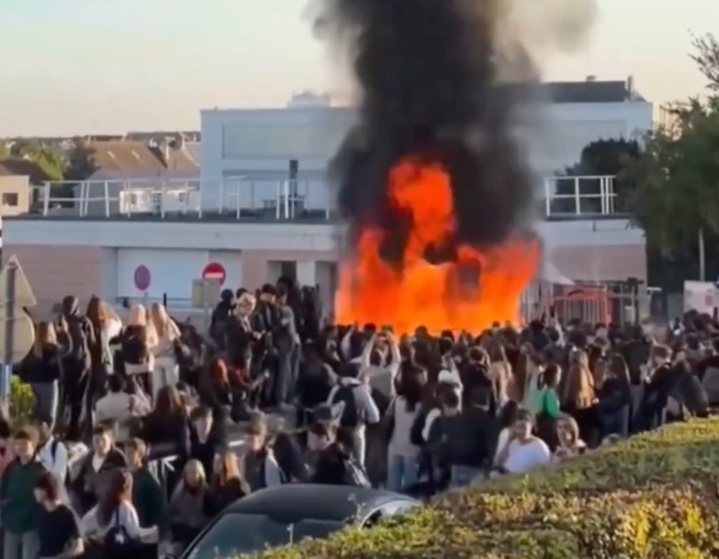

Mass school protests have begun across France, with high school and university students taking to the streets to demand greater investment in the country’s education system, following several days of clashes, injuries and arrests.
The protests have brought students, parents, teachers and trade union activists together in demonstrations across the country. Students are protesting over overcrowded classrooms, deteriorating school buildings, teacher shortages and wider concerns about the condition of public education.
A coalition of major national unions, including France’s largest trade union, the French Democratic Confederation of Labour (CFDT), has called for demonstrations in Paris, Lyon, Marseille and around 30 other cities. The teachers’ union SNES-FSU has also urged its members to join the protests.
Parents and union activists have gathered alongside students, with some wearing white armbands in an effort to support the teenagers and create what local media described as a protective “buffer zone”.
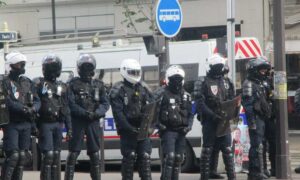
The mass mobilisation comes after a week of unrest in which 215 young people and 715 police officers have been injured, while more than 6,000 people have been arrested.
Tensions escalated sharply on Monday after a student in the northern city of Lens suffered a severe hand injury during a confrontation involving riot police.
Accounts of what happened have differed. Reports said the student either picked up a stun grenade fired by riot police or was injured when one was fired close to him.
The incident followed another serious injury last week involving a 14-year-old student, Eden, in Saint-Ouen-l’Aumône. He was reportedly struck on the head by a tear-gas grenade.
According to his lawyer, Eden suffered a double jaw fracture and required extensive surgery.
His mother spoke publicly about the incident on Monday, expressing anger over the treatment of young protesters and saying children should not be subjected to such violence while demanding better conditions in which to study.
France’s National Education Minister Édouard Geffray expressed sympathy for the student injured in Lens and said protecting students was the government’s priority.
“I want to express my thoughts for this young man. Our absolute priority is to protect our students. This is obviously a tragedy,” Geffray told France Info.
The minister, however, also condemned what he described as extreme violence within the protest movement.
Geffray said the government had called for dialogue from the beginning rather than encouraging school blockades. He also alleged that “ultraviolent” elements had entered the high school student movement.
Louis Letoublon, vice-president of the student organisation Les Lycéens, responded that the minister had listened to the protesters but now needed to act.
The mass demonstrations follow measures announced by Prime Minister Sébastien Lecornu aimed at addressing problems faced by secondary school students and education workers.
Lecornu said the government would bring about “visible changes” in schools and address difficulties raised by students and staff.
But the Union Syndicale Lycéenne (USL), one of the main groups organising the student movement, rejected the government’s announcement, saying it had offered “nothing concrete”.
Lecornu has also warned that the government would not tolerate violence. He said authorities stood with students and school staff who had been attacked, as well as police officers and gendarmes injured during the unrest.
More than 500 schools were partially or completely closed because of protests on Monday, according to the education minister.
The movement initially involved high school students before university students joined. Demonstrations that began in Paris in September have since spread to other parts of France.
The latest mobilisation marks a broader escalation, with organised labour and teachers now joining students on the streets.
The protests are centred on education but have increasingly become part of a wider political confrontation over public services, government policy and the handling of the unrest.
The La France Insoumise (LFI) has backed the student movement. Party leader Jean-Luc Mélenchondescribed it as the most powerful high school and university student movement since 1968, when France experienced major social unrest and mass strikes.
The government and right-wing politicians have accused the radical left of contributing to the escalation.
Lecornu criticised LFI for encouraging the movement to spread, while National Rally leader Marine Le Pen argued that the unrest had gone beyond ordinary student protests.
Le Pen accused LFI politicians of overseeing the demonstrations and called for a new anti-rioting law.
Mélenchon, meanwhile, has accused police of abuses of power and called on people to take to the streets to support the young protesters.
In Marseille, left-wing mayor Benoît Payan condemned the violence but said young people had legitimate concerns about their future and the state of public services. He urged protesters to express their demands peacefully.