

In the changing world of Kashmiri literature, the passage from oral tradition to the written novel has often been a tool for grappling with trauma, identity, and the metaphysical.
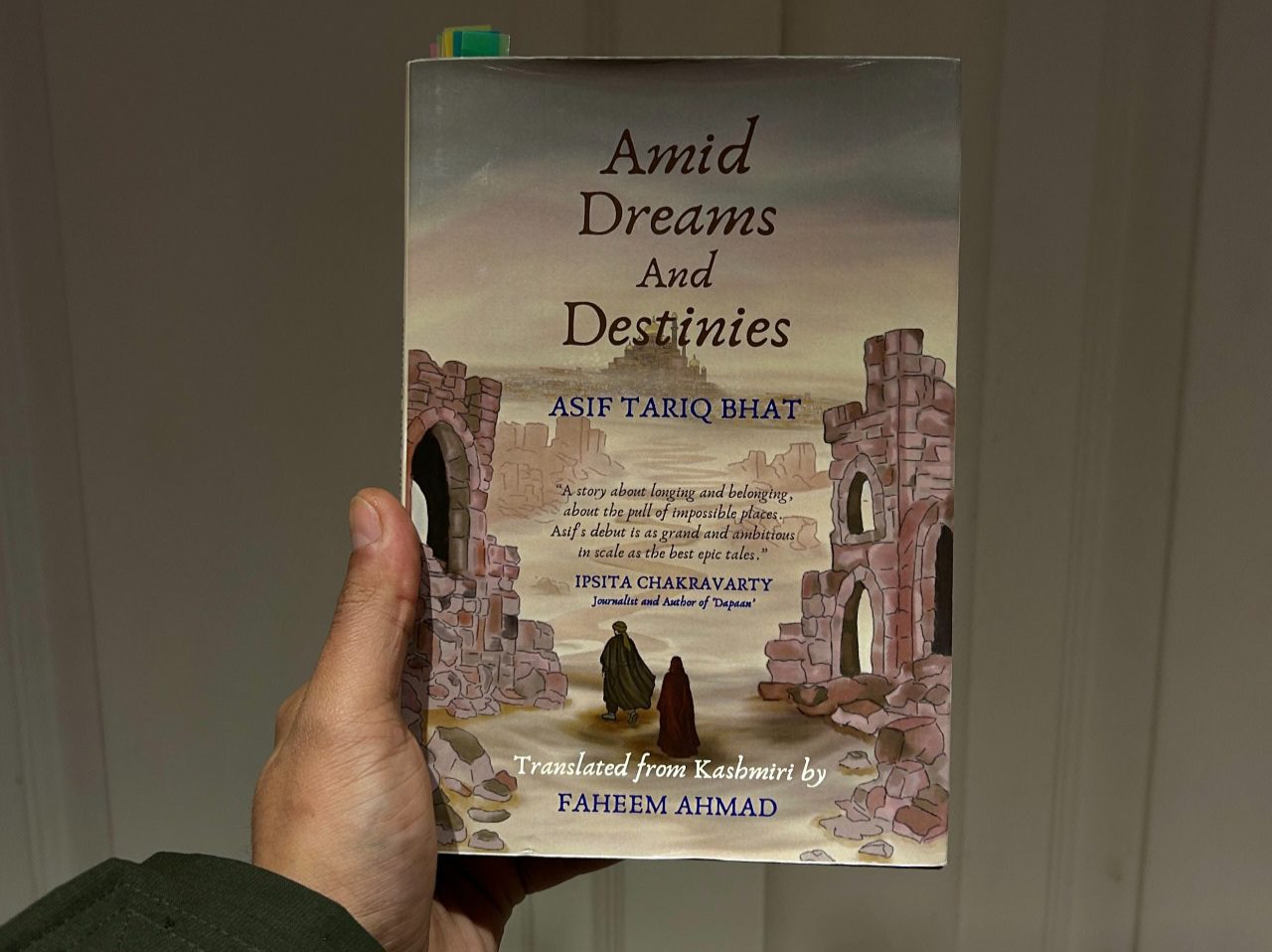
Asif Tariq Bhat’s Amid Dreams and Destinies, previously Khwaban Khayalan Manz and translated with a similar lyrical precision by Faheem Ahmad, is a major, thoughtful, profound new addition to the canon.
This is a work that serves at once as a tale full of folk and a savage and scathing sociological critique of the condition of an outcast that traces the journey of an outcast in a world where divine and cruel man remain eternally confused.
The story revolves around Arham, an orphan who enters the world with a double whammy: the death of his mother and a long drought that affects his village.
A community, in search of a scapegoat, labels Arham as ill-omened: a cursed child.
This first act of othering sets the tone for a tale of the “socially unfit” hero. Arham’s distinguishing physical feature, a horizontal iris, is a motif in the story.
It is a symbol of a different way of seeing and being that society will reject, but the cosmos will eventually accept.

Faheem Ahmad is a Research Scholar at the University of Kashmir. This is his first translation.
Bhat has set up his storytelling in an episodic style. At the same time, it also has close links with the others. This style of storytelling also resembles dastan.
But Bhat draws his story from reality. Arham doesn’t just get lucky; he has a tenacity—a quiet one—that won’t budge.
He masters various crafts, including sculpting and carpentry, as well as the more elusive art of colour-making and perfumery, becoming a subaltern polymath.
They are not mere survival skills, but an effort by Arham to build himself a world that has disowned him.
His apprenticeship with a master colour-maker is an allegory for the illuminating power of those oppressed by the evil of superstition, as he succeeds in producing a colour which the master had been seeking for years.
In the body of the novel, we have movement away from just one person’s path to survival to a focus on systemic violence.
The character of Isra, therefore, explores the “dehumanisation and captivity” that characterise women’s lives in a patriarchal setup.
In the “Market of Jazbeel”, girl children are reduced to commodities, betraying the deep-seated misogyny present in and behind the facade of tradition.
The statement of Isra when she says she is “cherished at night and despised during the day” is a shocking articulation of dissociated selfhood under abuse.
In this part of the text, the magic of folklore is lost as sheer brutal clinicality dominates. Readers are forced to confront the normalised cruelty of people celebrating a feast that hails from the exploitation of the less privileged.
The story reaches its philosophical peak with Muqaddas, the “Sacred City”, or a perfect version of ordinary life.

Asif Tariq Bhat is a writer from Ganderbal, Kashmir. He recently completed his Master’s in Kashmiri literature. Khwaban Khayalan Manz is his debut Novel.
Muqaddas is a place of non-interference, and it is here that Arham’s horizontal iris – the very sign of shame and a taunt in the world – comes to be seen as a prophecy fulfilled.
The investigation of the Hazb (black stone) and Jazb (red stone) introduces an element of magical realism; both stones, it seems, cannot change; destiny belongs to the ‘non-greedy’.
Yet, Bhat is not the ‘chosen one’ type. When Arham is given the chance to kill the old King and take the throne by force, he chooses mercy instead, thus changing the ending to that of the prophecy.
The refusal of the “art of cruelty” is the moral centre of the novel; it is the core act of agency.
The most striking thing about Amid Dreams and Destinies is its final subversive movement.
The final chapter of the novel, “Memory of a Dream” by Bhat, instigates a brutal ontological shift.
After Arham seems to have achieved his fate of ruling Muqaddas as a wise King and marrying Isra, the world breaks.
He wakes up “drenched in sweat” in the ruins of the desert, with a realisation that his life as a saviour was a hallucination of a dying or captured man.
The ending stands in strong condemnation of escapism.
Moving away from the idyllic dream to the dark reality where Arham remains bound, and Isra is dead reflects a deeply Kashmiri view: that the quest for ‘purpose’ and ‘sovereignty’ often ends in the crushing weight of a reality that mocks such aspirations.
The masked man at the end, who taunts Arham, is a metaphor for the harsh reality that the quest for a holy city will usually lead to a desert.
Faheem Ahmad’s translation of the Kashmiri text preserves the cultural deposit of the original.
By having terms like Wanpyend (the small sitting areas outside shops), Hakeem, and the philosophical weight of Kun Faya Kun, it imbues the allegory with a certain linguistic texture that connects it to the soil of the Valley.
The prose is restrained, ensuring the events draw forth an emotionally powerful response without exaggerated melodrama.
To close off, Amid Dreams and Destinies, we can also say, is a deep meditation on human dignity and hope.
By titling the original Khwaban Khayalan Manz, Bhat signals from the outset the uncertain nature of Arham’s voyage.
The tale proffers dreams that shall shield one from the “commodification of human lives”, but in the world, there is only “cruel irony”.
According to the book review of The Last Wish, it is basically the work of a writer who is ethically serious and devastatingly emotional.
Bhat must be counted as a significant voice in a literature that is finding new ways to think about history, myth and the struggle of the self.