

As global temperatures rise and water scarcity worsens, researchers in Australia have developed a nanoengineered paint designed to tackle both challenges by cooling buildings and harvesting water from the air.
University of Sydney researchers Chiara Neto and Ming Chiu developed the cooling paint, which reflects most incoming sunlight and reduces heat absorption in buildings.
The idea eventually led to the formation of startup Dewpoint Innovations in 2022. The company aims not only to develop cooling paint but also to rethink urban infrastructure by turning rooftops into systems that reflect heat and collect water.
Cities around the world are increasingly experiencing the urban heat island effect, in which concrete structures and rooftops absorb solar energy and raise surrounding temperatures.
“Our paint will significantly reduce the heat load the sun puts on cities,” said Chiu, co-inventor and chief technology officer at Dewpoint Innovations.
The specially engineered nanomaterials use passive radiative cooling to reflect most of the sun’s energy while releasing heat back into the sky. This allows roof surfaces to remain cooler than the surrounding air without consuming energy.
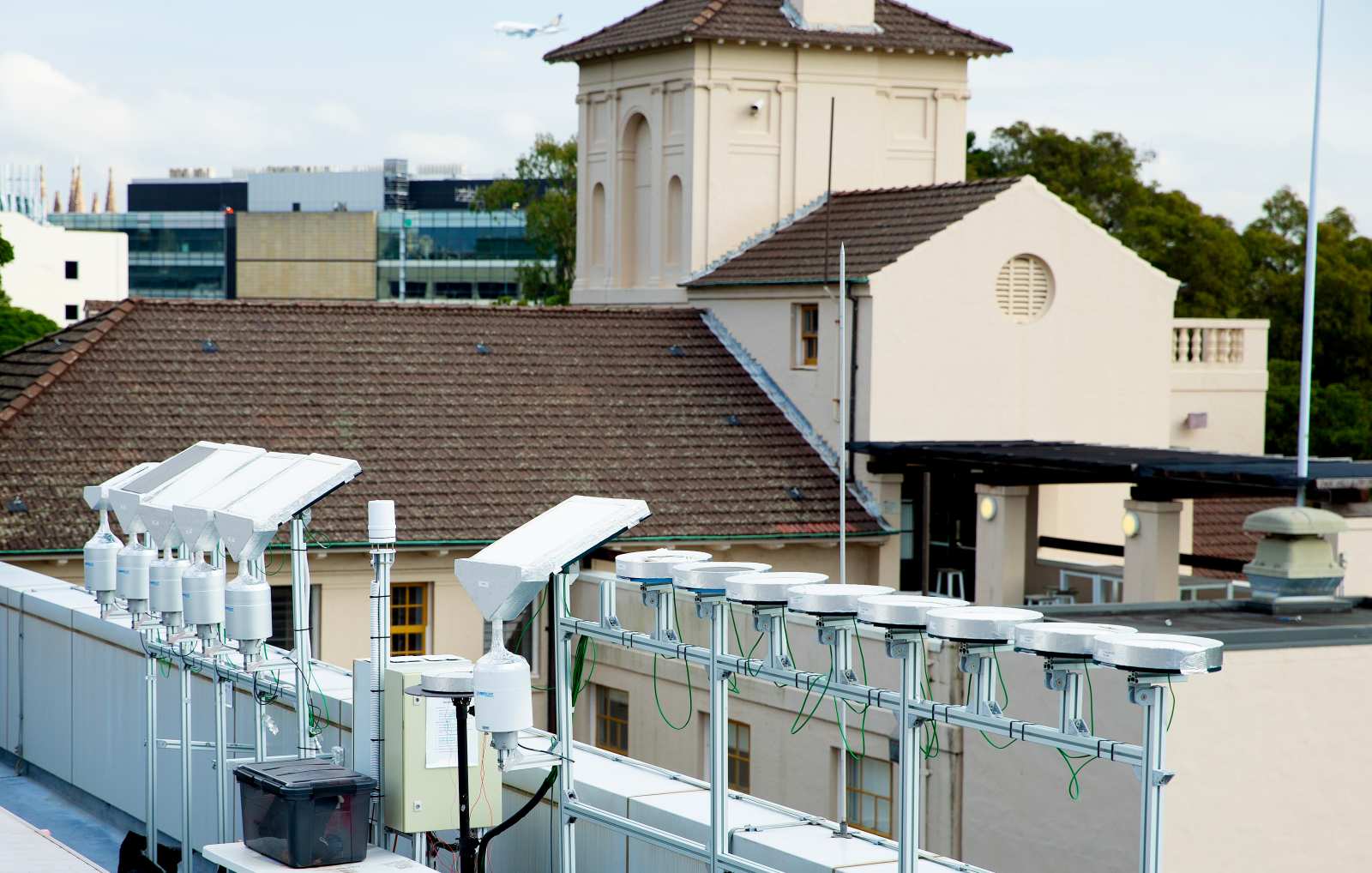
Researchers tested four painted panels, black, white, reflective and Dewpoint’s paint, over three months on a University of Sydney rooftop while monitoring temperature and atmospheric conditions.
Distinguished Professor Baohua Jia, a nanotechnology expert at RMIT University in Melbourne who is not associated with Dewpoint Innovations, said commercial white paint typically reflects 70% to 80% of incoming sunlight.
According to a six-month outdoor trial reported in 2025, Dewpoint’s coating achieved solar reflectance of up to 96%. The coating kept roof surfaces up to six degrees Celsius cooler than the surrounding air by reducing heat absorption and heat transfer into buildings.
In a three-month field trial in Sydney in late 2023, the paint remained up to 30 degrees Celsius cooler than a standard dark roof, leading to an estimated reduction of up to 34% in household cooling energy use.
Jia said the technology could provide a scalable way to reduce the urban heat island effect.
“This technology can potentially drastically reduce ambient urban temperatures, ease heat stress and reduce reliance on air conditioning, making it a tangible tool for climate adaptation in dense urban areas,” she said.
“One of the amazing properties of having a surface that is maintaining a cooler temperature, while the rest of the environment is increasing in heat, is that it also encourages any moisture in the air to condense on its surface,” Dewpoint chief executive officer Perzaan Mehta told CNN.
The process is similar to water forming on the outside of a cold glass.
Although still under development, early trials showed the system could collect 74 litres of water per day from a 200 square metre roof. Mehta said this amount is roughly equivalent to the water used during a five-minute shower in regions with greater water availability.
“It’ll help reduce the burden, but it’s not the miracle cure,” Mehta said.
Dewpoint’s modelling data found that water collection requires a minimum relative humidity of around 70%, making tropical and coastal regions such as Singapore and the Amazon Basin more suitable for the technology.
“In the tropics, you’re going to get much better performance, and that’s where we’ve seen a lot of the international interest from our products,” Mehta said.
Jia said passive water harvesting is one of the fastest-growing trends in the radiative cooling field. While humidity, wind and temperature can affect performance, she said ongoing field improvements are increasing consistency, including in semi-arid regions.
Dewpoint plans for the captured water to support irrigation systems or to be filtered for drinking and household use.
Chiu said the technology could also support wildlife by reducing heat stress under animal shelters and providing water during drought conditions.
The devastating bushfires across Australia between 2019 and 2020, which affected around 80% of the population, influenced Chiu’s thinking about atmospheric water capture after he saw images of firefighters giving water to dehydrated koalas.
“Water capture systems could be deployed as constructive features in the middle of nowhere to generate water from the air so wildlife can have access to drinking water when they need it and they couldn’t find it anywhere,” Chiu said.
“There is a future where you’d be able to purchase this paint and apply it on your roof,” Mehta said.
Dewpoint is preparing for larger rooftop trials in Australia and overseas, with plans to commercialise the product through Australian company Haymes Paint.
Andrew Brewer, group merchandise and product manager at Haymes Paint, told CNN the company is enthusiastic about bringing the technology to market.
“Project builders default to known products,” Brewer said, adding that adoption would depend on independently validated performance, whether energy savings justify upfront costs and compatibility with standard application methods.
“Over the longer term, as sustainability and heat management increase in importance in construction, we foresee increased demand for products that contribute to a cooling effect,” Brewer added.
Mehta said the paint is expected to be priced similarly to functional paints, which are generally 50% to 100% more expensive than regular paint.
Researchers worldwide are also developing other highly reflective ultra-white paints to reduce air-conditioning use. Some teams are using machine learning to design cooling paints capable of keeping buildings between five and 20 degrees Celsius cooler than conventional paints during midday heat exposure.
Jia said radiative cooling products still face challenges including long-term durability, lower performance in cloudy weather, higher upfront costs and the absence of standardised testing and building codes. However, she added that improvements in materials, design and manufacturing are expected to make the technology more reliable and widely adopted.
“As research and industrialisation continue, the field of passive radiative cooling will play an increasingly vital role in cooling cities, cutting carbon emissions and securing water supplies, all without consuming precious energy or relying on artificial refrigerants,” Jia said.
Dewpoint ultimately hopes its paint becomes part of future urban planning and development.
“I think it would be fantastic to see Dewpoint as part of the toolkit that city planners and architects have going forward,” Mehta said, “and have products like ours become part of the regulatory framework of how we think about cities being designed.”