

Every year at Tulmul village in Ganderbal, thousands of Kashmiri Pandits gather at a natural spring they regard as the manifested body of the goddess herself, and have done so, with growing fervour, for nearly a hundred and fifty years.
Scholar Madhu Bazaz Wangu’s ‘A Goddess is Born’ is the definitive study of how this devoteeship emerged.
Her central argument is precise: Khir Bhavani is a newly emerged goddess, rooted in the Tantric Shaiva tradition, who crystallised in the last decades of the nineteenth century amid acute political, social and economic flux.
The followership was not ancient. It was summoned into being by the people.
The beginnings were local and mystical. The people of Tulmul village paid homage to a natural spring surrounded by marshes.
As late as 1848, they crossed those marshes by walking over reeds. Then a village mystic, Pandit Govind Joo Gadru, had a vision of a goddess who manifested herself as a serpent.
He carried a vessel of milk, rowed through the marshes and poured the milk at the sacred spot to which the serpent/spring goddess had led him.
The site came to be known as Tulmul Naga. From the last quarter of the nineteenth century its reputation grew rapidly: within fifty years the island shrine became the most important pilgrimage centre near Srinagar.
The appellation Khir Bhavani — “the one born from milk and rice dessert” — was given to the goddess after the ritual offering of milk-and-rice (Khir) was well established at her shrine, Wangu argues, no earlier than 1887.
By the 1920s, a small marble shrine had been constructed on the island in the middle of the sacred spring, furnished with a metal railing, and the surrounding area paved with Baramulla stone.
What drove this emergence? Wangu locates it squarely in historical suffering.
The Kashmiri Pandits, descendants of Saraswat Brahmins and the valley’s educated class, had endured centuries of misrule — Pathan, Sikh and then Dogra.
A catastrophic famine in 1877–79 destroyed crops and depopulated entire villages. Into this devastation came missionary activity and the reforms of Maharaja Pratap Singh (1885–1925), which paradoxically mobilised Kashmiris — men and women alike — in a resurgent movement.
The followership of a new deity, Maharajni Khir Bhavani (the Great Empress), was the emotional and spiritual vehicle for that revival.
The goddess absorbed and synthesised much that came before her.
She incorporated the attributes of Sharada (the Kashmiri form of Saraswati), goddess of learning and knowledge; elements of Durga/Kali and Tantric female power; and even Vaishnava figures — Rama, Sita, Hanuman and Ravana are woven into her mythology.
Rama himself is described as a devotee of the goddess in her Shyama/Kali form in her Mahatmya (scripture).
At the command of Rama, Hanuman brings her from the island of Lanka to the valley of Kashmir where she is installed as Maharajni Khir Bhavani.
The myth gave the goddess Sanskritic authority and pan-Hindu legitimacy while firmly placing her in Kashmir.
Her followership objects are definitely Tantric: a Yantra (mystical diagram), a Mantra (sacred syllables) and the Naga (serpent/spring) in which she appears.
Her constant companions in iconography are snakes.
The goddess is referred to as Jala-rupi — “having the form of water or serpent.”
The sacred spring itself is described as the island temple of Bindu, the spiritual fountain of power, surrounded by the ocean of infinite life energy.
Most famously, the spring’s waters are said to change colour — from white to black, grey, red, orange, yellow — as signals of the goddess’s emotional state and omens of events to come.
Wangu records that as recently as 1947, journalist RK Kak witnessed the spring water turn black just before Pathan tribesmen invaded Kashmir.
The changing colours are linked theologically to the three Gunas: dark hues with Tamas, warm colours with Rajas, white or light with Sattvas.
Wangu’s most striking conclusion is about the goddess’s nature as a virgin deity.
Unlike other Hindu virgin goddesses whose destructive power is controlled by a male god through marriage, Khir Bhavani tamed herself.
As Shyama, she controlled her violent power and became a Sattvika goddess not because a male god tamed her but because she channelled her powers through the discipline of Kundalini Yoga.
She raised herself from the stage of darkness to enlightenment through self-effort and discipline — a paradigm, Wangu writes, for all Kashmiris, female and male.
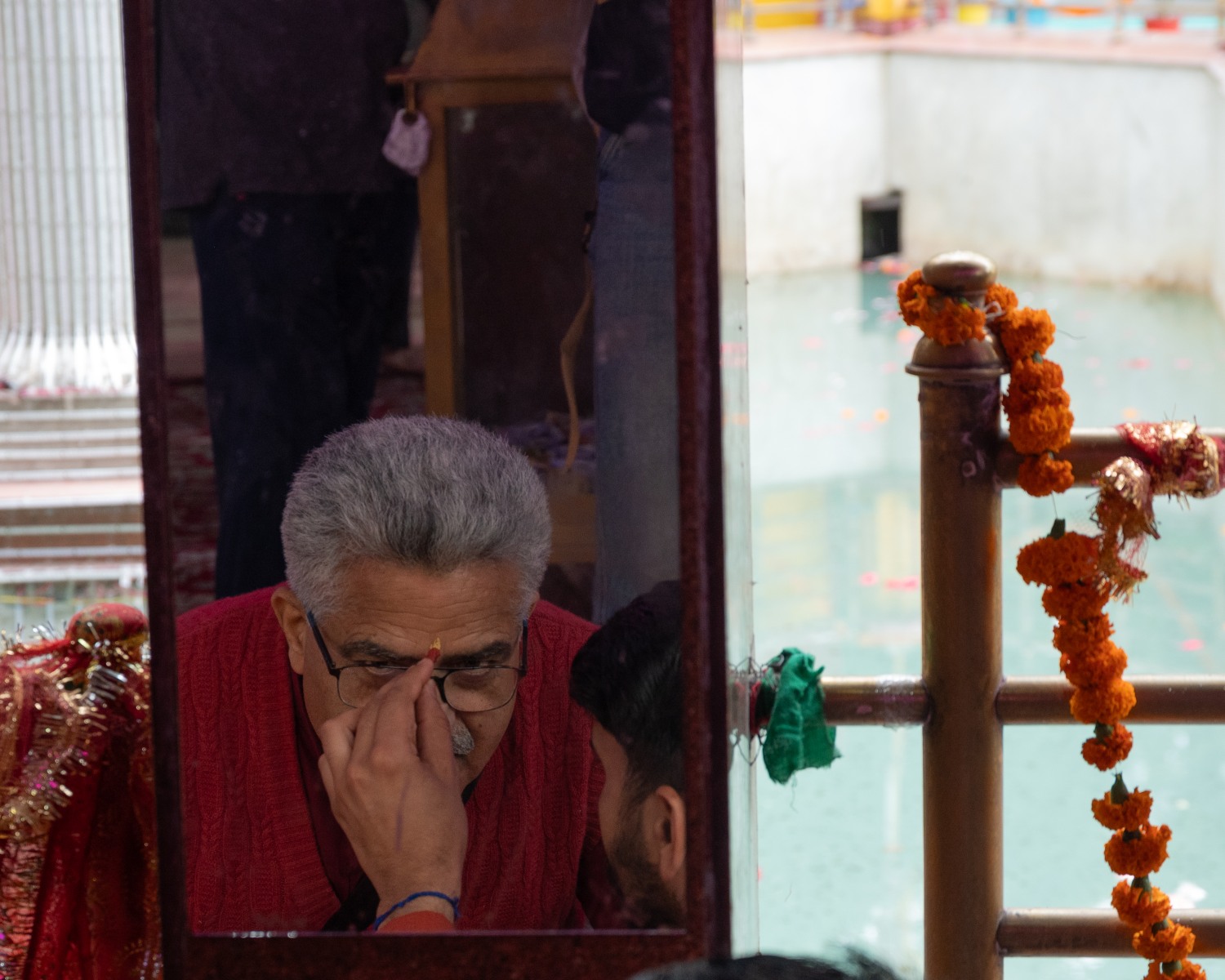
A Kashmiri Pandit devotee bows in prayer inside the Khir Bhavani temple, a tilak freshly applied to his forehead. [FPK Archive Photo/ Usaid Rehmani]
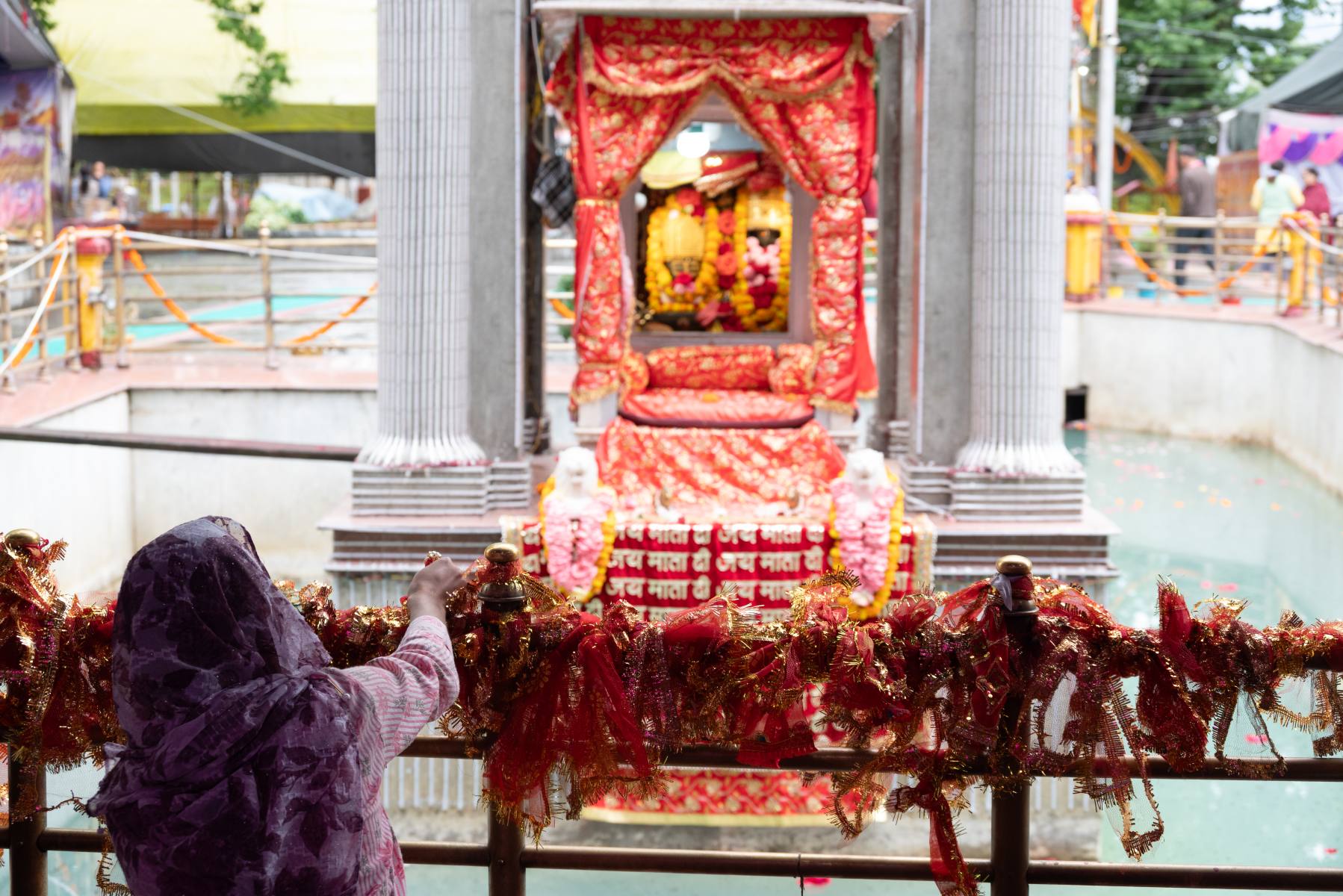
A woman offers prayer at the railing before the heavily decorated idol of Maharajni Khir Bhavani, draped in red and gold silk at the centre of the sacred island spring, during the annual Jyestha Ashtami mel, Tulmul, Ganderbal. [FPK Archive Photo/ Usaid Rehmani]
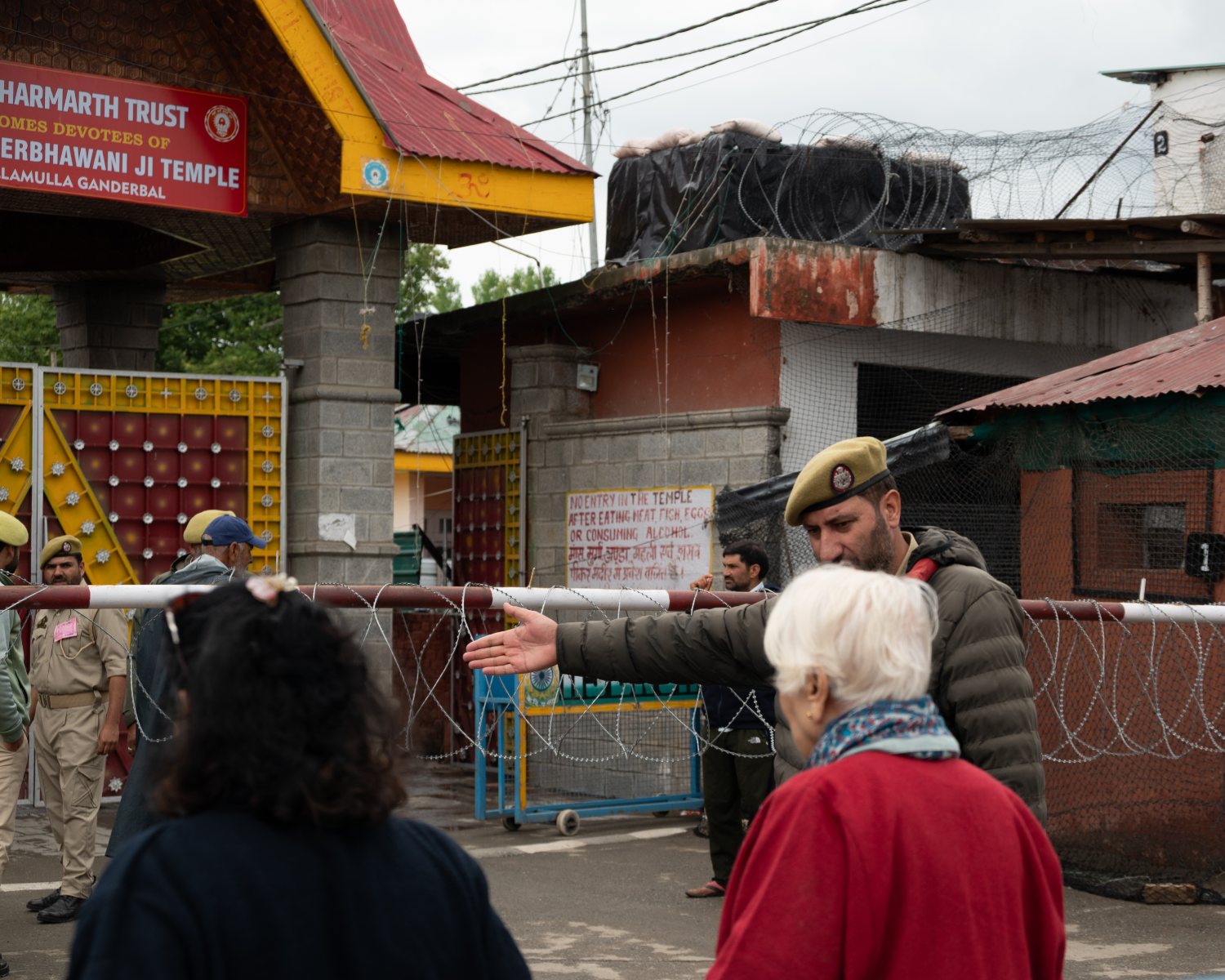
A security personnel extends his arm to direct pilgrims at the entrance gate of the Khir Bhavani temple, Tulmul, Ganderbal. [FPK Archive Photo/ Usaid Rehmani]
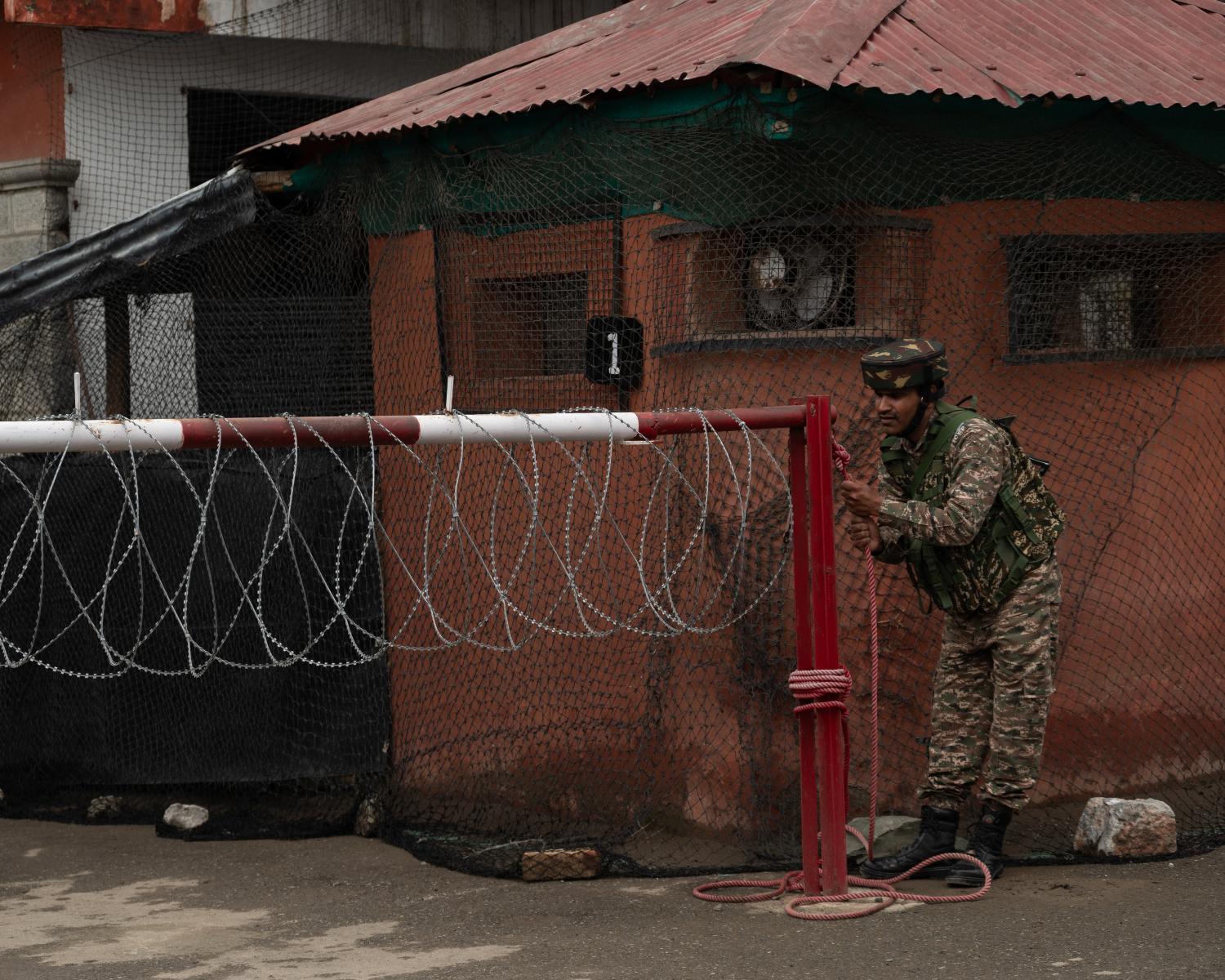
A security personnel extends his arm to direct pilgrims at the entrance gate of the Khir Bhavani temple, Tulmul, Ganderbal. [FPK Archive Photo/ Usaid Rehmani]
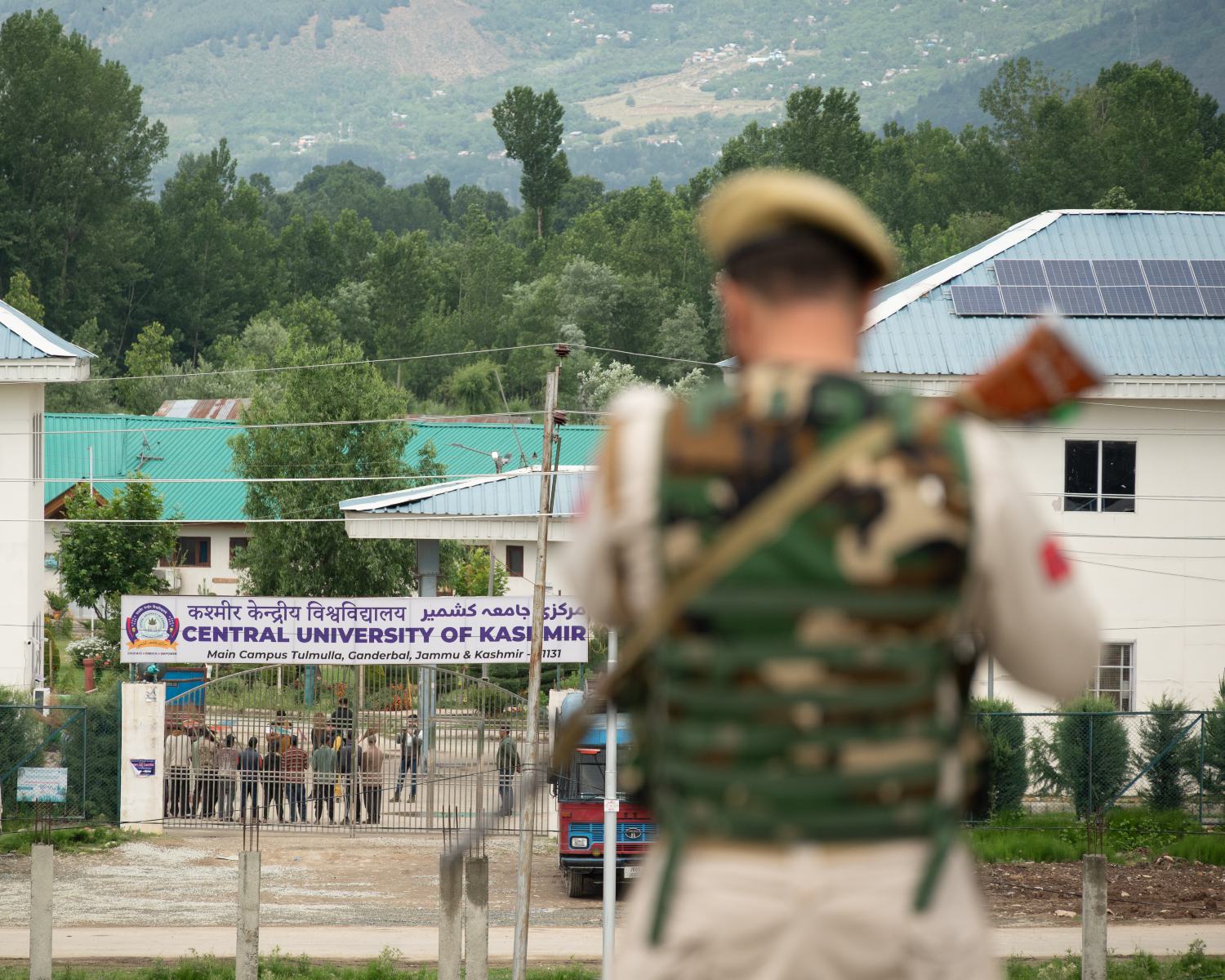
A paramilitary soldier stands guard with a rifle outside the main gate of the Central University of Kashmir campus adjacent to the Khir Bhavani shrine, as pilgrims gather inside the temple compound for the annual mela. Tulmul. [FPK Archive Photo/ Usaid Rehmani]

A man balances a heavy bag on his head as Kashmiri Pandit pilgrims arrive by organised convoy for the annual Jyestha Ashtami festival, Tulmul, Ganderbal. [FPK Archive Photo/ Usaid Rehmani]
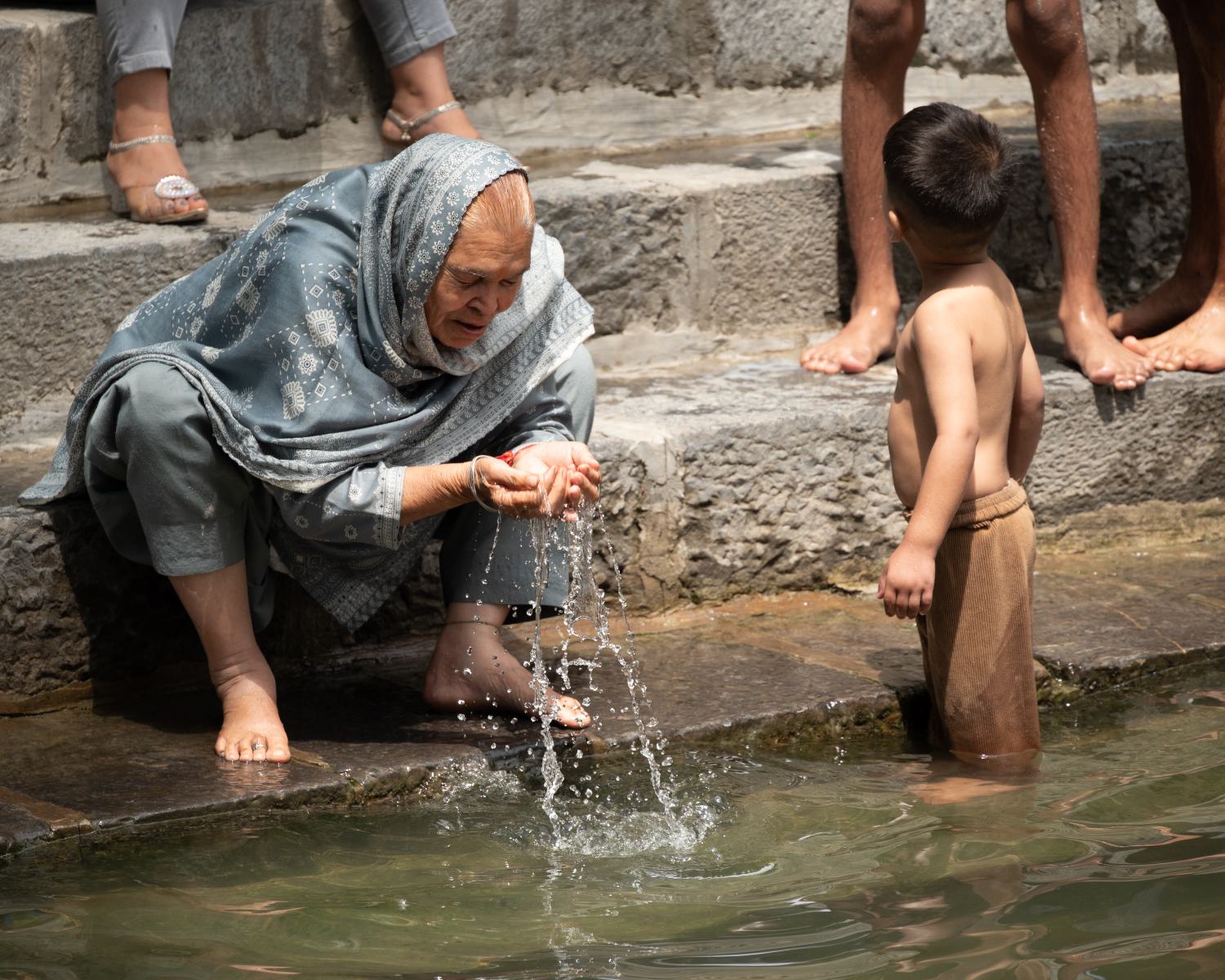
An elderly Kashmiri Pandit woman lifts water from the sacred spring in cupped hands, passing on a ritual of faith across generations at the Khir Bhavani mela, Tulmul, Ganderbal. [FPK Archive Photo/ Usaid Rehmani]
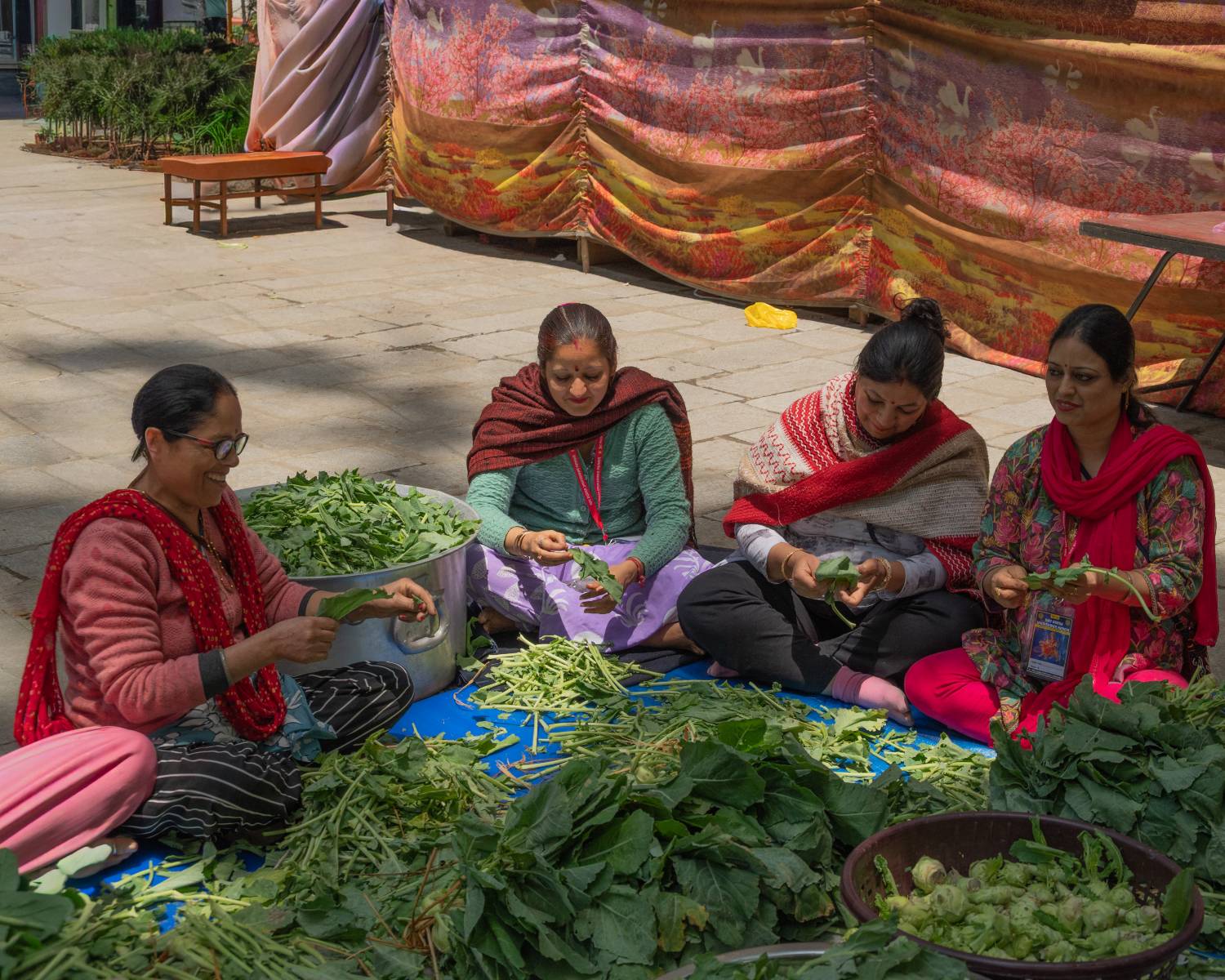
Women volunteers sit together sorting and cleaning large quantities of vegetables for the communal langar (free meal) served to thousands of pilgrims at the Khir Bhavani temple complex during the annual Jyestha Ashtami mela, Tulmul, Ganderbal. [FPK Archive Photo/ Usaid Rehmani]
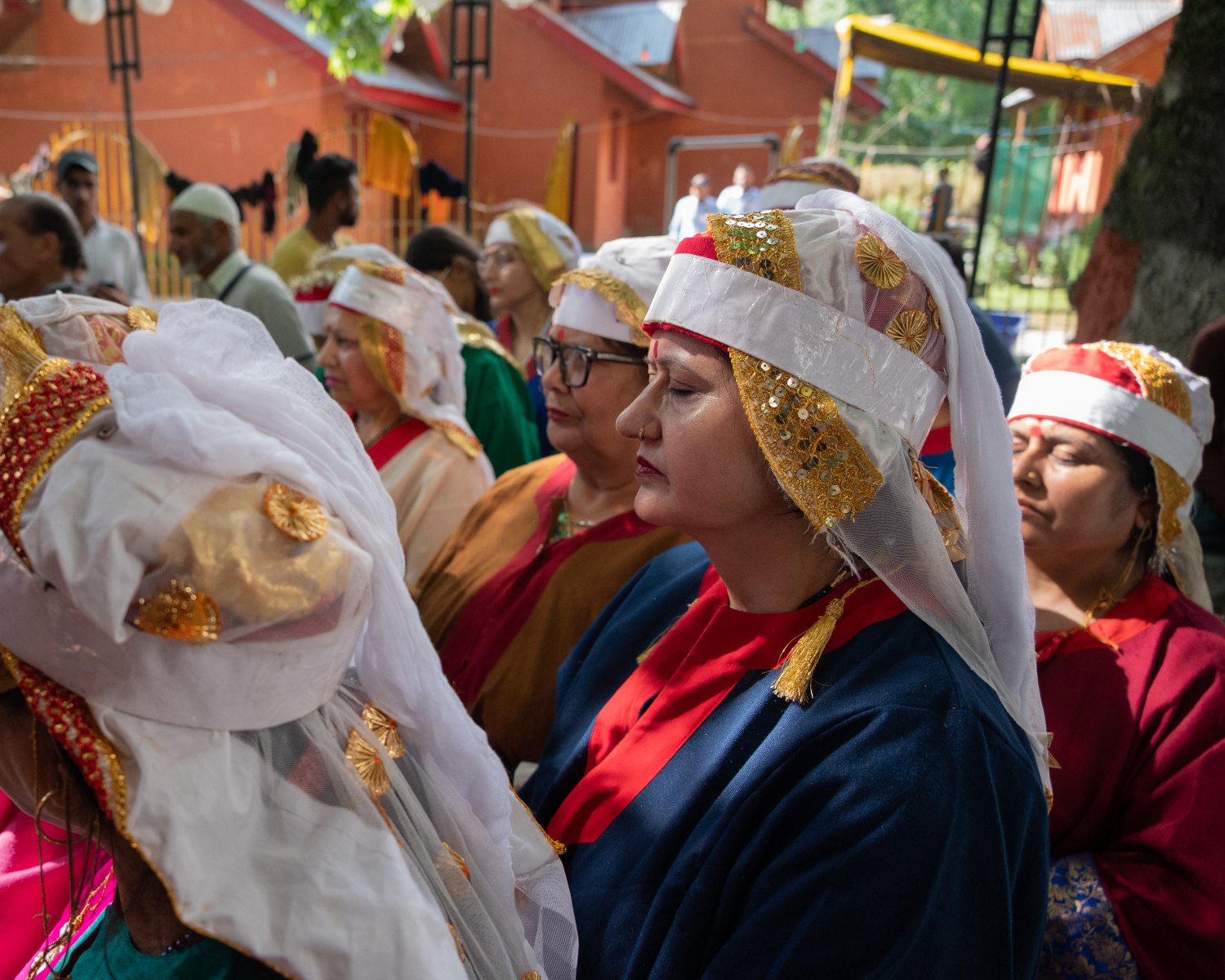
Kashmiri Pandit women wearing traditional white and gold dejhoor headgear participate in communal prayers at the Khir Bhavani mela, Tulmul, Ganderbal. [FPK Photo/ Usaid Rehmani]