

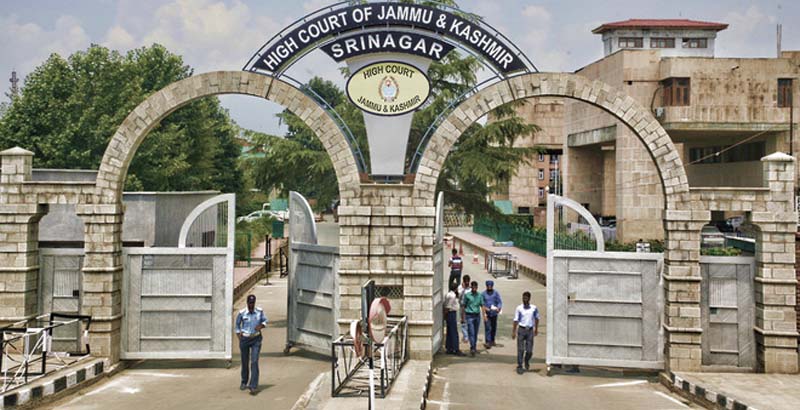

Court says ‘mere opinion given fact colouration’ cannot justify preventive detention; calls for ‘hardcore reportable and demonstrable factual content’ before invoking PSA
Srinagar: The High Court of Jammu and Kashmir and Ladakh has quashed the detention of an alleged overground worker (OGW), holding that the detention was “more of a vindictive nature” than preventive and warning that allowing incarceration on the “mere ipse dixit” of the police would create a “literally a draconian-like situation for any citizen.”
A single bench of Justice Rahul Bharti, while allowing a habeas corpus petition filed by Shabir Ahmad Rather, set aside the detention order issued by the District Magistrate, Pulwama, on September 4, 2024, along with all consequential approval, confirmation and extension orders passed by the government under the PSA. The court directed that the petitioner be released forthwith if not required in any other case.
The petitioner had been placed under preventive detention after the Senior Superintendent of Police (SSP), Awantipora, submitted a dossier alleging that he was a hardcore overground worker of the banned Jaish-e-Mohammad and had facilitated militant movement and logistics. The detention order also relied on his alleged involvement in FIR 76 of 2022, despite his having been granted bail by a competent criminal court.
Before the High Court, the petitioner argued that he had not violated any condition of bail and that the detention order was merely a reproduction of the police dossier, reflecting non-application of mind by the detaining authority. He further contended that there was no proximate material linking him to any fresh activity warranting preventive detention.
Examining the detention record, Justice Rahu Bharti agreed with the petitioner’s central contention.
“This Court cannot resist concurring with the plea of the petitioner’s counsel that the imposition of preventive detention custody upon the petitioner is more of a vindictive nature rather than for the purpose as meant to be portrayed,” the court said.
The Court noted that although the petitioner had been released on bail in the criminal case and there was no allegation that he had breached any of its conditions, the preventive detention was founded solely on the assertion of the SSP that he had resumed subversive activities and re-established contact with militants.
The court observed that detaining a citizen in such circumstances “just on the mere ipse dixit of the Senior Superintendent of Police (SSP), Awantipora” without supporting material would amount to “literally a draconian-like situation for any citizen to suffer.”
The court went on to caution that such an approach leaves an individual with “nothing at his or her disposal to defend against such types of vague and wild impressions and assumptions of district police.”
Justice Bharti rejected the proposition that police opinion alone could sustain preventive detention under the PSA.
“This court cannot lend its acceptance that mere opinion given fact colouration can form a basis for subjecting a person to preventive detention custody under the JK Public Safety Act.”
“There has to be some hardcore reportable and demonstrable factual content to sustain the suspicion of the District Police that a particular individual, in terms of his/her activity/ies is prejudicial to the security of the State,” the Court said while stressing the evidentiary threshold required for invoking extraordinary preventive powers.
The court further held that preventive detention cannot rest merely on suspicion or subjective satisfaction unsupported by objective material.
“In the absence of that material, a simpliciter self-entertained opinion resting purely on doubt cannot afford a basis for subjecting a person to preventive detention custody, and this is exactly what has happened in the present case.”
On that reasoning, the Court allowed the writ petition and quashed the detention order 30/DMP/PSA/24 dated September 4, 2024, together with all approval, confirmation and extension orders issued by the government in relation to the petitioner’s preventive detention.
The court finally directed the Superintendent of the concerned jail to release the petitioner forthwith, provided he is not required in connection with any other case.