
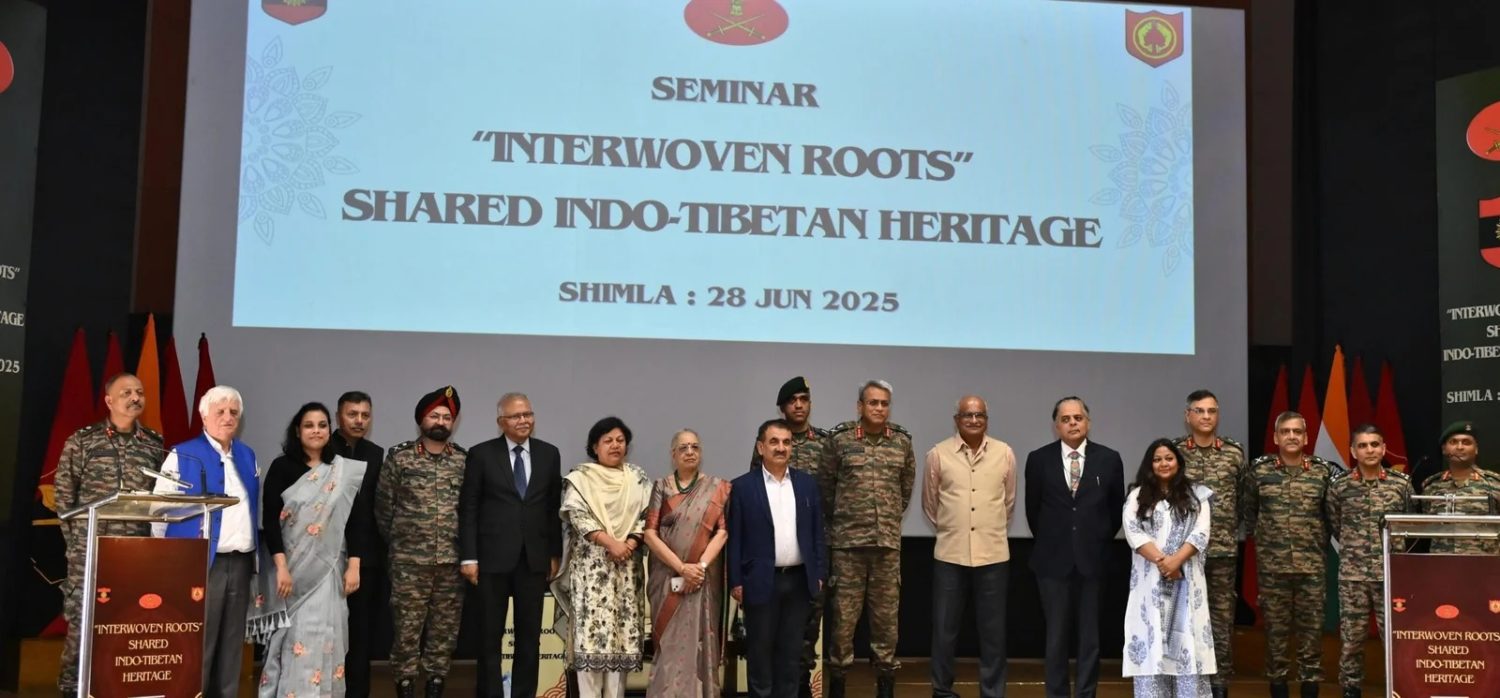

New Delhi: As part of its efforts to strengthen national security through cultural insight, the Central Command of the Indian Army organised a one-day seminar titled “Interwoven Roots: Shared Indo-Tibetan Heritage” at DANFE Hall in Shimla on Saturday.
The seminar brought together scholars, military strategists, and senior defence personnel to delve into the longstanding civilisational connections between India and Tibet, and to evaluate their relevance in current border security and regional stability. The idea behind the seminar stemmed from a growing consensus within strategic circles that a deep understanding of history and culture is crucial to national security, especially in the Himalayan region. India and Tibet share more than a border — their ties include spiritual depth, cultural integration, historic trade routes, and shared civilisational values.
Highlighting the Indian Army’s role beyond traditional defence, Lieutenant General Anindya Sengupta, PVSM, UYSM, AVSM, YSM, General Officer Commanding-in-Chief of the Central Command, noted in his keynote address that the Army has embraced a comprehensive approach to border security — one that incorporates cultural knowledge, community engagement, and historical awareness alongside tactical and geographical considerations. He said the seminar aimed to connect strategic thinking with cultural expertise, enabling defence professionals to base their strategies on historical context while facing new challenges in border areas.
He also stressed the importance of cultural diplomacy in national security and reiterated the Army’s dedication to protecting both India’s borders and its civilisational identity.
The seminar featured two thematic sessions. The first focused on Indo-Tibetan connections, covering civilisational, spiritual, and economic linkages. Notable speakers included Claude Arpi, who discussed historical and cultural relations between northern India and western Tibet; Dr. Shashibala, who spoke on shared Buddhist traditions and sacred sites; and Dr. Aparna Negi, who examined traditional trade routes like Shipki La and their relevance today.
The second session tackled strategic and border management issues. Moderated by retired Major General G Jaishankar, the discussion addressed topics such as China’s grey-zone tactics, India’s border strategy, psychological and information warfare, and diplomatic coordination. The panel featured Lt Gen Raj Shukla (retired), Dr. Amrita Jash, Dr. Dattesh D Parulekar, Antara Ghosal Singh, and Ambassador Ashok K Kantha.
Before the seminar, participants visited forward areas between June 24 and 27 — including Pooh, Shipki La, Nako, Sumdo, Giu, Tabo, and Kaza — to gain direct exposure to the cultural and strategic dynamics of the Indo-Tibetan frontier, grounding the seminar discussions in practical experience.
In his closing remarks, Lt Gen D G Misra, AVSM, GOC, Uttar Bharat Area, highlighted the importance of integrating cultural heritage with strategic vision to protect India’s border regions.
He praised the speakers for their insights and emphasised the Army’s commitment to fostering platforms that encourage collaboration between military and academic communities.