
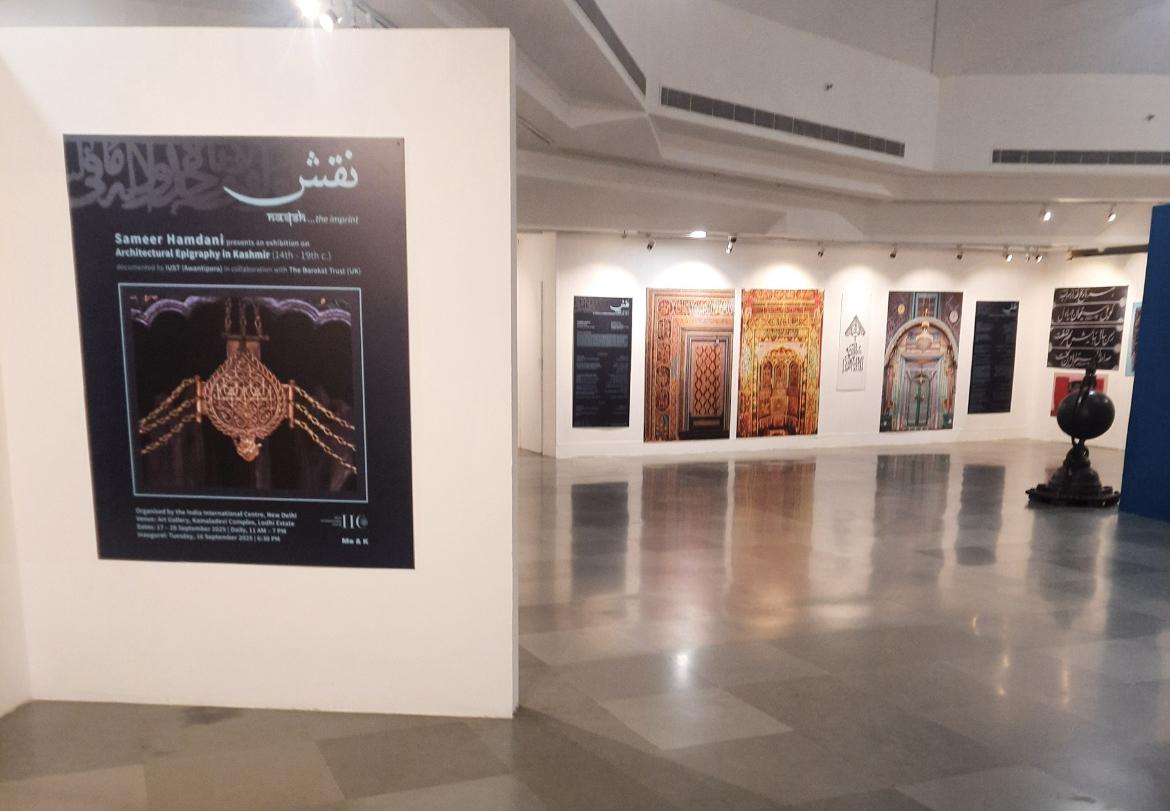

New Delhi: The India International Centre (IIC), Delhi, on Wednesday opened an exhibition titled Naqsh, the Imprint that explores the architectural epigraphy of Kashmir from the 14th to 19th centuries. The exhibition, running from September 17 to 28, showcases the results of a year-long documentation project.
The display features architectural drawings, photographs, and translations of original Arabic, Persian, and Sanskrit inscriptions. The project was undertaken in 2023–24 under a Conservation Grant awarded to scholar Sameer Hamdani by the Barakat Trust (UK), in collaboration with the School of Architecture and Planning, Islamic University of Science and Technology (IUST), Awantipora.
According to organisers, the exhibition highlights a repository of texts once inscribed across temples, viharas, khanqahs, mosques, mausoleums, gardens, and other public spaces in Kashmir’s urban centres. Only a few of these inscriptions survive today, offering rare insight into a past often overlooked.
Historians note that Kashmir, historically at the crossroads of civilisational encounters, evolved into a melting pot of religious and cultural traditions. Kashmiri art and architecture, influenced by South Asian, Hellenic, Chinese, Persian, and Central Asian idioms, reflect this hybridity.
Inscriptions were not only used as ornamentation but also served as deliberate public texts, strategically circulating script, style, and content while conveying the patronage and purpose of monuments.