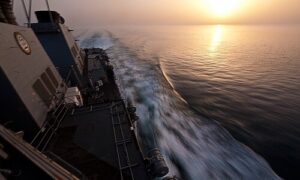


Iran will temporarily restrict traffic through a crucial global oil transit corridor as negotiations over its controversial nuclear programme continue with the United States, which has deployed naval forces to the Gulf to increase pressure on Tehran for concessions.
US President Donald Trump suggested that “regime change” in Tehran could be beneficial, while Iran’s Supreme Leader Ali Khamenei warned that any attempt by Washington to overthrow his government would not succeed.
As the Geneva talks commenced, Iranian state media reported that parts of the strategically significant Strait of Hormuz would be closed for several hours as a “security measure” during military exercises conducted by the country’s elite Revolutionary Guards.
In the past, Tehran has threatened several times to shut down the strait to commercial shipping if it is attacked, a move that would choke off a fifth of global oil flows and drive up crude prices.
US envoy Steve Witkoff and Jared Kushner took part in the Geneva talks, which are being mediated by Oman alongside Iranian Foreign Minister Abbas Araqchi.
Iranian state TV said a second round of talks had ended.
“We have entered certain details related to both the lifting of sanctions and nuclear subjects,” Iranian foreign ministry spokesperson Esmaeil Baghaei told state media before the talks ended.
“We are ready to continue these talks as long as it takes; the issues are complicated. There is no trust between the two parties; we have to continue the negotiations in these conditions,” he added.
Baghaei has said Tehran’s views on the nuclear issue, the lifting of economic sanctions and a framework for any understanding have been conveyed to the U.S. side.
Trump earlier said he himself would be involved “indirectly” in the Geneva talks and that he believed Tehran wanted to make a deal.
“I don’t think they want the consequences of not making a deal,” Trump told reporters aboard Air Force One on Monday. “We could have had a deal instead of sending the B-2s in to knock out their nuclear potential. And we had to send the B-2s.”