

Srinagar: A 6.83% average increase in electricity tariffs in Jammu and Kashmir has triggered a political storm, with opposition parties demanding a rollback, the government defending the revision as a necessity and the issue set to figure prominently in the upcoming Assembly session.
The revised tariff, approved by the Joint Electricity Regulatory Commission (JERC) for Jammu and Kashmir and Ladakh, will come into effect from September 1 and apply to electricity consumed until March 31, 2027, unless modified or replaced by the regulator. The order covers consumers of the Jammu Power Distribution Corporation Limited (JPDCL) and the Kashmir Power Distribution Corporation Limited (KPDCL).
The increase has come after a gap of four years and is being defended by the government as the lowest possible adjustment in view of the financial condition of the power distribution sector. But the timing has made the decision politically sensitive, particularly because the ruling National Conference had promised 200 units of free electricity during the 2024 Assembly election campaign.
Why the tariff was raised
The central issue behind the revision is the widening gap between the cost of supplying electricity and the revenue recovered from consumers.
According to figures from the JERC tariff order, the combined Annual Revenue Requirement of JPDCL and KPDCL for 2026-27 was assessed at Rs 10,275.72 crore after the Commission’s prudence check.
At the existing tariff, the two distribution companies were projected to recover only Rs7,352.87 crore, leaving a revenue gap of Rs 2,922.85 crore.
JERC noted that recovering the entire shortfall from consumers through tariffs alone would have required an increase of around 40 per cent, which it considered a tariff shock. The regulator therefore adopted a combination of a moderate tariff increase and government financial support.
The government has committed Rs 2,420.78 crore as financial support under Section 65 of the Electricity Act, 2003. Following the revised tariff, the utilities are expected to generate Rs 7,854.94 crore, with the remaining gap to be met through government grant-in-aid.
This means the 6.83% figure does not represent the full cost-recovery requirement of the power sector. A substantially larger increase would have been necessary if the entire revenue gap had been placed on consumers.
What consumers will pay
The 6.83% is an average tariff revision and does not mean that every household’s electricity bill will rise by exactly 6.83% .
For metered domestic consumers, the revised energy charge has been fixed at Rs 2.45 per unit for monthly consumption up to 200 units, Rs 4.20 per unit for consumption between 201 and 400 units and Rs 4.60 per unit above 400 units. A fixed charge of Rs 10 per kW per month will also apply.
Under the previous tariff, the corresponding domestic energy charges were Rs 2.30, Rs 4 and Rs 4.35 per unit. The increase in the energy component therefore varies by slab, while the fixed charge has also been revised.
Concessional rates continue for certain categories, including BPL households and small agricultural consumers. Commercial and other consumer categories have separate tariff structures.
The actual impact on an individual bill will consequently depend on the consumer category, monthly consumption, sanctioned load and applicable subsidy.
Government says hike was a compulsion
Chief Minister Omar Abdullah has defended the decision, saying his government never promised that electricity rates would remain unchanged.
Speaking to reporters, Omar said the government had promised 200 units of free electricity to the poorest and most deserving households, not a freeze on electricity tariffs for all consumers.
He described the latest increase as a “compulsion” and said it had been kept to the minimum possible level after a four-year gap.
The chief minister also pointed to previous tariff increases under earlier governments, saying rates had risen by more than 14 per cent during the PDP-BJP coalition period and by around 15 per cent four years ago.
He argued that the government’s requirement to raise tariffs would reduce as losses in the power sector come down.
The government’s position is therefore that the tariff revision cannot be viewed in isolation from the financial condition of the distribution companies, the subsidy being provided by the UT administration and efforts to reduce transmission and distribution losses.
The 200-unit promise
The biggest political flashpoint, however, remains the National Conference’s promise of 200 units of free electricity.
Opposition parties have seized on the tariff increase to question the government’s commitment to that promise.
The government, meanwhile, has maintained that the free-electricity commitment is separate from the general tariff structure.
Omar has said the 200-unit benefit is intended for poor and needy households and is to be implemented through a solar-based scheme. He has maintained that the free-power programme and the general revision of electricity tariffs are separate policy issues.
The distinction is significant because the government’s approach has increasingly focused on using rooftop solar to provide the promised benefit to eligible households rather than simply waiving the first 200 units of grid electricity for every consumer.
Opposition protests
The tariff decision has nevertheless provided the opposition with a fresh issue against the government.
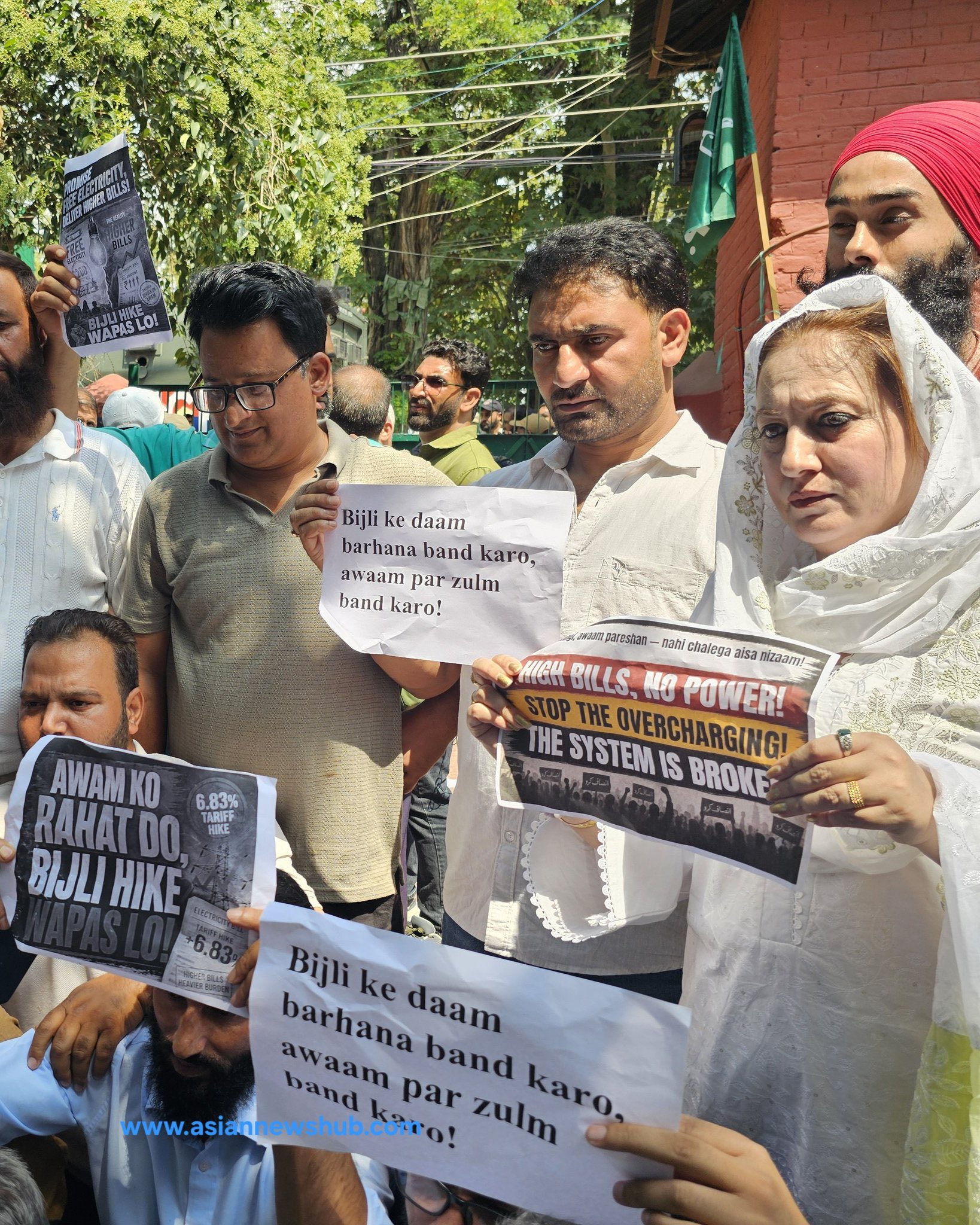
The Peoples Democratic Party and Jammu and Kashmir Apni Party held separate demonstrations in Srinagar on Monday, demanding withdrawal of the tariff increase.
PDP workers protested outside the party headquarters, while Apni Party workers assembled at Press Enclave. Protesters accused the government of adding to the financial burden on households and questioned the tariff revision in light of the election promise of 200 units of free electricity.
Other opposition voices, including the BJP and Peoples Conference, have also criticised the increase.
The BJP has announced that it will raise the issue during the upcoming Assembly session and has announced a September 2 protest targeting the Secretariat over the tariff hike and other issues.
CPI(M) MLA Mohammad Yousuf Tarigami has also indicated that the matter will be taken up in the Assembly, putting further pressure on the government to explain the rationale behind the revision and its implications for consumers.
Why the government is still subsidising power
Despite the tariff increase, electricity in J&K remains heavily subsidised.
The official KPDCL consumer information explains that the regulator determines the full cost of electricity supply, while the government provides subsidy support and the distribution companies pass the benefit on to eligible consumers.
This distinction is important in understanding the present controversy.
The regulator assessed a combined revenue requirement of more than ₹10,000 crore for JPDCL and KPDCL, while existing tariffs were insufficient to recover the cost. Rather than allowing the entire deficit to translate into consumer tariffs, the government has agreed to cover ₹2,420.78 crore through subsidy and grant support.
The debate, therefore, is not simply about whether electricity should be subsidised. It is about how much of the cost should be recovered from consumers and how much should be borne by the government.
The larger power-sector problem
The tariff controversy also highlights a structural problem that has persisted in J&K’s electricity sector: the gap between the cost of purchasing and supplying power and the revenue collected from consumers.
JERC’s assessment shows that the existing tariff would have left the two distribution companies with a gap of nearly ₹2,923 crore for 2026-27.
The Commission’s decision to limit the tariff increase while relying on government support effectively spreads that burden between consumers and the public exchequer.
The regulator has also retained distribution-loss targets of 15 per cent for JPDCL and 19 per cent for KPDCL and approved an average power purchase cost of Rs 4.88 per unit for 2026-27.
Reducing distribution losses is consequently central to the government’s argument that future tariff pressures can be contained.
The chief minister has also linked the need for future tariff revisions to the performance of the power sector, saying that as losses decline, the need for such increases should diminish.
What happens next
For consumers, the immediate change begins on September 1, when electricity consumed will be billed under the revised tariff.
For the government, the political test will be whether it can reconcile the tariff increase with its promise of providing 200 units of free electricity to eligible households.
For the opposition, the issue offers an opportunity to question the government’s economic priorities and its handling of an election commitment that featured prominently in the 2024 campaign.
The matter is also likely to move into the Assembly, where the government will have to explain not only why tariffs were increased but also how the 200-unit free electricity scheme will be implemented, who will qualify and how much it will cost the exchequer.
At the same time, the underlying financial arithmetic leaves little room for an easy solution. JPDCL and KPDCL face a revenue requirement of Rs 10,275.72 crore, existing tariffs were insufficient to cover that requirement, and the government is already committing Rs 2,420.78 crore in subsidy and grant support.
The immediate political demand may be for a rollback. But the larger question confronting Jammu and Kashmir is how to make its electricity distribution system financially sustainable without placing an excessive burden either on consumers or on the government’s finances.
For now, the 6.83% revision has turned what was essentially a regulatory tariff exercise into a wider political debate over subsidies, power-sector losses, household costs and the National Conference government’s promise of 200 units of free electricity.