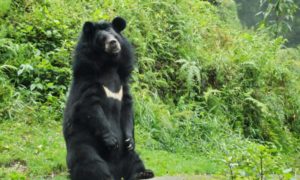


Srinagar: On a sweltering August morning last year, Ishfaq, a 32-year-old casual worker, rushed to Gujjarpati village in north Kashmir’s Kupwara district after frantic calls from residents reporting a black bear in the apple orchard.
Armed with a tranquilliser gun, he joined the Wildlife Department’s rescue team, unaware that the operation would soon turn into a fight for his own survival.
Ishfaq fired two tranquilliser darts at the black bear before it suddenly charged at him. As he tried to escape, he slipped into a gorge.
With the animal on top of him, he instinctively pushed his hands into the bear’s mouth in a desperate attempt to prevent it from biting his face and neck.
The bear mauled his hands, leaving him with severe injuries. He was hospitalised for nearly a week, but the scars and the trauma remain with him.
“I was immediately rushed to the hospital, where doctors put stitches in both my hands. I received multiple stitches in each hand,” Ishfaq said, adding that despite his injuries, he continues to serve the Wildlife Department as a casual labourer.
“The treatment cost me around Rs 15,000, and I didn’t receive any financial assistance from the department.
“Even today, my hand has not regained normal movement. The doctors told me that several small nerves were damaged in the attack, which has affected its functioning,” he said.
Ishfaq is not alone; 28-year-old Adil Ahmad Naik bears similar scars while doing his duty.
In April last year, Adil was among the wildlife department casual labourer rescue team responding to the reports of a leopard roaming in Larkipora village in south Kashmir’s Anantnag district. The operation left him and two others injured.
“I, along with two other workers, was injured while capturing the leopard. I was wearing protective gloves during the rescue, but the animal still bit my hand,” said Adil, who has been serving the department as a casual labourer for the past 13 years.
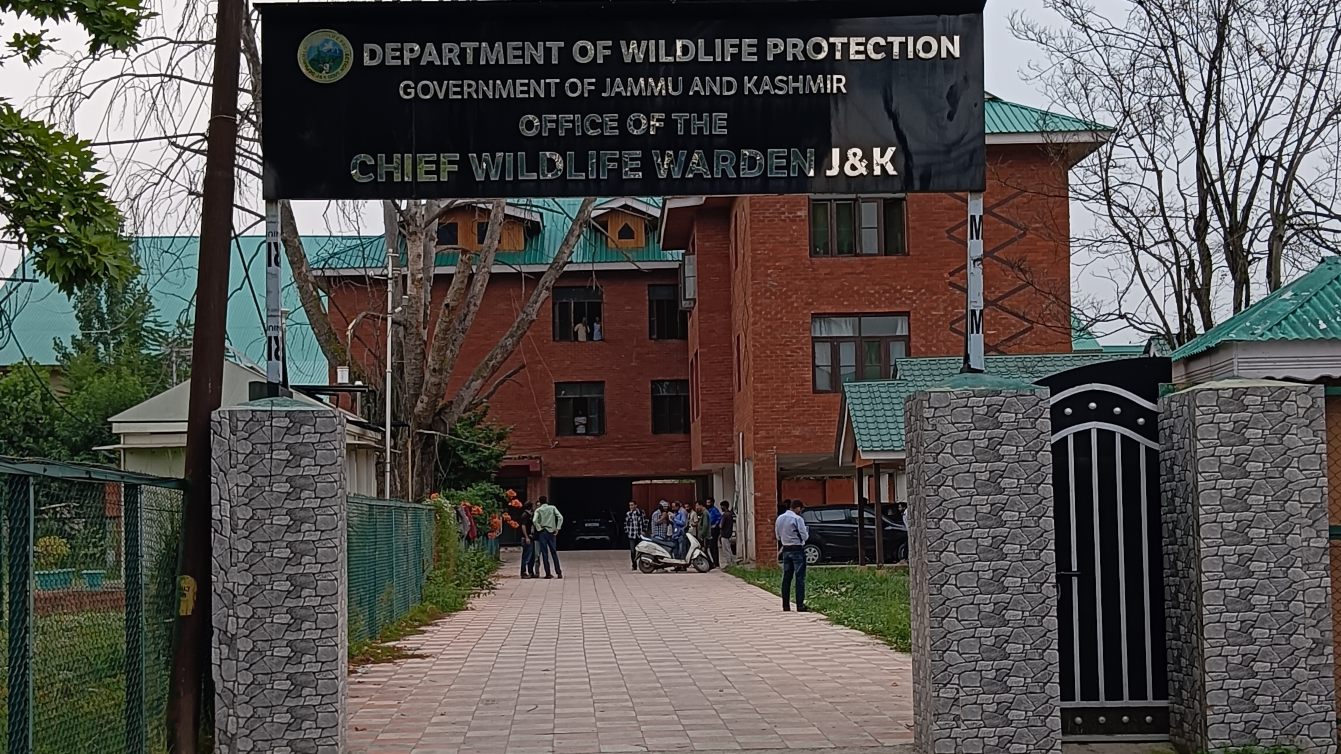
A year later, Ishfaq and Adil, who risked their lives to protect the people, are among the hundreds of casual workers in the wildlife department protesting outside the department for their basic rights since June 28.
The workers say they have not been receiving regular wages and health assistance and are insecure about their jobs after years of serving on the frontlines of Kashmir’s growing human-wildlife conflict.
“We are not asking for anything unreasonable. We are only asking why casual labourers in other government departments receive regular monthly wages while we don’t, despite working round the clock and risking our lives,” said Manzoor Ahmad Bhat, President, Wildlife Casual Labourers Association.
“We are unable to provide for our families. What is the point of putting our lives at risk if we can’t even earn enough to support them?” he asks.
Another casual labourer, Bilal Ahmad, said more than 600 workers form the backbone of the Wildlife Department’s field operations across Jammu and Kashmir.
“There is a severe manpower shortage in the department, and almost all ground-level work is carried out by us,” Bilal said.
“From rescuing black and brown bears, leopards, porcupines, snakes, bear cubs, leopard cubs and wild boars to dousing forest fires and responding to distress calls from villages, we are on round-the-clock duty across Kashmir,” he said.
“Yet, we receive only Rs 2,000 to Rs 3,000 in an entire year. It doesn’t even reflect a fraction of the work and risks we undertake,” he added.
The protesting workers said they are demanding regular monthly wages through the Finance Department’s Non-Plan Head, a time-bound policy for regularisation and insurance cover.
They warned that if the government fails to address their demands, they will intensify their agitation with an indefinite hunger strike from 2 July.
Free Press Kashmir reached out to the Regional Wildlife Warden Kashmir, Tawheed Dewa, through calls and text; however, he was not available for comments.
The Reporter also tried to contact the Principal Chief Conservator of Forests (PCCF) and the Chief Wildlife Warden, Jammu and Kashmir, Chaturbhuj Behera, for comments, but no response was received at the time of publication.