As dog bite cases surge across the Valley, fear is quietly reshaping everyday life for children, women and the elderly.
A mother tightens her grip on her child’s hand.
An elderly man, who once looked forward to his morning walks through the quiet lanes of his neighbourhood, now carries a stick not for support but for reassurance.
A schoolboy pauses at the entrance of a narrow alley, scans the road ahead, and only then takes another step.
These are not scenes from a dystopian novel. They are becoming an increasingly familiar reality across many parts of Kashmir.
There was a time when the primary concerns of Kashmiri families centred on education, employment and the everyday challenges of life.
Today, another fear has quietly entered public consciousness: the fear that a simple walk to school, a visit to the local market or an evening stroll may end in a frightening encounter with a pack of stray dogs.
The growing stray dog crisis in Kashmir is no longer merely a municipal concern.
It has evolved into a significant public health and public safety issue that affects children, parents, workers, women and elderly citizens alike.
While compassion towards animals remains a hallmark of a civilised society, compassion cannot come at the cost of human safety and dignity.
The scale of the problem is difficult to ignore.
According to data presented by the Jammu and Kashmir government in the Legislative Assembly, 206,460 dog bite cases were reported across the Union Territory during 2024 and 2025.
Of these, 93,765 cases were reported in 2024 and 112,695 in 2025. The Jammu division accounted for 126,844 cases, while the Kashmir division recorded 79,616.
Within Kashmir, Srinagar reported 35,174 cases, followed by Baramulla with 12,882 and Anantnag with 10,818.
These figures are more than the statistics recorded in official documents.
They represent hundreds of thousands of moments marked by fear, pain, trauma and uncertainty for ordinary citizens.
The human cost of this crisis became painfully evident earlier this year when eight-year-old Aiman Adnan Sheikh lost her life following a stray dog attack in Sopore.
The tragedy sent shockwaves across Kashmir and reignited questions that have troubled the region for years.
Behind every headline lies a family whose life has been permanently altered. Behind every statistic is a story of suffering that often goes unheard.
Yet the impact of the crisis extends far beyond those who become direct victims of attacks.
Across Kashmir, ordinary scenes increasingly reveal an extraordinary level of anxiety.
A man carrying household waste slows his pace as he approaches a community dustbin and instinctively looks around before moving forward.
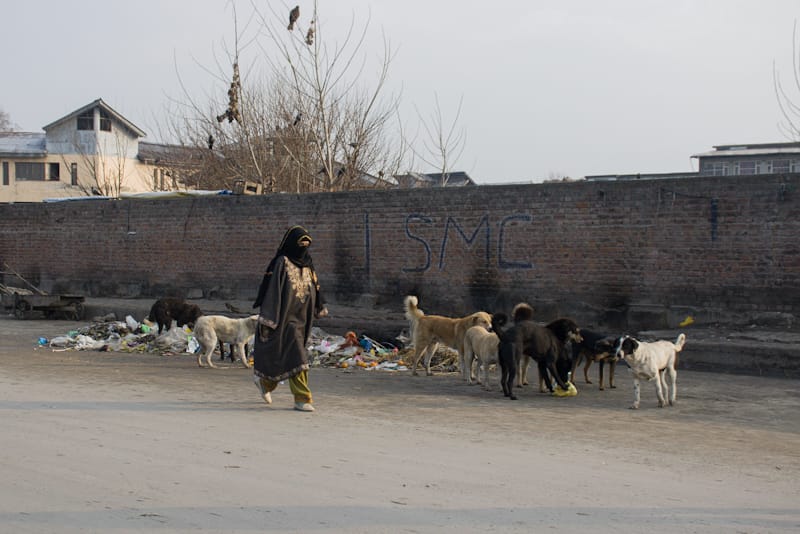
A woman returning from a nearby market becomes more cautious as she passes a group of stray dogs resting along the roadside.
A worker leaving home before sunrise chooses a longer route to avoid areas known for aggressive dog packs.
An elderly resident pauses at the entrance of his neighbourhood and wonders whether it is safer to abandon his morning walk altogether.
These moments may appear routine, but they point to a deeper reality.
For many Kashmiris, even the simplest tasks of daily life have become accompanied by caution and uncertainty.
Activities that should be effortless, disposing of garbage, walking to work, visiting a neighbour or taking an evening stroll, increasingly require vigilance.
Perhaps the greatest tragedy is not merely the attacks themselves but the gradual normalisation of fear.
Children should remember their neighbourhoods as places of friendship, laughter and play.
Streets should connect communities, not inspire anxiety.
Elderly citizens, who have spent decades building families and contributing to society, should not have to question whether stepping outside their homes is worth the risk.
When people begin altering their routines, avoiding public spaces and accepting fear as a normal part of everyday life, society has already paid a price that cannot be measured through statistics alone.
What makes the crisis even more troubling is the tendency of some voices to dismiss or minimise the fears experienced by ordinary citizens.
Concern for animal welfare is both important and necessary.
However, no principle of compassion can justify a situation in which children feel unsafe on their way to school, women experience anxiety while carrying out routine tasks and elderly citizens hesitate before leaving their homes.
A society that fails to protect its most vulnerable members cannot claim to have achieved the right balance between compassion and responsibility.
The challenge facing Kashmir is undoubtedly complex.
According to official estimates, Srinagar alone has a stray dog population of approximately 64,416 animals.
The magnitude of the problem reflects deeper structural issues, including inadequate implementation of sterilisation programmes, ineffective waste management practices and the difficulties associated with managing large free-ranging animal populations in densely populated urban areas.
Acknowledging complexity, however, cannot become an excuse for inaction.
A humane society must protect animals from cruelty.
Equally, it must protect children from preventable harm, safeguard elderly citizens and preserve every individual’s right to move freely and safely in public spaces.
Compassion and public safety are not opposing values. They are complementary responsibilities.
No parent should experience the anxiety of watching a child leave home with fear in their heart.
No elderly citizen should feel compelled to abandon a morning walk because of safety concerns.
No family should have to endure the loss of a loved one because society failed to address a preventable public safety challenge.
The growing stray dog crisis in Kashmir is therefore not merely a question of animal management.
It is a question of public health, civic responsibility, human dignity and the fundamental right of every citizen to feel safe in their own neighbourhood.
The streets of Kashmir should belong to everyone: children on their way to school, workers heading to their jobs, women carrying out the ordinary tasks of daily life and elderly citizens seeking peace in their morning walks.
Until that balance is achieved, however, many Kashmiris will continue to walk with an unwelcome companion.
Its name is fear.



















As dog bite cases surge across the Valley, fear is quietly reshaping everyday life for children, women and the elderly.
A mother tightens her grip on her child’s hand.
An elderly man, who once looked forward to his morning walks through the quiet lanes of his neighbourhood, now carries a stick not for support but for reassurance.
A schoolboy pauses at the entrance of a narrow alley, scans the road ahead, and only then takes another step.
These are not scenes from a dystopian novel. They are becoming an increasingly familiar reality across many parts of Kashmir.
There was a time when the primary concerns of Kashmiri families centred on education, employment and the everyday challenges of life.
Today, another fear has quietly entered public consciousness: the fear that a simple walk to school, a visit to the local market or an evening stroll may end in a frightening encounter with a pack of stray dogs.
The growing stray dog crisis in Kashmir is no longer merely a municipal concern.
It has evolved into a significant public health and public safety issue that affects children, parents, workers, women and elderly citizens alike.
While compassion towards animals remains a hallmark of a civilised society, compassion cannot come at the cost of human safety and dignity.
The scale of the problem is difficult to ignore.
According to data presented by the Jammu and Kashmir government in the Legislative Assembly, 206,460 dog bite cases were reported across the Union Territory during 2024 and 2025.
Of these, 93,765 cases were reported in 2024 and 112,695 in 2025. The Jammu division accounted for 126,844 cases, while the Kashmir division recorded 79,616.
Within Kashmir, Srinagar reported 35,174 cases, followed by Baramulla with 12,882 and Anantnag with 10,818.
These figures are more than the statistics recorded in official documents.
They represent hundreds of thousands of moments marked by fear, pain, trauma and uncertainty for ordinary citizens.
The human cost of this crisis became painfully evident earlier this year when eight-year-old Aiman Adnan Sheikh lost her life following a stray dog attack in Sopore.
The tragedy sent shockwaves across Kashmir and reignited questions that have troubled the region for years.
Behind every headline lies a family whose life has been permanently altered. Behind every statistic is a story of suffering that often goes unheard.
Yet the impact of the crisis extends far beyond those who become direct victims of attacks.
Across Kashmir, ordinary scenes increasingly reveal an extraordinary level of anxiety.
A man carrying household waste slows his pace as he approaches a community dustbin and instinctively looks around before moving forward.
A woman returning from a nearby market becomes more cautious as she passes a group of stray dogs resting along the roadside.
A worker leaving home before sunrise chooses a longer route to avoid areas known for aggressive dog packs.
An elderly resident pauses at the entrance of his neighbourhood and wonders whether it is safer to abandon his morning walk altogether.
These moments may appear routine, but they point to a deeper reality.
For many Kashmiris, even the simplest tasks of daily life have become accompanied by caution and uncertainty.
Activities that should be effortless, disposing of garbage, walking to work, visiting a neighbour or taking an evening stroll, increasingly require vigilance.
Perhaps the greatest tragedy is not merely the attacks themselves but the gradual normalisation of fear.
Children should remember their neighbourhoods as places of friendship, laughter and play.
Streets should connect communities, not inspire anxiety.
Elderly citizens, who have spent decades building families and contributing to society, should not have to question whether stepping outside their homes is worth the risk.
When people begin altering their routines, avoiding public spaces and accepting fear as a normal part of everyday life, society has already paid a price that cannot be measured through statistics alone.
What makes the crisis even more troubling is the tendency of some voices to dismiss or minimise the fears experienced by ordinary citizens.
Concern for animal welfare is both important and necessary.
However, no principle of compassion can justify a situation in which children feel unsafe on their way to school, women experience anxiety while carrying out routine tasks and elderly citizens hesitate before leaving their homes.
A society that fails to protect its most vulnerable members cannot claim to have achieved the right balance between compassion and responsibility.
The challenge facing Kashmir is undoubtedly complex.
According to official estimates, Srinagar alone has a stray dog population of approximately 64,416 animals.
The magnitude of the problem reflects deeper structural issues, including inadequate implementation of sterilisation programmes, ineffective waste management practices and the difficulties associated with managing large free-ranging animal populations in densely populated urban areas.
Acknowledging complexity, however, cannot become an excuse for inaction.
A humane society must protect animals from cruelty.
Equally, it must protect children from preventable harm, safeguard elderly citizens and preserve every individual’s right to move freely and safely in public spaces.
Compassion and public safety are not opposing values. They are complementary responsibilities.
No parent should experience the anxiety of watching a child leave home with fear in their heart.
No elderly citizen should feel compelled to abandon a morning walk because of safety concerns.
No family should have to endure the loss of a loved one because society failed to address a preventable public safety challenge.
The growing stray dog crisis in Kashmir is therefore not merely a question of animal management.
It is a question of public health, civic responsibility, human dignity and the fundamental right of every citizen to feel safe in their own neighbourhood.
The streets of Kashmir should belong to everyone: children on their way to school, workers heading to their jobs, women carrying out the ordinary tasks of daily life and elderly citizens seeking peace in their morning walks.
Until that balance is achieved, however, many Kashmiris will continue to walk with an unwelcome companion.
Its name is fear.