

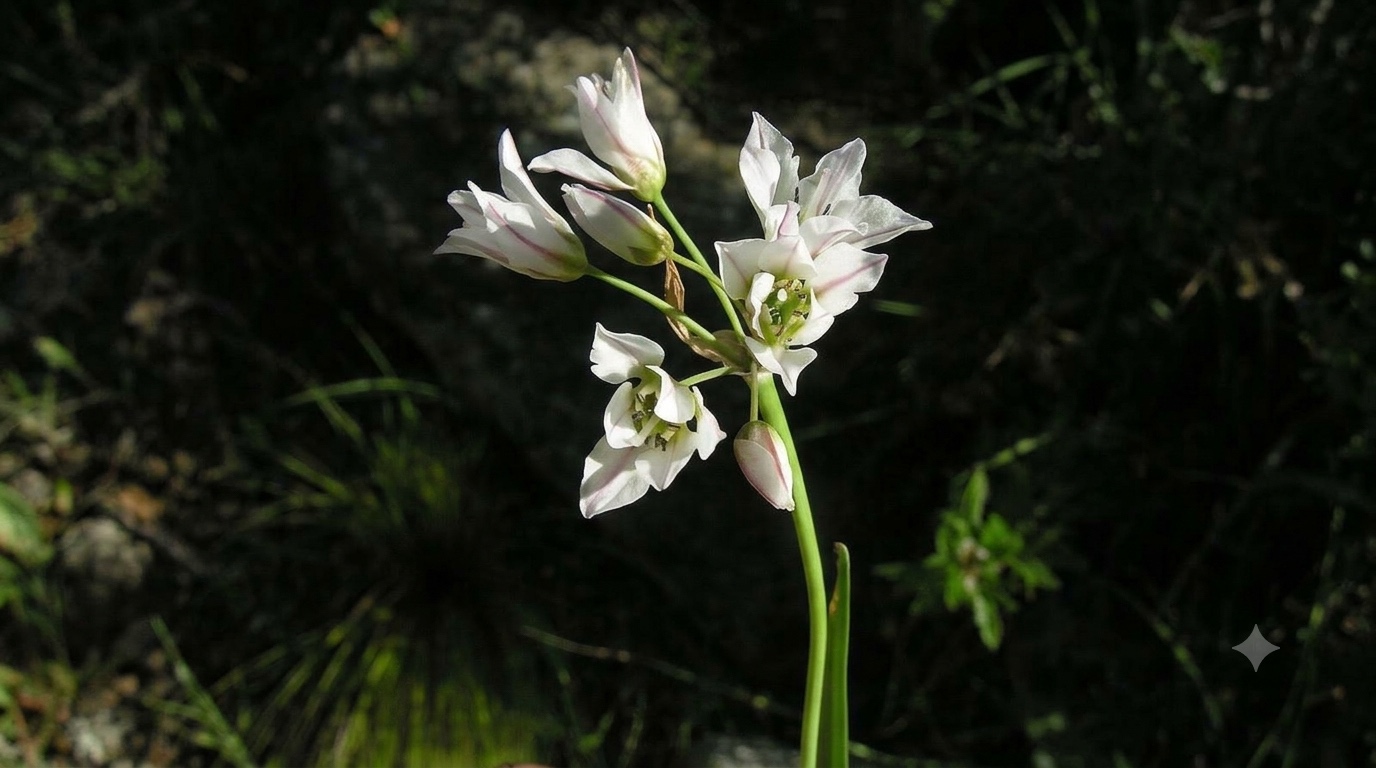

Jammu: The invasive plant species Nothoscordum gracile, also known as false garlic, has been detected at a few places in Jammu and is spreading rapidly, posing a threat to native species.
The study, entitled “Nothoscordum gracile (Aiton) Stearn: A New Alien Plant Record for Jammu and Kashmir,” was published in 2025 in Discover Plants by Springer Nature. The research was conducted by professors at the University of Jammu, including Sajan Thakur, Bhavana Sharma, Udhay Sharma, Romica Verma, Veenu Kaul, and Sunit Sing.
The study confirms that the species is highly intrusive. It has been found that the species resembles garlic and has numerous small bulblets that can reproduce and regenerate very quickly, resulting in its rapid spread in great abundance in areas where it is present.
Irfan Rashid, Professor, Department of Botany, University of Kashmir, told Free Press Kashmir that the presence of this plant species had been reported in India before, but it has been reported in Jammu for the first time.
“This is the right time for the managing authorities to eradicate the plant because after five or six years, the species will spread everywhere in the Jammu division, and at that time, it will be very difficult to eliminate it. Our native plant species cannot compete with it, and their growth will be affected by this species,” Professor Rashid said.
He informed that the species resembles garlic and onion plants and is very difficult to recognise until its flowering stage.
“Whenever any invasive species, by any means, grows at any place, it thrives, and other native species do not have the capacity to compete with invasive species. You have to eradicate it along with the bulbs because if any bulb remains in the soil, it will grow into a full plant, as we see in garlic plants,” Professor Rashid explained.
There are two methods, he said, that can control the growth of invasive species.
“We have two major management strategies. One strategy is ‘quarantine check’, which directs that invasive species should not be allowed to enter your periphery, and for that, you keep checkpoints at airports or at borders.”
The second strategy, he said, is ‘early detection and rapid response (EDRR)’, in which, once you detect the presence of any invasive species in your periphery and it is trying to spread, you need to prevent it from spreading by manually pulling it out carefully along with the bulblets and discarding it either by burning or cutting it so that it cannot grow again,” Rashid informed.
Free Press Kashmir tried to contact the authors from the University of Jammu; however, they were not available for comment.